


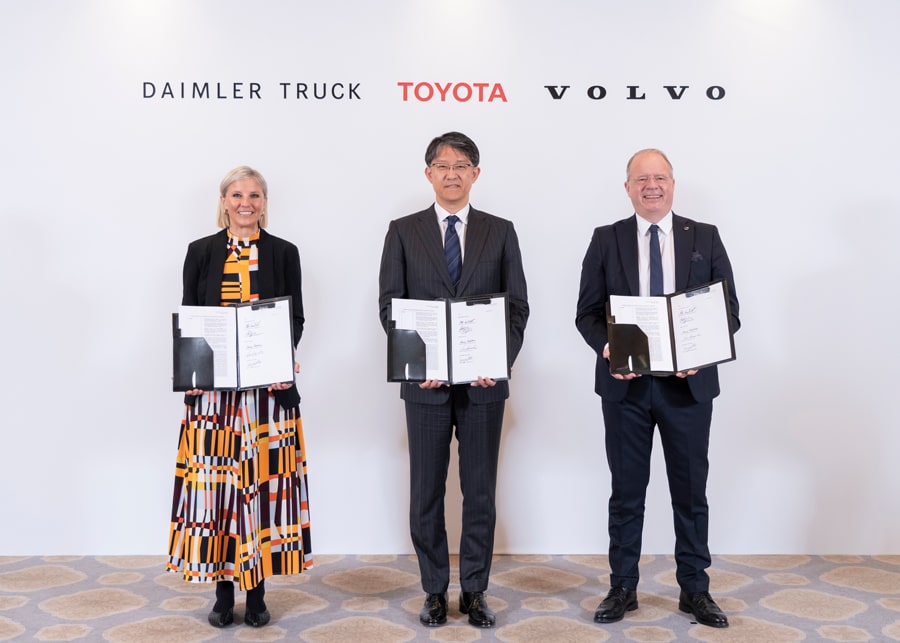


Daimler Truck AG, Volvo Group, and Toyota Motor Corporation have signed a non-binding agreement to jointly advance fuel cell systems through their existing joint venture, cellcentric.
The proposed structure would introduce Toyota as a third equal shareholder alongside Daimler Truck and Volvo, effectively consolidating European heavy-duty vehicle manufacturing expertise with one of the most established fuel cell development programs globally. The strategic rationale is clear: no single manufacturer has yet achieved the scale necessary to make hydrogen competitive with diesel or battery-electric alternatives in long-haul trucking.
Fuel cell systems for heavy-duty vehicles remain significantly more expensive than internal combustion engines and battery-electric drivetrains on a per-kilometer basis, largely due to low production volumes and the cost of core components such as membrane electrode assemblies. The collaboration’s emphasis on jointly developing fuel cell unit cells reflects an attempt to address this bottleneck at its source.
Toyota’s involvement is particularly relevant in this context. The company has accumulated more than 30 years of fuel cell research and has already industrialized components for passenger vehicles. However, scaling these systems for heavy-duty applications introduces different requirements in durability, power output, and operational cycles. Integrating Toyota’s manufacturing experience with the commercial vehicle expertise of Daimler Truck and Volvo is intended to accelerate cost reductions through standardization and higher production volumes.
The challenge is that cost competitiveness depends not only on manufacturing efficiency but also on hydrogen fuel pricing. Without large-scale deployment of low-cost green or low-carbon hydrogen, fuel cell trucks struggle to achieve parity with diesel on total cost of ownership, particularly in regions with high energy prices.
The partnership reinforces a broader industry consensus that hydrogen and battery-electric technologies will coexist rather than compete directly across all segments. Daimler Truck and Volvo have both positioned battery-electric systems as the preferred solution for short and regional routes, while hydrogen is targeted at long-haul applications where range, payload, and refueling time constraints become more critical.
This segmentation reflects physical limitations rather than strategic preference. Battery-electric trucks face challenges related to energy density and charging infrastructure at higher ranges and payloads. Fuel cell systems offer higher energy density and faster refueling, but at the cost of system complexity and reliance on hydrogen supply chains that are still in early stages of development.
cellcentric’s mandate as a central development and production hub suggests an effort to avoid duplicative investment across manufacturers while maintaining competition at the vehicle level. Each partner will continue to develop and market its own trucks independently, but with shared access to core fuel cell technology.
Infrastructure Dependency Limits Near-Term Deployment
The agreement explicitly acknowledges the need to support hydrogen infrastructure development, a factor that remains the primary barrier to adoption. Unlike battery-electric trucks, which can leverage existing grid infrastructure with upgrades, hydrogen vehicles require an entirely new refueling network, including production, transport, storage, and dispensing systems.
Current hydrogen refueling capacity for heavy-duty vehicles is limited to pilot corridors in Europe, North America, and parts of Asia. Expanding this network requires coordinated investment across multiple stakeholders, including energy companies, governments, and transport operators. The capital intensity of this buildout raises questions about timing and sequencing relative to vehicle deployment.
Without synchronized infrastructure expansion, fuel cell trucks risk remaining confined to demonstration projects and niche applications. The partnership’s emphasis on collaboration across the hydrogen value chain reflects recognition that vehicle technology alone cannot drive adoption.
The entry of Toyota into cellcentric also carries implications for industrial policy and regional competition. Europe has been actively promoting hydrogen as part of its decarbonization strategy, while Japan has pursued a long-term vision of a hydrogen-based energy system. Aligning these approaches through a joint venture creates potential synergies but also introduces complexity in aligning regulatory frameworks, funding mechanisms, and market priorities.
For Daimler Truck and Volvo, the collaboration offers a way to share development costs while maintaining a presence in hydrogen technology, even as battery-electric platforms gain market traction. For Toyota, participation provides access to the heavy-duty segment, which has different scaling dynamics compared to passenger vehicles.
The equal shareholding model suggests a deliberate effort to balance influence among the partners while preserving cellcentric’s independence as a supplier to a broader market. This positioning could allow the joint venture to serve additional customers beyond the founding companies, potentially increasing production volumes and improving cost competitiveness.
The focus on joint development of fuel cell unit cells and associated control systems highlights the increasing importance of integration in fuel cell technology. Performance, durability, and efficiency are not determined solely by individual components but by the interaction between stack design, thermal management, power electronics, and system controls.
Achieving competitive performance in heavy-duty applications requires optimization across these layers, particularly under variable load conditions typical of long-haul transport. This complexity has historically limited the scalability of fuel cell systems, as incremental improvements in one area often require adjustments elsewhere in the system.
By consolidating development efforts, the partners aim to accelerate iteration cycles and reduce fragmentation in design approaches. However, this also requires alignment on technical standards and intellectual property sharing, which can introduce governance challenges within joint ventures.
The agreement remains non-binding, with further negotiations required before a definitive structure is established. This reflects both the scale of the commitment and the uncertainties surrounding hydrogen market development. Regulatory approvals, capital contributions, and long-term strategic alignment will all influence whether the partnership progresses to full implementation.


