


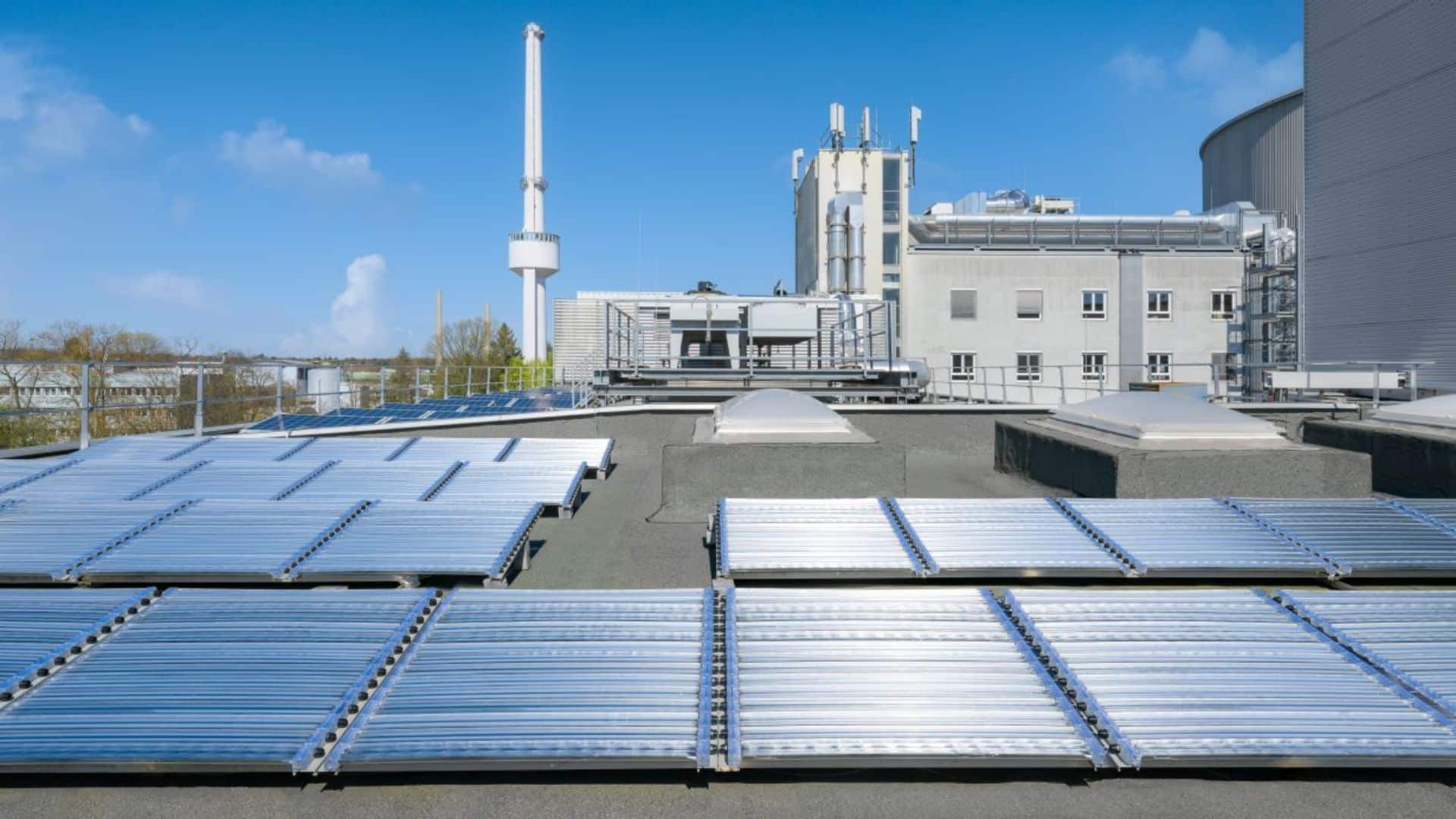


The standard cost architecture of green hydrogen production is built around two capital-intensive components: a photovoltaic array to convert sunlight into electricity, and an electrolyser to convert that electricity into hydrogen through water splitting. Each component has its own capital cost, efficiency loss, maintenance requirement, and infrastructure dependency.
The electricity generated by the PV array must be conditioned, managed, and delivered to the electrolyser at the correct voltage and current profile. The electrolyser requires deionised water, thermal management, membrane maintenance, and in most configurations a grid connection or battery buffer to handle the variability of solar input. The combined system is technically mature, commercially deployed at scale, and still expensive enough that green hydrogen remains uncompetitive against grey hydrogen in most applications without subsidy.
Photreon, a spin-off from the Karlsruhe Institute of Technology, is developing a technology that eliminates the first conversion step. Its photoreactor panel uses photocatalytic materials to split water molecules directly into hydrogen and oxygen using absorbed sunlight, bypassing the intermediate electricity generation stage. The company presented a one-square-metre prototype at Hannover Messe 2026, demonstrating a single-process system that operates without grid connection and without electrolyser equipment. The core proposition is straightforward: if the energy conversion chain can be shortened from two steps to one, and if the capital and operational costs of the eliminated components exceed the costs introduced by the photocatalytic materials and reactor design, the overall system economics improve.
The Photocatalysis Mechanism and Its Engineering Requirements
Photocatalytic water splitting uses light-sensitive semiconductor materials that absorb photons and use the resulting excited electrons to drive the oxidation and reduction reactions that separate water into its constituent elements. The process requires photocatalytic materials with appropriate band gaps to absorb a useful portion of the solar spectrum, surface catalysts to accelerate the half-reactions at acceptable overpotentials, and a reactor architecture that manages light distribution, water flow, gas separation, and product removal simultaneously. Each of these requirements presents engineering challenges that have kept photocatalytic hydrogen production at laboratory and early pilot scale for decades despite sustained research investment.
Photreon’s differentiation appears to lie primarily in the reactor geometry rather than in novel photocatalytic materials. The Karlsruhe Institute of Technology has filed a patent covering the internal geometry of the reactor, which the team describes as engineered to optimise the interplay of light transport, chemical reaction, and reaction product removal. The hydrogen gas produced during the photocatalytic reaction must be continuously removed from the reaction zone to prevent product inhibition and to maintain concentration gradients that favour continued reaction. Managing that removal process in a panel geometry that also maximises the illuminated surface area and ensures uniform light distribution across the photocatalytic material is a non-trivial engineering problem, and the patent filing suggests the team believes it has found a configuration that addresses it more effectively than prior approaches.
The Efficiency Constraint That Has Historically Limited Photocatalysis
The principal technical objection to photocatalytic hydrogen production as a commercial technology has been solar-to-hydrogen efficiency. Conventional PV-electrolysis systems, using commercially available photovoltaic panels operating at 20 to 22 percent efficiency and modern PEM electrolysers operating at 65 to 70 percent efficiency, achieve an overall solar-to-hydrogen efficiency of approximately 13 to 15 percent. The most advanced photocatalytic systems reported in academic literature have achieved solar-to-hydrogen efficiencies in the range of one to three percent under realistic operating conditions, with the theoretical maximum for single-junction photocatalytic systems constrained by the same band gap and thermodynamic limits that apply to single-junction photovoltaics.
Photreon has not published solar-to-hydrogen efficiency figures for its prototype, and the Hannover Messe presentation did not include quantitative performance data that would allow direct comparison with PV-electrolysis systems or with the academic photocatalysis literature. The commercial viability case for photocatalytic panels depends critically on whether the cost reduction achieved by eliminating the electrolyser and PV array is sufficient to compensate for the lower efficiency of the photocatalytic conversion, or whether efficiency improvements can close the gap. At current electrolyser costs, roughly €600 to €1,000 per kilowatt for PEM systems at scale, and PV module costs around €0.10 to €0.15 per watt, the cost of the components being eliminated is substantial. Whether a photoreactor panel of equivalent aperture area can be manufactured at a lower cost while producing comparable hydrogen output is the commercial question the prototype data has not yet answered publicly.
The Decentralised Deployment Case and Its Target Markets
Photreon’s commercial positioning does not appear to target the large-scale centralised green hydrogen production market, where utility-scale PV-electrolysis systems benefit from economies of scale and where efficiency per unit of land area is a critical parameter. The team has identified a different market segment: industrial sites and geographic locations where the infrastructure requirements of conventional green hydrogen production create prohibitive barriers to entry, specifically the need for grid connection, water treatment equipment, and electrolyser installation and maintenance capability.
The target applications described by Photreon’s co-founders include medium-sized industrial companies in specialty chemicals, food production, and metalworking that want to produce hydrogen on-site for process use, and solar hydrogen projects in regions with high solar irradiance but limited grid infrastructure. For an industrial site that currently purchases hydrogen from a supplier or uses grey hydrogen from on-site steam methane reforming, the capital and operational cost of a small-scale PV-electrolysis system includes grid connection upgrades, electrolyser maintenance contracts, and water treatment infrastructure that may not be economically justifiable at the volumes required. If a photoreactor panel system can be installed and operated at a comparable cost to a rooftop solar installation, with hydrogen as the output rather than electricity, the addressable market includes a segment of industrial hydrogen consumers that conventional green hydrogen production cannot serve economically at a small scale.
The off-grid argument is analytically distinct and potentially more compelling for specific geographies. Regions with high solar irradiance but limited electrical infrastructure include substantial portions of North Africa, the Middle East, South and Southeast Asia, and sub-Saharan Africa. In those contexts, the capital cost of grid connection or battery storage to stabilise PV output for an electrolyser may represent a significant fraction of total system cost. A photoreactor panel that produces hydrogen directly from sunlight without requiring grid-quality power input removes that cost element and simplifies the system architecture for deployment in locations that currently lack the infrastructure prerequisites for conventional green hydrogen production.
Manufacturing Design and the Scalability Claim
Photreon’s description of its panels as utilising common materials and standard manufacturing processes is central to its cost and scalability argument, but the claim carries different weight depending on what the photocatalytic materials themselves require. The photosensitive components of a photocatalytic system are not standard commodity materials in the way that silicon wafers are for PV manufacturing or stainless steel is for electrolyser construction. If the photocatalytic materials in Photreon’s panels require rare or expensive precursors, specialised deposition processes, or careful quality control to maintain consistent performance, the standard manufacturing processes claim applies only to the reactor housing and not to the active components that determine system performance and durability.
The modular design principle, where individual panels can be deployed in small units or aggregated into large arrays, is a sensible approach to market entry that allows the technology to be validated in small-scale installations before the capital requirements of utility-scale deployment are confronted. The analogy to PV module deployment is instructive: solar panel manufacturing achieved dramatic cost reductions through a combination of technical improvement, manufacturing scale, and supply chain development over several decades. Photreon is at the prototype stage with a one-square-metre panel, which means it is at approximately the stage that photovoltaics reached in the 1970s. The trajectory from that stage to commercial viability at competitive cost has taken other clean energy technologies between ten and thirty years, with outcomes that were not predictable from the prototype performance alone.
Where Photocatalysis Fits in the Broader Hydrogen Technology Landscape
The Fraunhofer Institute’s 2025 meta-study on hydrogen, which synthesised over 100 individual fact checks into 77 meta-statements, concluded that green hydrogen’s deployment trajectory is directly constrained by the availability of renewable electricity: as long as renewable electricity remains scarce relative to all the applications competing for it, directing it into electrolysis imposes an opportunity cost relative to direct use. Photocatalytic production, which does not consume grid electricity, is structurally exempt from that constraint. A photoreactor panel that converts sunlight directly to hydrogen does not compete with electric vehicles, heat pumps, or industrial electrification for renewable electricity supply. That characteristic is not a marginal advantage in a world where the pace of renewable electricity expansion is itself a binding constraint on green hydrogen production.
The question of where photocatalytic hydrogen sits relative to other emerging production pathways, including photoelectrochemical cells, biological hydrogen production, and thermochemical cycles, is not resolved by a prototype demonstration. Each of those approaches offers a different combination of efficiency, material requirements, operating conditions, and development maturity. What the Photreon prototype does establish is that the reactor geometry approach to photocatalytic hydrogen production is sufficiently advanced to produce a panel-format device suitable for demonstration at a major industrial exhibition, and that the Karlsruhe Institute of Technology considers the reactor design sufficiently novel to warrant patent protection. The distance between that point and commercially competitive hydrogen production at cost parity with grey hydrogen, or even with PV-electrolysis green hydrogen, is substantial and will be determined by performance and durability data that the current prototype stage has not yet generated.
Add EnergyNews.biz as a preferred source on Google


