


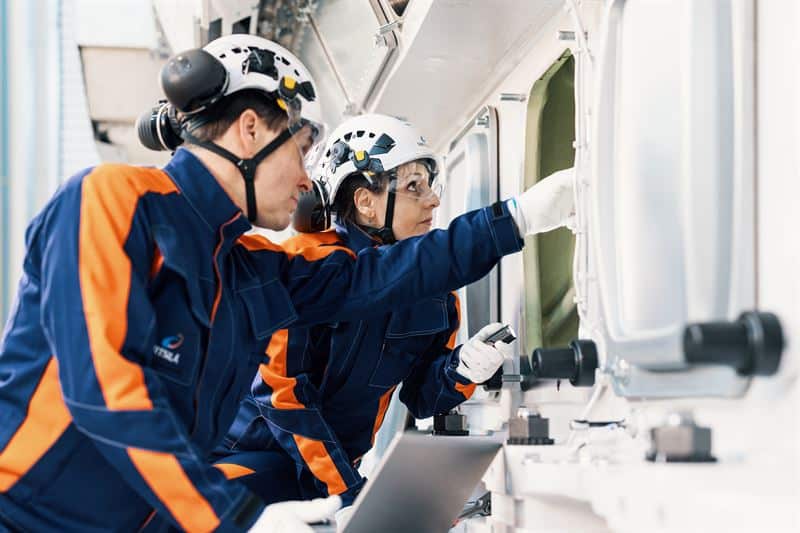


Wärtsilä has joined the H4PERION initiative, a four-year program backed by Horizon Europe, to test hydrogen-based combustion systems under real operating conditions.
Led by the University of Vaasa, the project aims to address a central constraint in maritime decarbonization. While alternative fuels such as ammonia, methanol, and hydrogen are advancing at the conceptual and pilot stages, their integration into existing propulsion systems at scale remains limited by safety, efficiency, and operational reliability challenges. The H4PERION framework targets these gaps by focusing on internal combustion engine adaptation rather than complete system replacement, a strategy that reflects both cost considerations and the long asset lifecycles typical of maritime fleets.
Wärtsilä’s role centers on developing a combustion concept capable of operating on hydrogen and biomethane blends, with a stated objective of enabling up to 100 percent hydrogen use in open-sea conditions. This approach highlights a broader industry trend toward dual-fuel or flexible fuel systems, which are increasingly seen as a transitional solution in a fragmented fuel landscape. Pure hydrogen operation remains technically challenging due to issues such as flame stability, energy density, and onboard storage requirements, particularly for long-distance voyages.
The project also addresses methane slip, a persistent issue in gas-fueled engines where unburned methane escapes into the atmosphere, carrying a significantly higher short-term global warming potential than carbon dioxide. Wärtsilä plans to develop catalyst systems aimed at reducing these emissions, signaling an attempt to improve lifecycle performance rather than focusing solely on fuel substitution. This is a critical distinction, as regulatory scrutiny is increasingly shifting toward full lifecycle emissions rather than tailpipe outputs alone.
Demonstration activities will take place aboard the Aurora Botnia, operated by Wasaline on the Finland-Sweden route. The choice of a short-sea shipping corridor reflects a pragmatic deployment strategy. Compared to deep-sea shipping, these routes offer more controlled conditions, shorter distances, and access to port infrastructure, making them suitable for early-stage fuel and propulsion testing. Parallel laboratory testing of an identical full-scale engine will enable controlled performance optimization, with both datasets feeding into a digital twin model for iterative design improvements.
The emphasis on digital modeling signals a shift toward data-driven optimization in maritime engineering. By integrating real-world and simulated performance data, developers aim to accelerate the validation process and reduce the time required to move from prototype to commercial deployment. However, the effectiveness of this approach will depend on the quality and representativeness of operational data, particularly as scaling from short-sea to long-distance applications introduces additional variables.
H4PERION brings together 16 partners across seven European countries, spanning ship design, engine manufacturing, classification, and academic research. Participants include American Bureau of Shipping and MEYER WERFT, reflecting a coordinated attempt to align technological development with regulatory and industrial frameworks. This cross-sector structure addresses a recurring challenge in maritime decarbonization, where fragmented stakeholder interests often slow adoption despite technological progress.
Despite these advances, structural uncertainties remain. Hydrogen’s viability as a marine fuel depends not only on engine compatibility but also on upstream production, distribution infrastructure, and cost competitiveness relative to other alternatives. Current hydrogen supply chains are limited, and large-scale maritime adoption would require significant expansion of both production capacity and bunkering infrastructure.
Training programs for crew and port personnel included in the project highlight another critical constraint. The introduction of new fuels such as hydrogen involves safety protocols and operational procedures that differ substantially from conventional marine fuels. Without adequate workforce preparation, deployment risks increase, particularly in early-stage applications.
The H4PERION timeline, running through May 2030, aligns with broader industry targets set by the International Maritime Organization to reduce emissions intensity over the coming decades.
Add EnergyNews.biz as a preferred source on Google


