


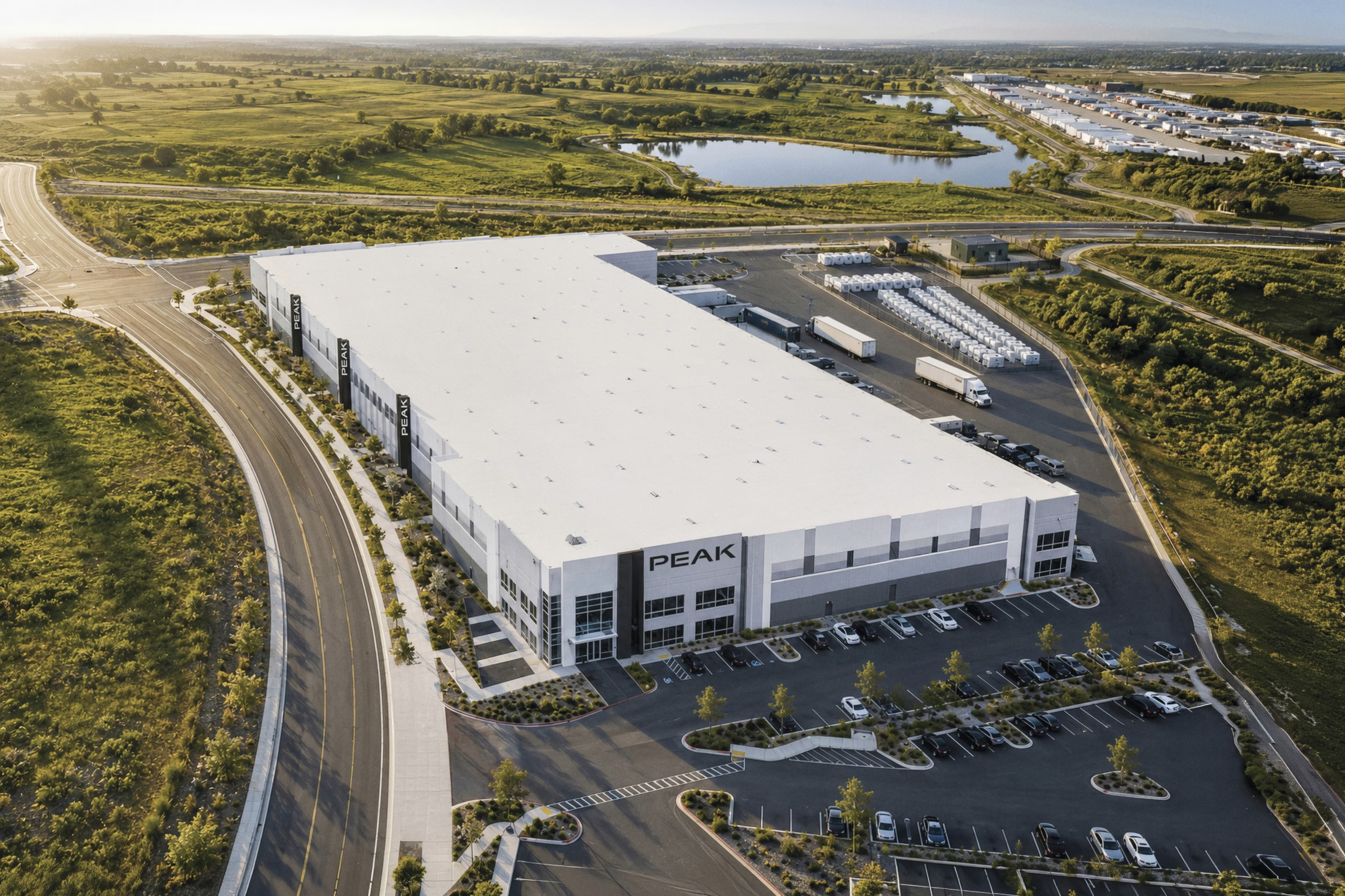


Global sodium-ion battery shipments reached 9 GWh in 2025, up 150% year over year, almost entirely driven by Chinese manufacturers operating at a scale that Western producers have yet to match. In that context, Peak Energy has announced a 183,000-square-foot manufacturing facility in Sacramento, California, targeting 4 GWh of annual sodium-ion battery system production and citing more than 6 GWh of customer commitments from Jupiter Power, Energy Vault, and RWE Americas.
The facility, representing up to $71 million in capital investment and supported by a $10.5 million CalCompetes tax credit awarded in May 2026, is scheduled to begin production and shipments in the first quarter of 2027. It is, by Peak’s own description, the first US facility dedicated to grid-scale sodium-ion energy storage systems.
The timing is deliberate, and the competitive logic is defensible. China currently manufactures approximately 80% of the world’s lithium-ion batteries and controls an even larger share of the upstream refining and cathode material supply chain. Sodium carbonate, the primary raw material for sodium-ion cells, trades at around $300 per ton and is available domestically in the United States in significant quantities, compared to lithium carbonate, which has swung between $6,000 and $80,000 per ton over the past five years and is sourced predominantly from Australia, Chile, and China. Supply chain diversification away from Chinese-controlled materials is a stated US industrial policy priority, and Peak is positioning its facility explicitly within that framing.
The Cost Gap That Peak Has to Close
The commercial case for sodium-ion in grid storage rests on a cost and operational argument that the independent data only partially supports at this stage. Wood Mackenzie estimated average costs in 2025 at $52 per kWh for lithium iron phosphate batteries and $59 per kWh for sodium-ion, a gap that persists despite sodium’s material cost advantage because sodium-ion cell manufacturing is still operating at far lower volumes than the established LFP production base. Wood Mackenzie does not expect sodium-ion to reach cost parity with LFP until around 2035 under current trajectories.
Peak’s counter-argument centres on operational rather than capital costs. The company claims its passively cooled sodium-ion system reduces total energy storage costs by 20% compared to lithium-ion alternatives, on the basis that eliminating active thermal management removes a significant ongoing cost burden. In California alone, the company estimates that removing battery refrigeration costs could save ratepayers an average of $100 million annually across deployed systems. The claim is plausible in direction but not independently verified. Thermal management costs for lithium-ion BESS include both capital expenditure for HVAC equipment and operating costs for electricity consumption, and the magnitude of savings depends heavily on local climate conditions, system utilisation rates, and the specific lithium-ion technology being compared.
The safety dimension strengthens Peak’s argument in the California market specifically. The January 2025 fire at the Moss Landing battery storage facility in California, a 300 MW lithium-ion installation, resulted in extended community displacement, regulatory scrutiny, and significant reputational damage to lithium-ion BESS development in the state. More than 100 local authorities in New York had already enacted moratoria or bans on battery storage projects by 2025, largely in response to fire safety concerns. Sodium-ion chemistry carries materially lower thermal runaway risk than NMC lithium-ion and modestly lower risk than LFP, a characteristic that translates directly into permitting and siting advantages in markets where community opposition to lithium-based storage has become a project development bottleneck.
What the GM Partnership Adds
Peak’s recently announced strategic partnership with General Motors, including a direct investment from GM Ventures, introduces the cell supply dimension that is otherwise the most opaque aspect of Peak’s commercialisation plan. Peak’s product is described as a battery energy storage system, meaning it integrates cells into a complete packaged solution. The partnership with GM is structured around pairing GM’s next-generation sodium-ion cell technology with Peak’s proprietary system platform, which means Peak is positioning itself as an integrator and system designer rather than a cell manufacturer.
This is a structurally important distinction. The cell is where most of the cost and most of the technical differentiation in battery storage reside. If Peak is sourcing cells from GM’s development programme rather than manufacturing them internally, its capital cost structure is different from what the 183,000-square-foot Sacramento facility might imply, and its cost trajectory is tied to GM’s ability to bring sodium-ion cell production to competitive cost levels. GM’s investment in sodium-ion cell development is real but early-stage: the automaker has not committed to commercial sodium-ion cell production at the scale that would be needed to supply 4 GWh per year of Peak’s systems. The partnership provides Peak with technical credibility and a pathway to domestic cell supply, but it does not resolve the question of whether competitively priced sodium-ion cells from a non-Chinese source will be available in the volumes Peak needs by the time its Sacramento facility enters full production in 2027.
The Broader US Sodium-Ion Landscape
Peak enters a US market where two earlier sodium-ion ventures have already failed. Bedrock Materials, a Stanford spinout focused on sodium-ion cathode materials, closed in April 2025. Natron Energy, which had begun commercial-scale sodium-ion cell production at its Holland, Michigan, facility as recently as April 2024, ceased operations entirely in September 2025. Both failures occurred before reaching the production volumes at which sodium-ion’s material cost advantages could offset its manufacturing scale disadvantage against the global LFP supply chain.
The structural difference between those ventures and Peak is that Peak is entering as a system integrator targeting an already-identified customer base with contracted commitments, rather than as a materials or cell producer attempting to build demand from a position of manufacturing primacy. The 6 GWh of customer commitments that Peak reports, if they represent firm contracts with creditworthy counterparties, de-risk the facility’s early production years in a way that earlier US sodium-ion ventures did not have. Jupiter Power’s agreement, described at the announcement as potentially covering its entire current development portfolio, represents a meaningful anchor customer in the US grid storage market.
The broader question for US sodium-ion commercialisation is whether the policy environment will actively support domestic production at the cell level, not just the system integration level. The “one big beautiful bill” budget legislation passed in July 2026 introduced new restrictions on tax credit eligibility based on the involvement of companies with material ties to China’s battery supply chain. The precise scope of those restrictions and their application to sodium-ion supply chains, which currently rely on Chinese precursor processing even when raw materials are sourced domestically, will significantly affect whether Sacramento becomes the first node in a domestic sodium-ion manufacturing ecosystem or remains an integration facility dependent on foreign cell supply.


