


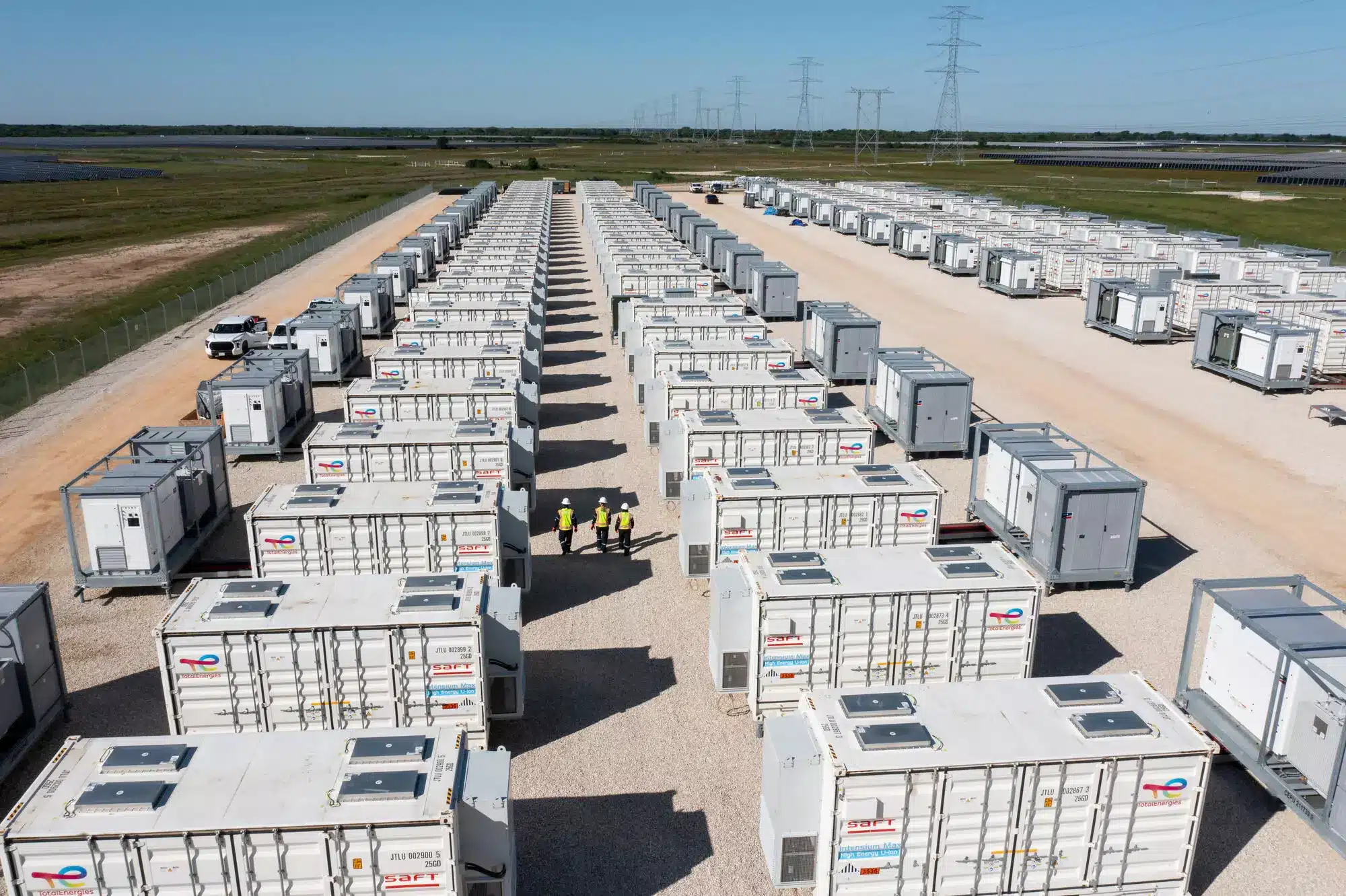


The announcement discloses a 5 megawatt-hour nominal capacity per unit, no total project size, no customer name, and no site location. Judged against what competing generator makers have already put on the public record this year, gigawatt-scale gas deals paired with battery storage measured in the hundreds of megawatt-hours, calling this Cummins’ largest battery energy storage deployment to date is a claim about the company’s own short history in the category more than about its position in the market.
Cummins entered the battery energy storage business in May 2025, which means the deal announced this week, its largest to date by the company’s own description, is being measured against a track record barely more than a year old. The release does not disclose the total capacity of the project, only that Cummins’ BESS platform ships in 5 megawatt-hour nominal blocks using lithium iron phosphate cells with liquid cooling, leaving the actual scale of what will be the company’s biggest deployment unstated. That gap matters because rivals in the same data center power market have been considerably more specific. Caterpillar’s January agreement with American Intelligence & Power Corporation for the Monarch Compute Campus in West Virginia covers 2 gigawatts of fast-response natural gas generators for the project’s initial phase, augmented with battery storage designed to handle AI load swings, with the site’s long-term buildout targeted at up to 8 gigawatts. A separate Caterpillar-backed campus in Millard County, Utah, developed with Joule Capital Partners, pairs a fleet of G3520K gas generators with more than 1 gigawatt-hour of battery storage against an eventual 4 gigawatts of capacity, a battery component alone that is roughly 200 times the size of a single Cummins BESS block. Rolls-Royce’s mtu business separately secured a 72-megawatt natural gas order with integrated microgrid control for a Frankfurt hyperscale campus in January. None of this means Cummins’ deal is unimportant, but it does mean the comparison implied by “largest deployment to date” is being drawn against Cummins’ own prior projects rather than against what the broader market is currently building.
The technical problem Cummins describes, utility-defined requirements for managing AI-driven load fluctuations, mitigating load oscillations, and enhancing ride-through performance, is not vendor framing dressed up as urgency. It reflects a documented and escalating grid reliability issue. In July, a single fallen power line on the PJM grid in Northern Virginia, the world’s densest concentration of data centers, triggered a voltage spike after more than 3 gigawatts of data center load disconnected almost simultaneously, an event roughly twice the scale of a comparable 2024 incident in which 60 data centers dropped 1.5 gigawatts. PJM’s own capacity shortfall has widened sharply, from 208.7 megawatts in the 2026/2027 base residual auction to more than 6.5 gigawatts projected for 2027/2028, and the Department of Energy invoked emergency wartime authority three separate times in 2026 to force data centers within PJM’s territory onto diesel backup generation during grid stress events, a power it had previously used only about 26 times combined across all US grid operators since 2000. Grid operators are responding by shifting from treating disconnection as an acceptable fallback to requiring large loads to ride through disturbances instead. PJM has proposed curtailing new large loads that lack independent power sources starting as soon as mid-2027, and ERCOT is moving in a similar direction, which converts what Cummins markets as a performance feature into what is becoming, in at least one major grid territory, a compliance requirement for continued interconnection.
That regulatory shift is also why nearly every major generator manufacturer has moved into some version of the same hybrid architecture Cummins is now offering. Caterpillar’s G3516 sets for the Monarch campus are specified to ramp from zero to full load in about seven seconds, specifically to follow AI-driven load swings, and its Utah project pairs generation with battery storage sized to smooth the same oscillations Cummins cites. A dedicated ride-through specialist, ON. Energy is already installing what it describes as 3 gigawatts worth of battery and power-conversion systems across four data center campuses, designed to make a facility appear to the grid as a steady, well-behaved load rather than a source of voltage disturbance during disconnection events, a scale that exceeds the undisclosed total of Cummins’ new project by a wide margin even accounting for the different technical approach. Against that backdrop, Cummins’ entry looks less like a differentiated technology bet and more like a necessary catch-up move to remain a full-service vendor to data center developers who increasingly expect generators, batteries, and microgrid controls bundled together, a shift Cummins’ own president of Power Systems acknowledged in describing the broader shift toward “bridge-to-grid” architectures.
Cummins remains, by revenue and by its own recent capital allocation, primarily a generator company rather than a battery company. In February, Cummins committed 150 million dollars to expand its Fridley, Minnesota facility specifically to increase output of its QSK95 high-horsepower diesel generator sets by 30%, addressing 18-month lead times that had built up as data center demand for large gensets outstripped supply, an investment roughly comparable in scale to a single BESS project but directed at the business Cummins has run for a century rather than the one it launched fifteen months ago. Cummins and Caterpillar are described in industry analysis as the dominant players in the high-horsepower generator segment above 2 megawatts specifically because of their ability to cross-sell from mining, marine and industrial applications, an advantage that does not automatically transfer to battery systems, where established grid-scale suppliers such as Tesla, Fluence and Sungrow, along with Chinese cell manufacturers that account for roughly two-thirds of global battery energy storage installations, have years of deployment experience Cummins is only beginning to accumulate. The market’s own reaction to the announcement was muted at best, with Cummins shares falling more than 3% on the day, a decline that outpaced both the broader industrial sector’s 1.1% drop and the S&P 500’s 0.6% decline, though the stock remains up nearly 55% over the preceding twelve months and the same day’s losses were broad enough across industrials that attributing the move specifically to this announcement would overstate what a single trading session can show. What the announcement more reliably demonstrates is that the underlying problem, a grid increasingly unable to absorb the volatility of concentrated AI compute load without dedicated on-site buffering, is real and worsening quickly enough that even a company whose core expertise sits in diesel and natural gas engines now needs a battery product to stay relevant to the customers building that load.
Add EnergyNews.biz as a preferred source on Google


