


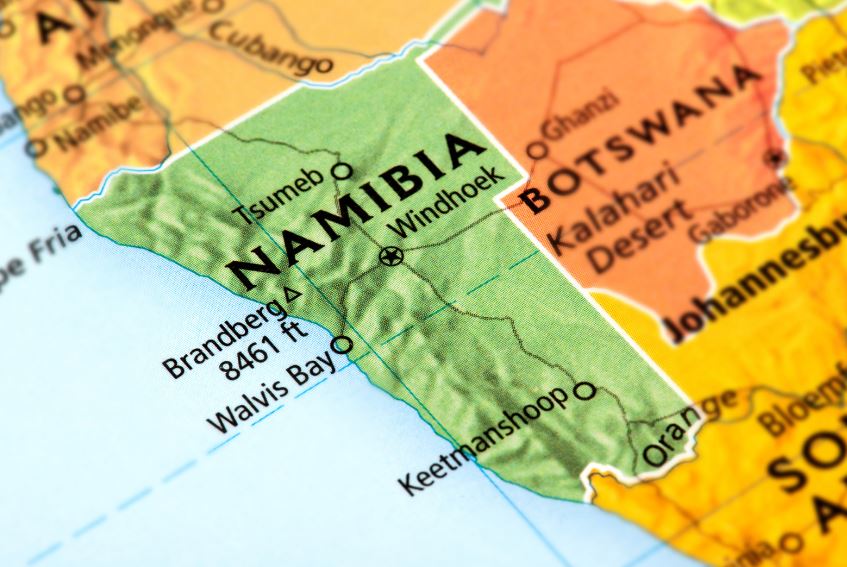


Namibia has commissioned an integrated green hydrogen facility at Walvis Bay that combines a 5 MWp solar park, a 5 MW proton exchange membrane electrolyzer and 5.9 MWh of battery storage, creating an operating model that links renewable electricity generation directly with hydrogen production, storage and end use.
The Cleanergy Solutions Namibia facility, developed by CMB.TECH and Ohlthaver & List, is being positioned as Africa’s first fully integrated green hydrogen facility. Its initial hydrogen output is intended for industrial and transport applications, including hydrogen dual fuel trucks, generators, port equipment and railway applications. The project is also intended to support the development of a hydrogen powered freight locomotive, placing rail and port logistics among the first potential demand centers for the fuel.
The facility is relatively small by the standards of Namibia’s proposed green hydrogen industry, but its significance lies less in production volume than in the integration of the value chain. The project brings solar generation, battery storage, electrolysis, hydrogen compression, storage and refueling infrastructure into a single site rather than developing each component independently.
CMB.TECH’s 2025 annual report states that the hydrogen production facility became fully operational in September 2025. The formal commissioning reported in August 2026 therefore represents a public milestone for a facility that has already been operating, rather than the start of hydrogen production itself.
The 6.5 hectare solar installation contains approximately 7,000 panels and supplies electricity to the 5 MW PEM electrolyzer. A 5.9 MWh battery energy storage system helps manage fluctuations in solar output and enables the electrolyzer to operate beyond periods of direct photovoltaic generation.
The configuration is important because an off grid electrolyzer cannot rely on the broader electricity network to balance intermittent renewable generation. The battery therefore becomes part of the hydrogen production system rather than simply an auxiliary power asset.
SMA Altenso, which supplied the power conversion and energy management system, describes the plant’s control architecture as integrating forecasts for solar production, hydrogen demand and auxiliary loads. The system is designed to balance generation and demand and manage periods of low or absent photovoltaic output.
The underlying question, however, is not whether such an architecture can operate. It is whether the combination can produce hydrogen at a cost competitive with alternative fuels once the system is expanded.
CMB.TECH’s earlier project planning estimated approximately 500 tonnes of annual hydrogen production for the first phase. The same plan envisaged adding another 5 MW electrolyzer, an 8 MWp solar park and a 4 tonnes per day ammonia plant.
That expansion would change the economics and energy requirements of the site substantially. The current installation should therefore be viewed as a demonstration and demand creation platform rather than evidence that Namibia has already established competitive large scale hydrogen production.
Demand Comes Before Export Ambitions
One of the more consequential features of the Walvis Bay project is its emphasis on captive demand.
Rather than building a large hydrogen production facility and then searching for customers, CMB.TECH is using the fuel within its own industrial ecosystem. The hydrogen is intended for trucks, port equipment, railway applications and small ships, creating initial demand around the production site.
That approach addresses one of the central weaknesses of the global green hydrogen project pipeline: production capacity can be developed substantially faster than dependable demand.
The Walvis Bay model instead links production with applications that can consume hydrogen locally. This is particularly relevant for a country such as Namibia, where the long term proposition is based partly on exporting hydrogen and hydrogen derived products to international markets.
A domestic demand base can provide a practical testing ground for equipment, operating procedures, safety standards and commercial models before larger export infrastructure is committed.
It also reduces the immediate dependence on international offtake agreements, which remain difficult to secure for many prospective green hydrogen projects because the delivered cost of hydrogen and its derivatives remains uncertain relative to incumbent fuels.
The hydrogen facility is located near Walvis Bay, one of the country’s most important logistics assets, and its planned applications extend across trucks, port equipment, railway equipment and marine uses. Namibia’s national green hydrogen program has previously identified the port environment as an area for hydrogen demonstrations, including hydrogen dual fuel port equipment and railway applications.
The railway application is significant because it illustrates where hydrogen could have a role even as direct electrification remains the more energy efficient pathway for many heavily used rail corridors.
Namibia’s rail network includes routes where extensive electrification would require significant capital investment. A hydrogen or hydrogen dual fuel locomotive can potentially reduce diesel consumption without requiring immediate electrification of an entire route.
That does not establish hydrogen as the preferred technology for rail freight in general. Its economic case will depend on hydrogen production costs, locomotive utilization, fuel storage requirements, infrastructure availability and the cost of alternatives, including diesel and future rail electrification.
The value of the Walvis Bay demonstration is therefore its ability to test the technology within an actual logistics ecosystem rather than in isolation.
CMB.TECH’s development plans include an additional electrolyzer, solar capacity and a 4 tonnes per day ammonia plant. A subsequent phase envisages an ammonia import and export terminal with storage and bunkering infrastructure at Walvis Bay. The company’s 2024 planning documents put the targeted storage capacity at 55,000 tonnes, with operational readiness previously projected for 2028.
The strategic logic is straightforward. Hydrogen is difficult and expensive to transport over long distances because of its low volumetric energy density. Converting hydrogen into ammonia provides an established chemical carrier that can be transported and potentially used as a marine fuel.
For Namibia, that creates a potential connection between renewable electricity, hydrogen, ammonia production and the country’s maritime infrastructure.
But it also introduces another layer of conversion losses and capital requirements. Producing ammonia does not eliminate the economic challenge facing hydrogen; it adds synthesis, storage, handling and bunkering infrastructure to the value chain.
The commercial case will consequently depend on whether demand for low carbon ammonia develops sufficiently to justify those additional assets.
Namibia’s Export Ambitions Remain Much Larger Than Walvis Bay
The country’s strategy envisages development of large renewable energy and hydrogen projects capable of serving domestic industry and international markets. The central region around Erongo, which includes Walvis Bay, has been identified as an important location because of its renewable resources, industrial base and access to the port. Namibia’s green hydrogen strategy has previously identified the region’s potential for developing hydrogen and synthetic fuel production at substantially larger scales.
CMB.TECH has indicated that the existing solar installation occupies only a fraction of the available site and has discussed expanding capacity first to 250 MW and eventually to 500 MW.
Those targets should be treated as long term development ambitions rather than current production capacity.
The difference in scale is substantial. Moving from a 5 MW electrolyzer to hundreds of megawatts would require much larger renewable generation capacity, hydrogen storage, water supply, electrical infrastructure, compression and distribution systems, as well as dependable customers for the resulting hydrogen or ammonia.
That makes the success of the initial facility relevant not because it demonstrates that Namibia can immediately produce hydrogen at export scale, but because it provides operational experience across the technologies that larger projects will require.
The project’s location at Walvis Bay also highlights a broader feature of Namibia’s hydrogen strategy: the infrastructure challenge extends beyond renewable generation and electrolysis.
A future export oriented hydrogen economy would require ports, storage facilities, pipelines or other transport systems, water infrastructure, electricity transmission, renewable generation and industrial facilities to develop in parallel.
Namibia’s government has increasingly framed green hydrogen alongside ports, logistics, rail, storage, minerals, manufacturing, electricity and water infrastructure. Recent government material explicitly identifies these sectors as interconnected components of the country’s emerging green industrial ecosystem.
That makes Walvis Bay more than a hydrogen production site. Its potential value is as an interface between renewable energy production and the logistics infrastructure needed to move hydrogen derived products into domestic and international markets.
The same logic applies to rail. A hydrogen locomotive has limited value without a dependable fuel supply, refueling infrastructure, appropriate maintenance capabilities and freight demand. Similarly, a hydrogen refueling station has limited commercial value without vehicles that use the fuel regularly.
The project also includes a Hydrogen Academy intended to develop local technical capabilities. The facility employs 25 people, with 24 reported to be Namibian, while training is aimed at engineers, technicians, drivers and other workers involved in hydrogen applications.
This is a material consideration for Namibia’s wider ambitions. Scaling hydrogen production requires more than imported electrolyzers and renewable energy equipment. It requires technicians capable of operating high pressure hydrogen systems, maintaining power electronics and electrolyzers, managing safety systems and integrating hydrogen into industrial and transport operations.
The Hydrogen Academy therefore addresses a constraint that is often less visible in project announcements than production capacity: the availability of people able to operate and maintain the infrastructure once it is built.
The Walvis Bay facility provides a more concrete test of Namibia’s hydrogen ambitions than a large proposed export project because the equipment is operating within a defined local ecosystem.
Its current scale remains modest, with 5 MWp of solar generation, a 5 MW electrolyzer and 5.9 MWh of battery storage. Its importance will ultimately depend on whether the model can move beyond demonstration into economically sustainable industrial applications.
The immediate test is therefore not whether Namibia possesses excellent solar resources. It does. The harder question is whether renewable electricity, electrolysis, storage and hydrogen end use can be integrated at a cost that supports sustained demand.
If the next phases succeed, Walvis Bay could develop into a broader energy and logistics platform connecting renewable electricity with hydrogen, ammonia, port operations, rail freight and maritime fuel demand. The project already reflects that direction, with its developers pursuing applications across transport and industrial operations and planning additional ammonia infrastructure.
Add EnergyNews.biz as a preferred source on Google


