


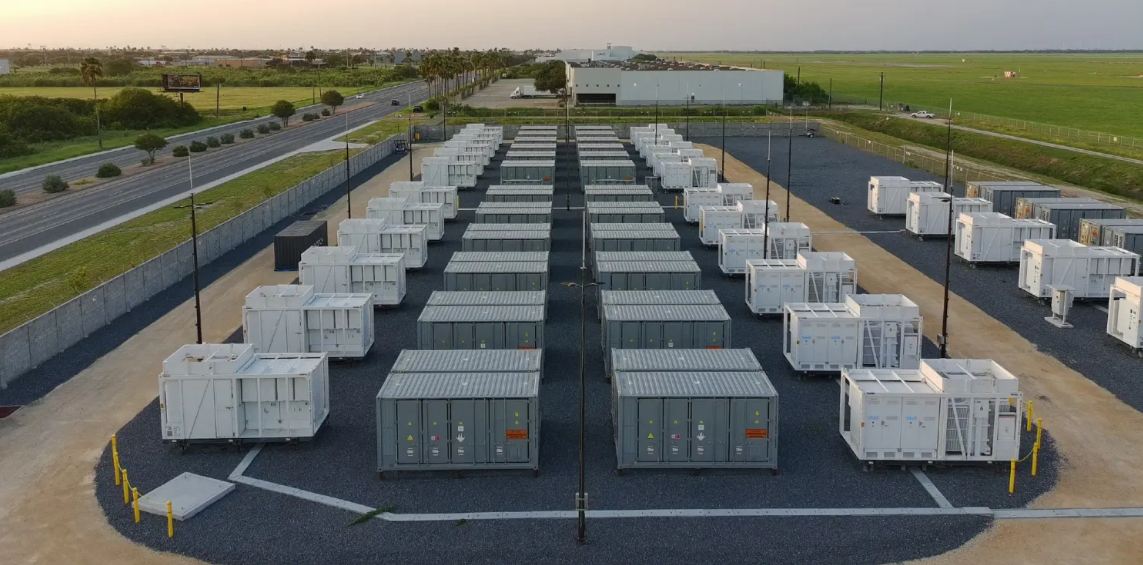


Equinor’s Citrus Flatts Energy Center enters Texas’s grid on a fully merchant basis, with no long-term utility contract backing its revenue. ERCOT battery storage’s monthly revenue index fell from 46,264 dollars per megawatt per year in January 2026 to just 15,306 dollars in February, a two-thirds drop in a single month, part of a broader collapse that has already cut average ancillary service earnings by roughly 80% since the market’s earlier boom years.
East Point Energy, Equinor’s wholly owned US battery storage subsidiary, brought the 100 megawatt, 200 megawatt-hour Citrus Flatts Energy Center in Harlingen online as its largest US project to date, following the smaller 10 megawatt Sunset Ridge Energy Center in Frio County. Both operate on a fully merchant basis inside ERCOT, meaning their revenue depends entirely on buying power when prices are low, selling when prices spike, and providing grid services, with Equinor’s trading arm Danske Commodities managing dispatch and portfolio optimization rather than any fixed utility offtake agreement. That structure places both projects squarely inside a revenue environment that has deteriorated sharply and unevenly over the past two years. Average ancillary service revenue in ERCOT fell to roughly 36,317 dollars per megawatt-year by 2024, according to Rabobank’s analysis of the market, a decline of close to 80% driven not by falling grid need but by a battery fleet that has expanded far faster than the fixed volume of ancillary products ERCOT procures. Energy arbitrage revenue, the other primary income source for merchant batteries, has proven similarly volatile: Modo Energy’s ERCOT battery revenue index swung from 46,264 dollars per megawatt-year in January 2026 to 15,306 dollars in February before partially recovering to 38,145 dollars in April, with price spreads down roughly 50% year over year by June.
The scale of competition behind that decline is set to intensify well beyond current levels. ERCOT battery capacity has grown roughly 70 times over since 2020, according to Modo Energy, and the US Energy Information Administration projects the fleet will expand further, from around 15 gigawatts in 2025 to 37 gigawatts by the end of 2027, more than doubling in the same window Citrus Flatts begins commercial operation. More batteries chasing the same structurally fixed set of price spreads and ancillary service volumes is precisely the dynamic that produced the revenue declines already on record, and nothing in the EIA’s capacity growth projection suggests that dynamic reverses before Equinor’s newest project has had time to establish a track record.
One structural feature works in Citrus Flatts’ favor. ERCOT batteries with two-hour duration, the configuration both Citrus Flatts and Sunset Ridge use, have consistently outearned one-hour systems by 15% to 81% depending on season over the past two years of Modo Energy’s tracking, with the premium widest during winter cold-snap scarcity events when multi-hour price spreads run deepest. Two-hour systems earned roughly twice the energy arbitrage revenue of one-hour batteries over the trailing year, a real and durable advantage tied to being able to capture wider daily price swings rather than a single peak hour. That does not offset the broader downward trend in absolute revenue levels, but it does mean Equinor’s choice of duration format sits in the more favorably compensated segment of an otherwise compressed market.
The financing environment around fully merchant ERCOT batteries has also shifted since the model Citrus Flatts uses was first popularized. Reporting from early 2026 describes financiers as having been “burned” by merchant BESS projects lacking long-term contracts, pushing the broader Texas storage market toward what analysts describe as a more stable, services-based structure favoring developers who can secure utility offtake agreements, a structural realignment reinforced by state policy attention through the Texas Energy Fund and new large-load interconnection rules. ERCOT’s own market design changes reflect the same pressure: Real-Time Co-optimization plus Batteries, which went live in December 2025, was intended to let storage capture both energy and ancillary service value more efficiently, and the grid operator launched a 25 million dollar incentive program in May 2026 specifically to encourage grid-forming battery technology. Revenue data through the first half of 2026 shows those reforms have not yet stabilized returns, with the sharp month-to-month swings in Modo Energy’s index continuing well after RTC+B’s launch.
Citrus Flatts also arrives as Equinor’s broader US renewables portfolio has taken a materially different kind of hit. The company booked a 955 million dollar impairment in the second quarter of 2025 tied to its Empire Wind offshore project off New York, followed by a further 1.4 billion dollars in impairments later in the year that pushed its renewables segment to a 1.6 billion dollar operating loss for 2025. Those write-downs followed repeated stop-work orders on Empire Wind under the Trump administration, in April and again between December and January, along with roughly 300 million dollars in added steel tariff costs and the loss of federal tax credits for the project’s second phase. A battery storage strategy built on onshore sites in Texas and Virginia, financed through balance sheet capital and merchant market participation rather than federal offshore leasing and construction permitting, carries a fundamentally different risk profile than offshore wind has shown under the current regulatory environment, even as the ERCOT market it depends on presents its own well-documented and still unresolved revenue pressures. East Point’s next projects, four batteries totaling 80 megawatts in Virginia expected online in PJM in early 2027, will test whether that onshore, merchant-oriented model performs more predictably in a different market than the one Citrus Flatts is now navigating in Texas.
Add EnergyNews.biz as a preferred source on Google


