


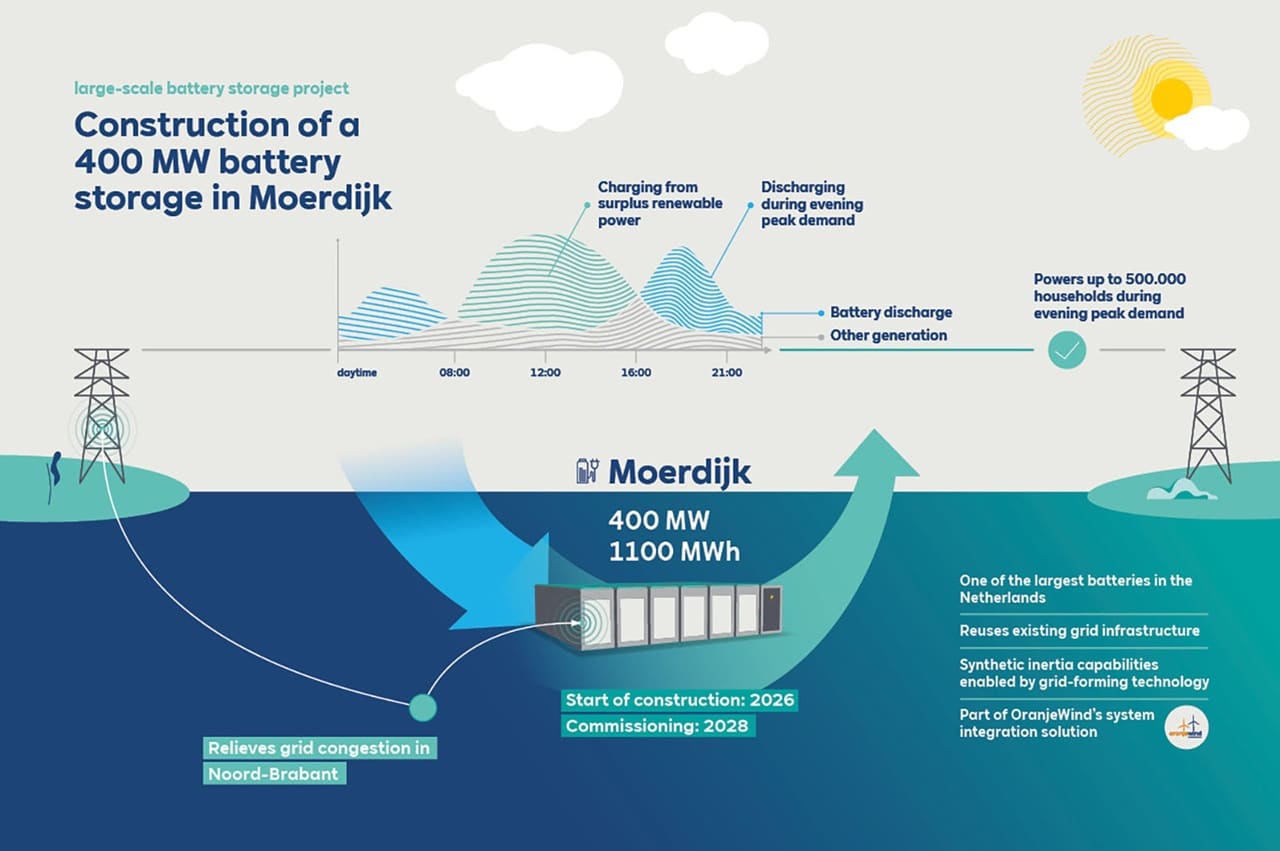


RWE has taken the final investment decision on a 400 MW/1,100 MWh battery energy storage system at its Moerdijk power station, with commissioning planned for the second quarter of 2028.
The lithium ion system will comprise 208 containers and be capable of delivering its maximum output for almost three hours. The scale is significant, but the more important feature is where and how the battery will operate. RWE plans to connect the system through the existing high voltage infrastructure at Moerdijk and use capacity steering agreements with TenneT to dispatch the battery when it can reduce congestion in Noord Brabant. This makes the project part of a broader shift in the role of battery storage, from an asset primarily optimized around electricity price spreads to infrastructure that can also provide location specific grid services.
The timing reflects the Netherlands’ increasingly constrained electricity network. Enexis reported six new congestion bottlenecks in Noord Brabant in August 2026, while customers in affected areas were already facing waiting lists because of constraints in the higher voltage TenneT network.
The Moerdijk battery is intended to address part of this problem by absorbing electricity during periods when the regional network is under pressure and supplying it back when network conditions allow. According to RWE, the system will be located close to the 150 kilovolt Moerdijk Noord substation, allowing it to support a regional bottleneck with implications for congestion elsewhere in Noord Brabant. TenneT and Enexis are expected to assess the impact of the project as part of the next congestion management review scheduled for December 2026.
That distinction matters. A battery does not create additional transmission capacity in the physical sense. Instead, it can alter when electricity flows through constrained infrastructure, potentially allowing existing network capacity to be used more efficiently. The effectiveness of that model therefore depends on dispatch rules, network conditions and coordination with the system operator rather than storage capacity alone.
At 400 MW and 1,100 MWh, the Moerdijk system has an energy to power ratio of 2.75 hours. RWE says it can deliver its full output for almost three hours. The project is therefore positioned between short duration grid balancing and longer duration energy shifting.
That profile is relevant to the Dutch system, where increasing renewable generation creates periods in which electricity supply can rise rapidly while demand does not move at the same pace. A battery with hundreds of megawatts of power can respond within seconds or faster, while its energy capacity determines how long that response can be sustained.
RWE is also planning additional grid functionality beyond conventional energy arbitrage. The new system will be equipped to provide advanced services including instantaneous reserve and inertia. Moerdijk already hosts a much smaller 7.5 MW/11 MWh battery designed to provide synthetic inertia. That system entered commercial operation in 2025 and uses grid forming inverters capable of responding within milliseconds.
The two projects illustrate how battery technology is being deployed for different layers of system flexibility. The 7.5 MW installation focuses on rapid electrical response and grid stability, while the 400 MW system adds substantial energy shifting capability and congestion management.
The Moerdijk project also has a strategic connection to RWE and TotalEnergies’ 795 MW OranjeWind offshore wind farm, which is currently under construction in the Dutch North Sea. The first monopile was installed in September 2026, with all 53 foundations expected to be completed by early 2027 and full commissioning planned for 2028.
OranjeWind is being developed as a system integration project rather than as an offshore generation asset operating independently of demand. The partners have committed to combining the wind farm with flexible technologies including battery storage, electrolysis, electric boilers and smart charging. The project is expected to generate around 3 TWh of electricity annually once operational.
The Moerdijk battery cannot directly eliminate the variability of offshore wind, nor can 1,100 MWh of storage absorb the entire output of a 795 MW wind farm for an extended period. Its value instead lies in providing a flexible buffer within a broader system. Electricity can be stored during periods of high renewable production and released when system conditions and demand justify it.
This approach also highlights a central issue for offshore wind expansion in the Netherlands. Adding generation capacity without sufficient flexibility and network capacity can shift the bottleneck from electricity production to electricity delivery. Batteries, flexible industrial loads, electrolysis and smart charging can help address that mismatch, but each operates on different timescales and has different economic constraints.
The Moerdijk project also benefits from being built at an established power generation site. RWE says the battery will use the existing grid connection at the power station rather than requiring an entirely new connection.
That is increasingly relevant in markets where grid connection queues can extend project development timelines. Reusing existing infrastructure does not remove network constraints, but it can reduce the need for additional connection infrastructure and place flexible assets directly where network conditions require them.
RWE is pursuing a similar strategy elsewhere in Germany. In January 2026, the company announced a 400 MW battery at its Lingen site with at least 800 MWh of storage capacity and planned commissioning in 2028.
The pattern suggests that large power plant sites can become strategic locations for batteries as power systems move toward higher shares of variable renewable generation. Existing substations, grid connections and industrial land can provide an infrastructure base for new flexibility assets, although their suitability ultimately depends on local network conditions.
The Moerdijk decision also represents part of a much broader expansion of RWE’s battery portfolio. The company says it currently operates around 1.7 GW of battery storage capacity globally, with another 3 GW under construction. In the Netherlands, it operates a 35 MW/41 MWh battery at Eemshaven in addition to the existing Moerdijk inertia battery.
The scale of that pipeline indicates how quickly batteries are moving from pilot applications toward utility scale infrastructure. Yet the economics of each project will increasingly depend on more than wholesale electricity price spreads. Congestion management contracts, balancing services, ancillary services and system integration requirements can create additional revenue streams, while also imposing operational constraints on when a battery can charge or discharge.
For Moerdijk, that distinction is particularly important. A battery dispatched exclusively according to market prices would not necessarily operate when the regional network needs relief. Capacity steering agreements with TenneT therefore introduce a system level requirement into the asset’s operating model.


