




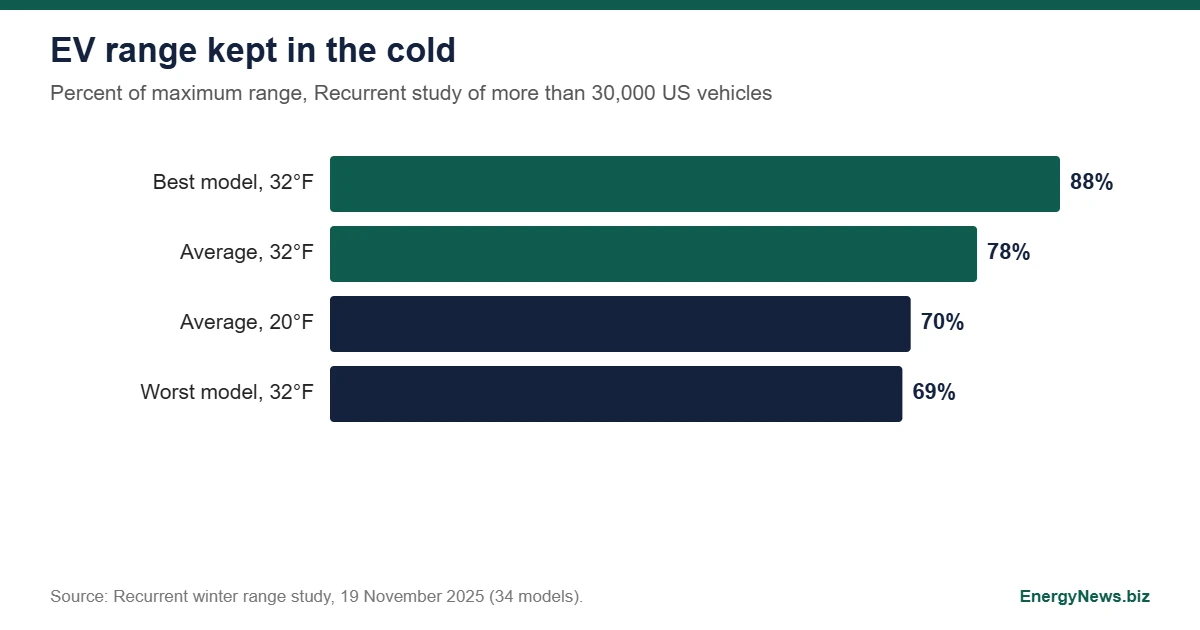
The average EV keeps 78 percent of its range at 32°F, a loss of 22 percent, according to the EV data company Recurrent’s winter study of more than 30,000 US vehicles. A widely read consumer explainer published on 12 October 2026 uses that study to say EV range can drop by nearly a third below freezing. The primary figures support a third only for the worst model at 32°F or for the average car at 20°F.
78 percent at 32°F, 70 percent at 20°F
The study covers 34 popular models and reports range retention against each model’s maximum range in ideal conditions, usually between 70°F and 80°F. At 32°F the average car keeps 78 percent. At 20°F it keeps 70 percent, which is a 30 percent loss and the point where “nearly a third” becomes accurate. The explainer says “below freezing” without a temperature, and below freezing spans both figures, which are 8 points apart.
The spread between models is wide. The best winter performer keeps 88 percent of its range at 32°F and the worst keeps 69 percent, so a loss of 12 percent and 31 percent for the same temperature. The study ranks Tesla models among the best and several General Motors models among the lowest, and it attributes the GM result to a resistive heater that, it suspects, starts at a higher temperature than other makers’ systems. That is Recurrent’s inference, stated as a belief, not a measured cause.
Heat pumps, and a ceiling on the cold-weather advice
Heat pumps extend range by about 10 percent at 32°F, according to the study, which also says the benefit shrinks as temperatures approach 0°F, where a heat pump is about as efficient as a resistive heater. A heat pump produces 3 to 4 units of heat per unit of electricity. The study describes the range loss as temporary, with no long-term effect on the battery, and its data combine several previous winters. All of it comes from US vehicles that report through one platform, so the sample is large but not random.
Heat: 5 percent at 90°F, 17 to 18 percent at 100°F
The explainer’s summer figure is closer to the data. Recurrent’s heat study of 29,716 vehicles found a loss of about 5 percent at 90°F, mostly from cooling the cabin and the battery, and 17 to 18 percent at 100°F. Vehicles with heat pumps do slightly worse in the heat: they keep 93 percent at 90°F against 97 percent without a heat pump, and 85 against 87 percent at 100°F. The study notes that air conditioning needs 3 to 5 kW to cool a hot car down and about 1 kW to hold the temperature. At 1 kW an hour of cooling costs about 1 kWh, which for a car assumed to cover 3 to 4 miles per kWh is 3 to 4 miles, consistent with the explainer’s line that air conditioning costs several miles of range an hour.
Speed, regeneration and the claims without a source
Two driving claims stand on physics or on no stated source. Aerodynamic drag force rises with the square of speed, so at 70 mph it is about 36 percent higher than at 60 mph (70 squared over 60 squared), if drag dominates, which it does not fully because rolling resistance and drivetrain losses behave differently. The explainer’s figure of about six miles saved per hour by driving 60 instead of 70 comes from a charging network’s advice and is not checked against a measurement here.
The statement that regenerative braking extends battery life by as much as 20 percent has no source in the piece. It mixes two different things: regeneration affects range, while battery life is about degradation over years, and the percentage is not attributed. The same piece says the average real-world range of 2026 models rose to 325 miles; that figure was not checked at its source for this article.
The test for cold weather range is concrete and available: Recurrent publishes range retention by model at 32°F and 20°F, and a buyer in a cold climate should read the model’s own number, not the average, because losses at 32°F run from 12 to 31 percent across the 34 models. For another transport technology judged on its own numbers, see Hyundai Glovis and LGL’s SMR powered car carrier study. Sources: Recurrent winter range study, 19 November 2025; Recurrent hot weather range study, 23 June 2025; consumer explainer of 12 October 2026.
Add EnergyNews.biz as a preferred source on Google


