


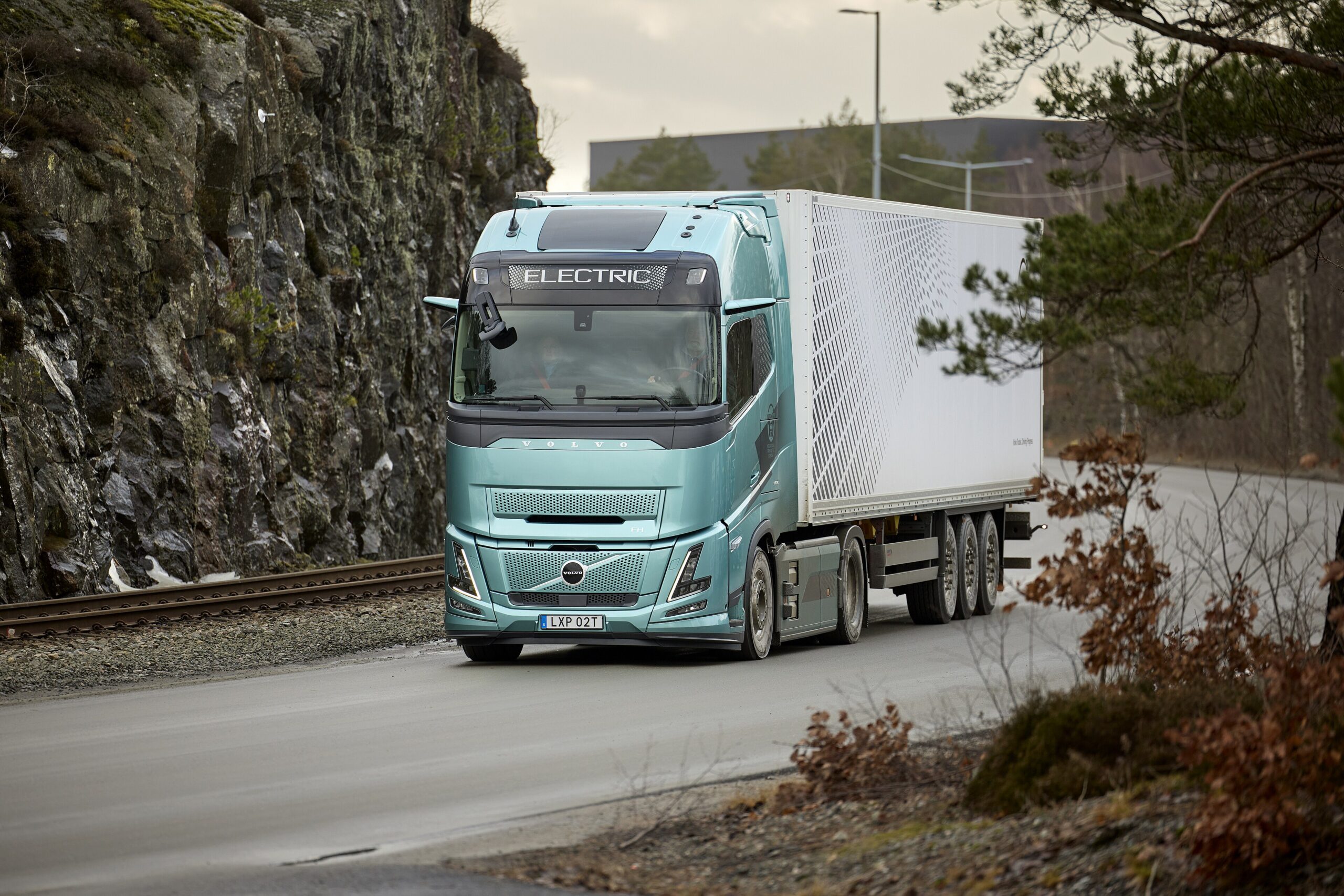


A model released on 28 September 2026 by the non-profit Transport & Environment finds that a battery-electric long-haul tractor costs less to own than a diesel one over five years in six of nine EU markets, which together account for 46% of new heavy truck sales. The Dutch saving is €100,000 and the German saving €85,000. Italy shows a deficit of €94,000. The spread tracks tolls, credits and subsidies more than the truck itself, which still lists at €265,000 against €120,000 for diesel.
Model assumptions behind the five-year result
The study assumes a long-haul tractor driven 116,000 km a year, 75% of it on motorways, bought by a medium-sized fleet with a 15% down payment and a 9.5% discount rate. Residual value is 35% of the pre-subsidy price. Energy use is 1.03 to 1.15 kWh/km for the electric truck and 26.4 to 28.9 litres per 100 km for diesel, with 80% of charging at the depot. Diesel is priced at 2025 averages. Only subsidies in force at publication are counted.
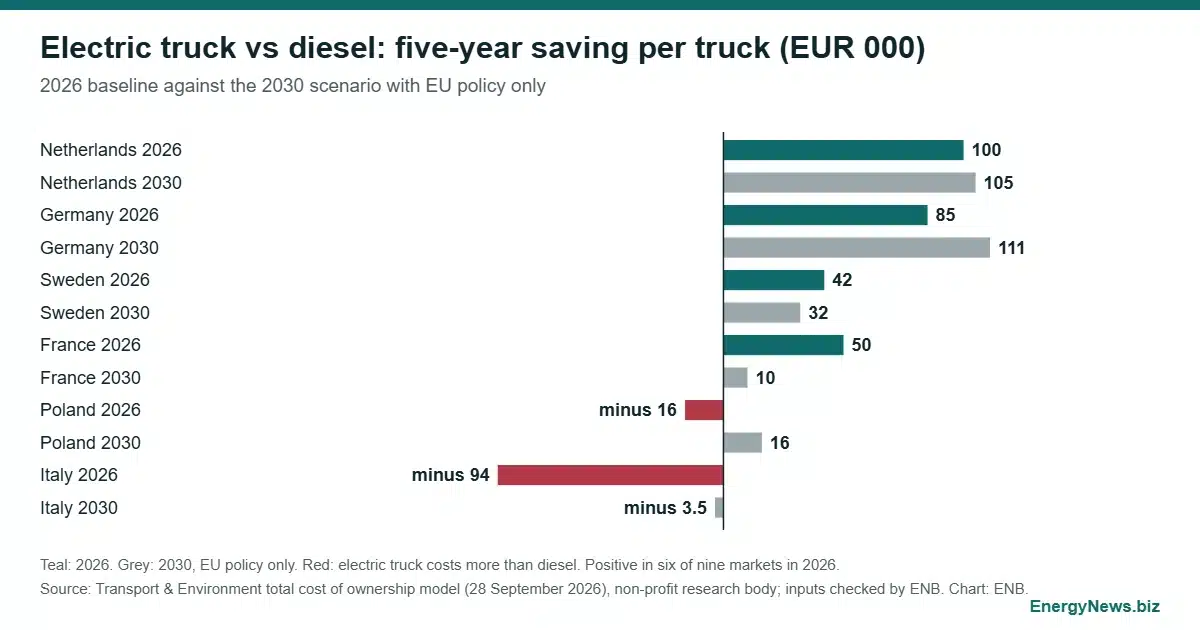
Electric truck TCO by country, 2026 and 2030
Savings are five-year totals per truck against diesel, EU-built electric model, in euros. The 2030 columns show the EU policy scenario and the result once national tolls and renewable fuel credits are added.
| Market | 2026 saving | 2030, EU policy only | 2030, with national measures |
|---|---|---|---|
| Netherlands | 100,000 | 105,000 | 105,000 |
| Germany | 85,000 | 111,000 | 111,000 |
| Sweden | 42,000 | 32,000 | 51,000 |
| France | 50,000 | 10,000 | 100,000 |
| Poland | minus 16,000 | 16,000 | 68,000 |
| Italy | minus 94,000 | minus 3,500 | 60,000 |
The pattern is policy, not technology. France reaches €50,000 in 2026 with a purchase subsidy the study puts at up to €107,000, yet the EU-only scenario for 2030 leaves it at €10,000.
Inputs checked against official data
Two inputs can be tested. Eurostat reports non-household electricity at €0.2264/kWh in Germany and €0.0970/kWh in Sweden for the second half of 2025 (500 to 2,000 MWh band), against the model’s €0.23 and €0.10. Germany’s federal logistics office confirms the toll exemption for zero-emission trucks now runs to 30 June 2031.
Break-even diesel price, calculated
Take the German case with the model’s own inputs.
- Price premium: €265,000 minus €120,000 = €145,000.
- Residual value gap: 35% of €145,000 = €50,750, leaving a net capital gap of €94,250.
- Insurance at 2.14% of the premium: €3,103 a year, €15,515 over five years.
- Gap to close: €109,765, or €21,953 a year, before interest, charger cost and subsidy.
- Electricity at midpoint 1.09 kWh/km: 126,440 kWh, €28,626 a year at €0.2264.
- Diesel at midpoint 27.65 L/100 km: 32,074 litres a year. Maintenance advantage: about €740 a year.
Fuel and maintenance alone close the gap at a net diesel price of about €1.55 per litre. Below it, tolls, credits or subsidies must make up the difference.
| Net diesel price, €/L | Five-year energy and maintenance saving, € | Balance against €109,765 gap, € |
|---|---|---|
| 1.30 | 69,051 | minus 40,714 |
| 1.55 | 109,143 | minus 622 |
| 1.80 | 149,236 | 39,471 |
Why the diesel price matters in 2026
The baseline uses 2025 diesel prices. Eurostat reports EU consumer diesel prices 29.0% higher in May 2026 than in May 2025, after a 5.8% fall from April, and the Commission’s oil bulletin of 30 March 2026 recorded a jump after the widened conflict in the Near East. The study’s release restates the Dutch and German savings at €123,000 and €106,000 with current diesel prices, which is €21,000 more for Germany than the baseline. Savings in the break-even table above are therefore likely understated at 2025 prices.
Payback claims need a second look
The study reports a two-year payback in the Netherlands and Germany. A simple payback on the €145,000 premium in two years needs €72,500 a year, or €0.62 per km. Backing out the German result instead, €85,000 plus the €109,765 gap implies about €38,950 a year of operating advantage, or €0.34 per km. The two figures only reconcile if payback is measured on a premium reduced by subsidy or credits, which the report does not spell out. This is a rough ENB estimate, undiscounted, and not the study’s own calculation.
The Dutch result is labelled a mature market for renewable fuel credits. The study values depot-charging credits at €48,000 per truck over five years, which would be close to half of the €100,000 saving if counted in full. Price is the other swing factor: a Chinese-built truck at €210,000 instead of €265,000 lifts the Dutch saving to €128,000.
2030 depends on standards holding
The 2030 results assume the heavy-duty CO2 standards stay in force. Regulation (EU) 2024/1610 sets reductions of 45% in 2030, 65% in 2035 and 90% in 2040, and the Commission presented flexibility measures in its December 2025 automotive package. The next test is whether those measures weaken the 2030 target before fleets commit to orders, and whether Poland, Spain and Italy implement the toll differentiation the model assumes. Battery trucks are not the only bet: see ENB’s analysis of Toyota joining Cellcentric to give fuel cell trucks a technology bloc.
Add EnergyNews.biz as a preferred source on Google


