





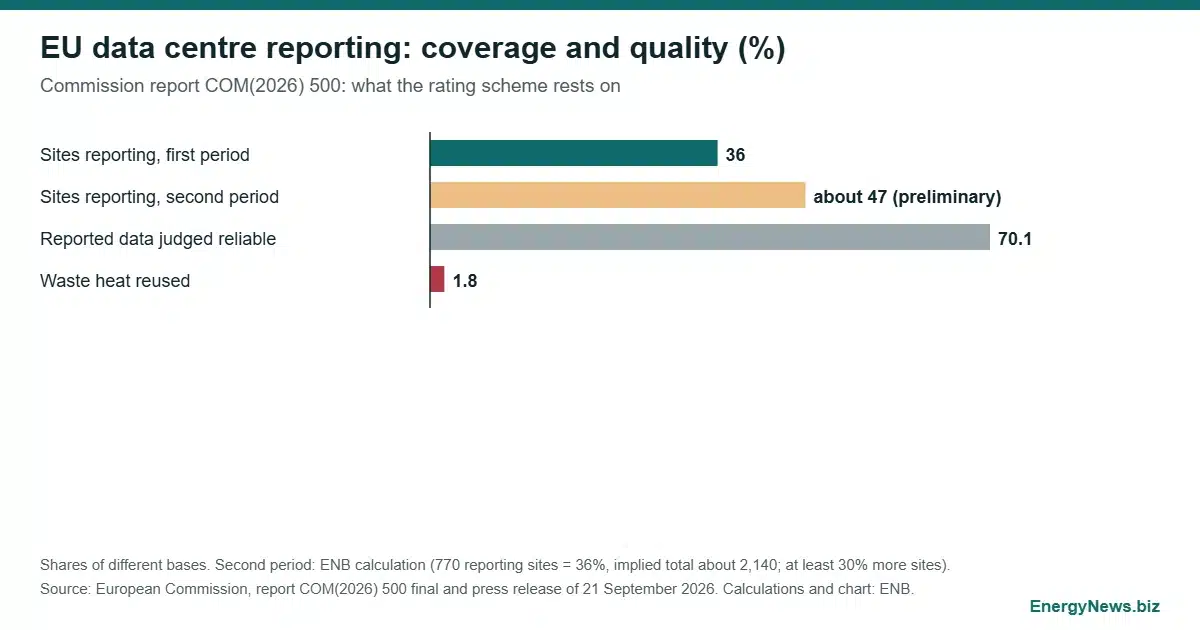
The Commission’s new data centre rating scheme will grade facilities on data that, in the first reporting period, covered about 36% of the data centres it estimates fall under EU reporting, and only 70.1% of the submitted data was judged reliable. The delegated regulation, issued on 21 September 2026, creates a label and no efficiency floor. Anyone reading it as a performance mandate is reading the wrong instrument, and the gap between the label and the data behind it is the real risk for operators, lenders and grid planners.
What the data centre rating scheme requires
The act supplements Directive (EU) 2023/1791. By 15 August 2027, and every year after, the European database must generate an electronic label for each reporting facility, and operators must hand it to anyone who requests it. The label rests on classes for Power Usage Effectiveness (PUE) and Water Usage Effectiveness (WUE) set out in Annex I. The scheme covers sites with at least 500 kW of installed IT power demand, and a first review is due by 31 December 2028. The act itself sets no minimum performance standard.
Standards are a separate track. Article 12(5) of the Directive asks the Commission to advance proposals that may include minimum performance standards, and the Commission has opened a call for evidence and public consultation on them. The Commission’s press release gives 14 December 2026 as the closing date. The rating act is also in a two-month scrutiny period before it can take effect.
| Date | Step |
|---|---|
| 21 September 2026 | Delegated regulation and Commission report published |
| Two months of scrutiny | Parliament review before entry into force |
| 14 December 2026 | Consultation on minimum performance standards closes |
| 15 August 2027 | First annual labels generated |
| 31 December 2028 | First review of the scheme |
Data centre reporting coverage under the EED
The Commission’s report to Parliament and Council says 770 data centres reported in the first period, around 36% of the estimated total. Dividing 770 by 0.36 implies roughly 2,140 facilities in scope. For the second period the report says the Commission has already received preliminary data from at least 30% more sites. That is about 1,000 facilities, or roughly 47% of the implied total, so more than half of the in-scope stock is still unreported at best. Where data are missing, the label cannot rank a site against its peers.
Is 68 TWh really 2.5% of EU electricity?
The report puts data centre consumption at 68 TWh in 2024, rising to 114 TWh by 2030, or 3.2% of EU electricity demand. It does not state the current share, so ENB tested it against Eurostat. For 2023, Eurostat shows gross electricity production of 2,749 TWh and sector final consumption summing to about 2,325 TWh. Against production, 68 TWh is 2.5%. Against final consumption it is 2.9%. The denominator moves the share by 0.4 points, and the years differ (2024 against 2023), so quote it as a range.
The 2030 figure implies more. Dividing 114 TWh by 3.2% gives about 3,560 TWh of demand, around 30% above 2023 production. The Commission’s share depends on an electrification path, not only on data centre growth. For the grid side of that growth, see ENB’s analysis of how the AI grid mismatch is getting worse each year.
A national cross-check is consistent. Statistics Netherlands reports 5.1 TWh for Dutch data centres in 2024 (provisional), 4.6% of national consumption. That is 7.5% of the EU total from one country, plausible for a hub market, though it cannot confirm how much of the 68 TWh is measured and how much is estimated.
PUE, heat reuse and what a floor could save
The report gives an average reported PUE of 1.36 for 2024, with national values from 1.15 to 1.66. Illustrative arithmetic, with its inputs:
- 68 TWh divided by 1.36 gives about 50 TWh of IT load and 18 TWh of overhead.
- At the best national value of 1.15, the same IT load needs 57.5 TWh, a saving of 10.5 TWh, or 15% of the 2024 total.
- This is an upper bound: it treats 1.36 as a load-weighted figure for all 68 TWh and ignores climate and age of plant.
Heat reuse shows a larger gap. The report says about 1.8% of heat generated is reused, roughly 1.2 TWh if nearly all of 68 TWh ends as heat. The Commission says reusing around half of all waste heat would equal the heating demand of 4 million households. Half of 68 TWh is 34 TWh, or 8.5 MWh per household, and about 28 times current reuse. The calculation does not price the heat pumps and networks needed to lift low-grade heat to usable temperatures, so no payback can be stated from these sources.
The next decisions are the end of scrutiny and the 14 December consultation. The open question is whether the minimum standards proposal will set binding limits on PUE, WUE or heat reuse, and on what share of reporting sites the first 2027 labels will actually rest.
Add EnergyNews.biz as a preferred source on Google


