


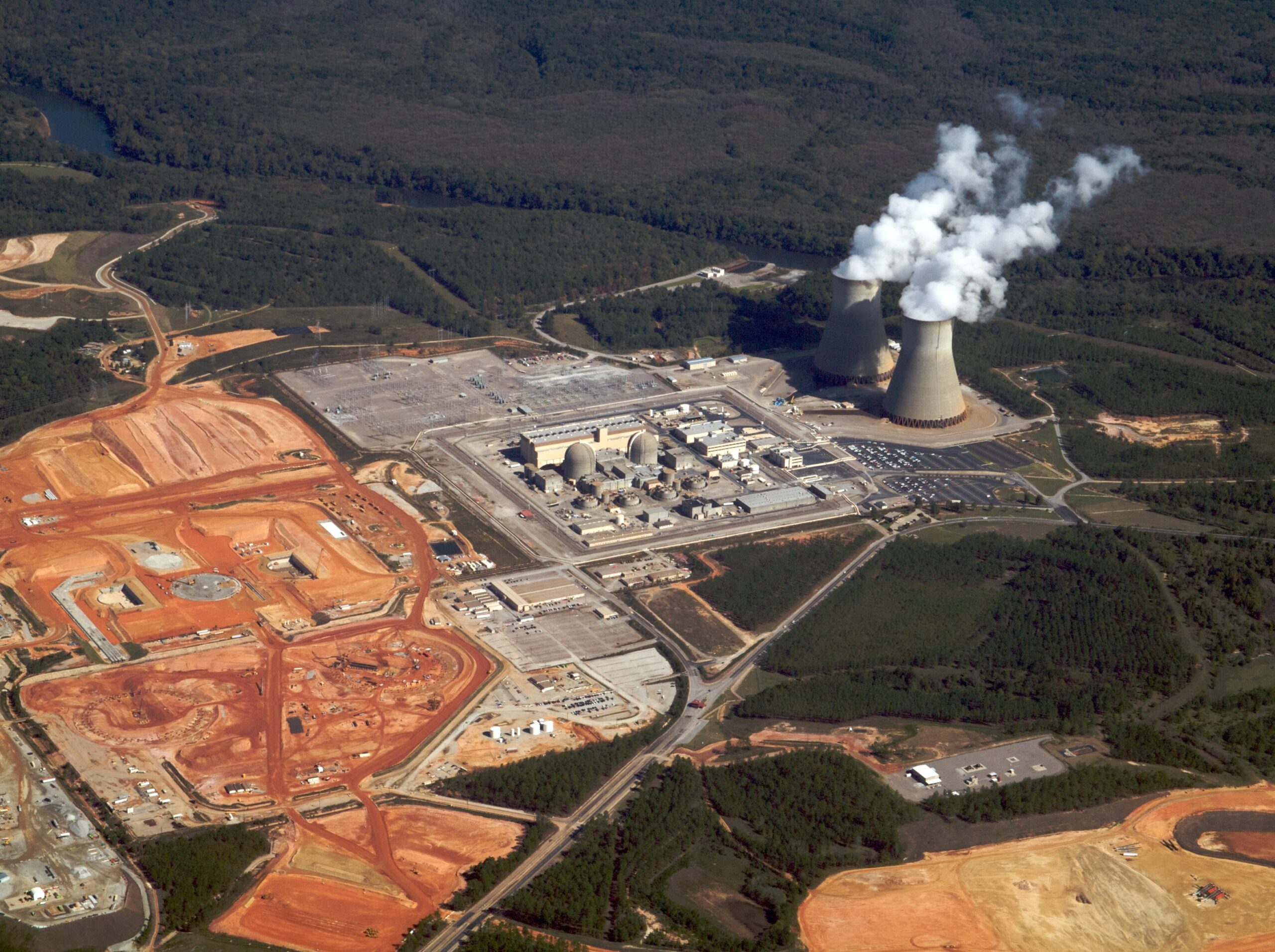


The US and Korea nuclear framework signed on 30 September 2026 carries a headline of $120 billion for eight reactors. The figure that tests it is the $100 billion of overnight construction cost, which equals about $10,460 per kW on the net ratings of operating units, before financing, escalation or the $20 billion contingency. The only AP1000 pair built in the United States cost more than $30 billion for roughly 2.2 GW. The documents are non-binding, no site is named, and a Korean annual funding cap decides how fast any of this money can move.
Deal terms in the Commerce fact sheet
The Department of Commerce fact sheet names the participants as the US Departments of Commerce and Energy, the Korean government, Westinghouse, KEPCO and KHNP. The partners’ own statements add detail on the equity side. Westinghouse’s owners describe the terms as non-binding and subject to final negotiation.
| Term | Stated position | Status |
|---|---|---|
| Units | Six AP1000 and two APR1400 | Sites, schedules and commercial terms not set |
| Total value | $120 billion | Non-binding framework |
| Construction (overnight) cost | $100 billion | Excludes financing |
| Contingency reserve | $20 billion | Counted inside the $120 billion |
| Advance payment | $10 billion by end of 2026, for long-lead items | Subject to domestic legal requirements |
| Westinghouse equity | Significant minority stake for Korean companies; the owners’ release says 5 to 10 percent | Details to be finalised |
| APR1400 value to Westinghouse | About $2 billion per unit, via licensing, engineering, procurement and fuel supply | As stated by a Westinghouse owner |
The same fact sheet ties the programme to the May 2025 executive order target of 10 new large reactors under construction by 2030. Eight units would cover most of that target, but only if construction starts, and a unit with no site and no licence application cannot yet be counted as a start.
Who pays and how fast
The framework sits under the Strategic Investment memorandum of understanding. The November 2025 joint fact sheet states that Korea committed $200 billion of additional investment under that memorandum, and that Korea is not required to fund more than $20 billion in any calendar year. Nuclear is therefore 60 percent of the envelope. The same Commerce document lists a $22.3 billion, 6,472 MW gas plant in Texas under the memorandum. Together the two projects take $142.3 billion, or 71 percent, leaving $57.7 billion for a third project, Alaska LNG, which the fact sheet makes conditional on commercial viability.
The cap converts that into time. $200 billion at $20 billion a year is a minimum of ten years. The nuclear programme alone equals six years of the full annual allowance, and nuclear plus the Texas plant equals 7.1 years. The $10 billion advance due by the end of this year is half of one year’s cap. Construction cash for reactors that start in the early 2030s would then compete with the gas plant, whose first stage the fact sheet places in 2029.
This is a ceiling on Korean cash flow, not a prediction of delay. The documents reviewed do not say whether the money flows as equity, loans, guarantees or purchases of equipment, and that gap is the first thing a supplier or lender should ask about.
Cost per kW against Vogtle
The fact sheet gives no capacity, so the per kW cost needs inputs from operating units. The test below uses the net ratings of Vogtle 3 (AP1000, 1,117 MWe) and Shin Hanul 1 (APR1400, 1,429 MWe) as proxies. Export APR1400 ratings could differ, which is a stated limit of the calculation.
| Item | Calculation | Result |
|---|---|---|
| Net capacity, six AP1000 | 6 x 1,117 MWe | 6,702 MWe |
| Net capacity, two APR1400 | 2 x 1,429 MWe | 2,858 MWe |
| Fleet net capacity | 6,702 + 2,858 | 9,560 MWe |
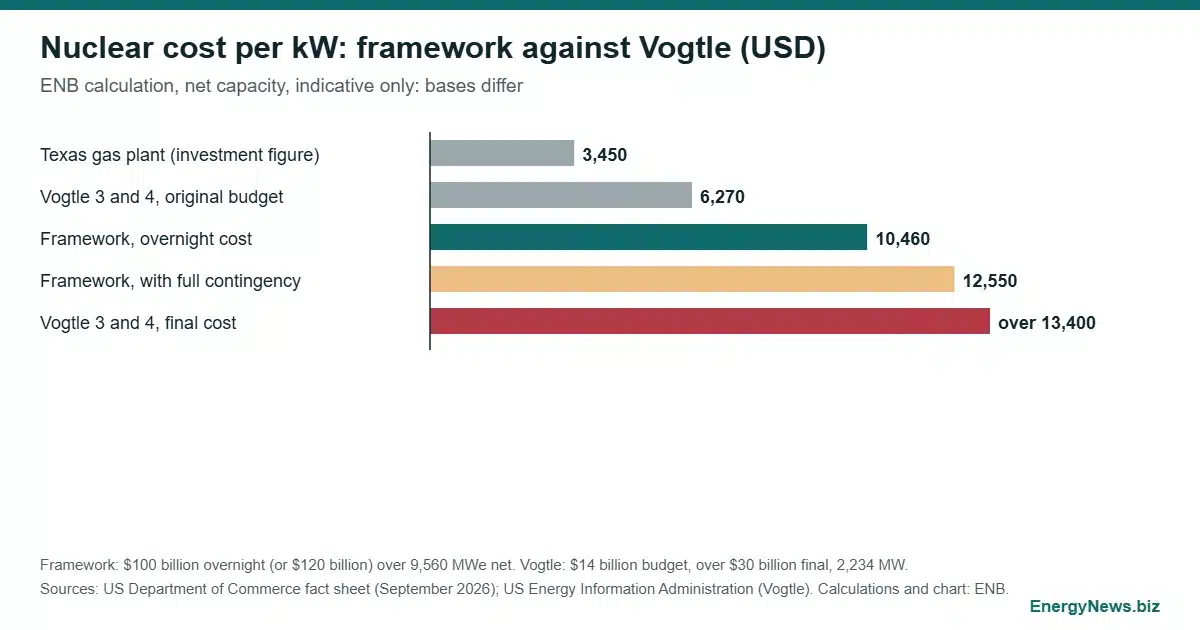
| Overnight cost per kW | $100 billion / 9.56 million kW | $10,460 |
| With full contingency | $120 billion / 9.56 million kW | $12,550 |
| Vogtle 3 and 4, original budget | $14 billion / 2.234 million kW | $6,270 |
| Vogtle 3 and 4, final | over $30 billion / 2.234 million kW | over $13,400 |
| Texas gas plant | $22.3 billion / 6.472 million kW | $3,450 |
The result cuts both ways. The framework’s overnight cost is 22 percent below Vogtle’s final cost per kW and 67 percent above Vogtle’s original budget. With the contingency fully spent it is 6.5 percent below Vogtle. The EIA states that Vogtle cost more than $30 billion against an original estimate of $14 billion, and that Unit 3 was originally due in 2016, against commercial operation in July 2023. The comparison is not like for like: the EIA page does not break out how Vogtle’s total treats financing and escalation, while the framework figure is overnight. Until both are put on one basis, the 22 percent gap is indicative only. The US financing side is covered in ENB’s analysis of DOE’s $17.5 billion nuclear loan plan.
On first principles the gas comparison is blunt. The Texas plant works out at about $3,450 per kW of nameplate capacity, roughly a third of the nuclear overnight figure, though a reactor’s capacity factor and fuel profile differ and the gas plant’s figure is described only as an investment amount.
What changed from the 2025 Westinghouse deal
In October 2025 the US government and Westinghouse’s owners announced a partnership under which at least $80 billion of new reactors would be built with Westinghouse technology, with profit sharing once thresholds are met. The announcing document warned of reliance on unconventional government funding mechanisms. That deal was framed around US government funding.
The September 2026 framework changes the payer. The owners’ release says the reactors are financed by Korea, on federal sites designated by the US government, in three two-unit plants for the AP1000 fleet. It also changes the technology mix, adding two Korean-designed units that, in the release’s words, incorporate Westinghouse technology. The documents reviewed do not say whether the $120 billion sits inside, beside or in place of the earlier $80 billion. A buyer of components cannot size the order book until that is settled. For the same vendor’s pitch abroad, see ENB’s analysis of Westinghouse’s AP300 challenging the state-led nuclear model in the UK.
Westinghouse equity and the APR1400 payments
Westinghouse’s owners state that Korea would take a cornerstone equity investment of 5 to 10 percent, and that Westinghouse would receive an upfront payment, guaranteed scope on the reactors and a fuel fabrication contract. One owner states that it does not expect any equity participation under the framework to affect its ownership interest, and that any equity investment is subject to definitive agreements, due diligence, corporate approvals and regulatory approvals.
Both statements are the owners’ claims, not findings. A 5 to 10 percent stake that leaves existing holdings unchanged implies new shares or a secondary sale that the documents do not describe. At about $2 billion per APR1400, the two Korean-design units would carry $4 billion of value to Westinghouse, 4 percent of the overnight cost if it sits inside that figure, which the documents do not confirm.
Timeline of commitments
- 28 October 2025: US government and Westinghouse’s owners announce at least $80 billion of Westinghouse reactors.
- 14 November 2025: joint fact sheet records $200 billion of Korean investment with a $20 billion annual cap.
- 30 September 2026: framework signed for six AP1000 and two APR1400 units.
- End of 2026: $10 billion advance payment for long-lead items.
- 2029 to 2032: first stage and full operation of the Texas gas plant under the same memorandum.
- 2030: the executive order target of 10 large reactors under construction.
The next testable event is the $10 billion advance due by the end of 2026, which the fact sheet makes subject to domestic legal requirements. Until site announcements, definitive agreements on the Westinghouse stake and the first commercial terms appear, the $10,460 per kW overnight figure remains an arithmetic result, not a contract price.
Add EnergyNews.biz as a preferred source on Google


