




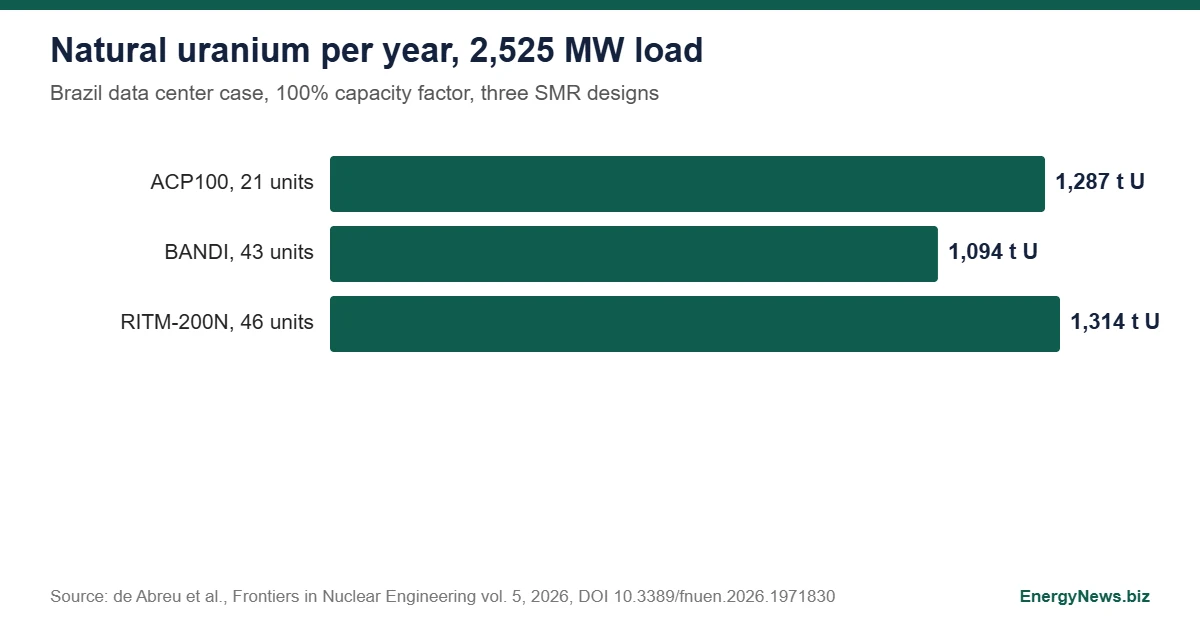
Supplying 2,525 MW of Brazilian data center requests with small reactors takes 21 to 46 units and 1,094 to 1,314 tonnes of natural uranium a year, depending on the design. The SMR data centers study behind those numbers appeared on 22 October 2026 in Frontiers in Nuclear Engineering (volume 5, article 1971830, DOI 10.3389/fnuen.2026.1971830), from a team at COPPE/UFRJ in Rio de Janeiro.
The paper is a fuel inventory screen, not a siting, cost or licensing case. It answers one narrow question, how much reactor and how much uranium, and the answer holds up on the arithmetic. What the SMR data centers case does not show is that the reactors can be built, licensed or paid for.
The demand behind the SMR data centers case
The demand input is a database of Brazilian Ministry of Mines and Energy ordinances from 2020 to 2025 that list data center grid connection requests. Eighteen of 21 ordinances carry power data, and together they total 2,525 MW: São Paulo 62% (1,574 MW), Ceará 31% (776 MW), Rio Grande do Sul 4% (95 MW) and Bahia 3% (80 MW). Three ordinances (2765, 2935 and 2969) had no power figure and are excluded. The authors treat the total as an illustrative input, not a forecast.
For scale, the paper cites data centers at 1.7% of Brazilian electricity demand in 2024 and an additional 13.2 GW by 2035 across six states. The 2,525 MW is about 19% of that projection.
Three reactors, three fuel cycles
Three pressurized water designs are compared. The ACP100 needs 21 units for 2,625 MW at 2.99% enrichment, 13.9 MWd/kgHM burnup and a 2 year cycle. BANDI needs 43 units for 2,580 MW at 4.95%, 29.4 MWd/kgHM and a 5 year cycle. The RITM-200N needs 46 units for 2,530 MW at 19.75%, 96.4 MWd/kgHM and a 4 year cycle. Initial heavy metal runs from 132.48 t for RITM-200N through 345.24 t for ACP100 to 511.27 t for BANDI.
The ranking flips between the two measures. RITM-200N loads the least heavy metal and has the highest natural uranium demand per MWh, 59.274 g against 48.405 g for BANDI, a 22% gap. The enrichment mass balance explains the flip: uranium enriched to 19.75% needs far more natural feed per kilogram than 4.95% uranium, and that outweighs the burnup gain. The 19.75% value also sits just under the 20% limit for low enriched uranium.
Checking the SMR data centers uranium arithmetic
The annual figures reproduce from the paper’s own table. Installed capacity times 8,760 hours times grams of natural uranium per MWh gives 1,286.7 t for ACP100 (2,625 MW), 1,094.0 t for BANDI (2,580 MW) and 1,313.7 t for RITM-200N (2,530 MW), matching the published values.
Two consequences follow. The spread between the best and worst design is 20%, narrow beside the 3.9 times spread in initial heavy metal. And the totals use installed capacity, which exceeds the 2,525 MW load by 4.0% for ACP100, 2.2% for BANDI and 0.2% for RITM-200N, so part of the ACP100 figure reflects unit size, not reactor physics. At 95% and 90% capacity factors the uranium demand falls by 5% and 10%, and the order of the designs does not change.
What would have to be true
The authors list what the study leaves out: no depletion analysis, economics, licensing or fuel fabrication assessment. Unit counts are not site counts, since vendors offer one or two unit plants. Larger designs, the Rolls-Royce SMR and Westinghouse AP300, are excluded for lack of open core data. The RITM-200N’s silumin based fuel may add fabrication and supply chain complexity. The heavy metal values come from OpenMC geometry and density calculations, not from a depletion run.
Earlier reporting on the topic: Alibaba exploring small modular reactors for AI data centers and a US consortium proposing a nuclear powered AI campus.
BANDI is still in basic design, with licensing expected between 2028 and 2032. That is the first dated check: until it passes, the SMR data centers case in this paper is an inventory of what would be needed, not a schedule.
Add EnergyNews.biz as a preferred source on Google


