




An optimisation study published in the Journal of Energy Storage finds that EV charging hubs combining photovoltaics and stationary batteries raise EV hosting capacity by 42.5 percent and cut feeder peak load by 23.5 percent compared with a charging layout using electric vehicles alone. The results come from simulations on the IEEE 33 bus and IEEE 69 bus test networks, not from a live grid, and that is the first caveat to keep in mind.
The problem EV charging hubs create for feeders
The paper, by Ahmad Abuelrub, starts from a familiar distribution problem. Charging demand follows mobility patterns, so sessions bunch together and create concentrated peaks even when the daily energy is moderate. Those peaks cause congestion, thermal overloading and voltage deterioration on radial feeders. The author argues that charging stations should operate as actively managed energy hubs rather than passive loads, with stationary storage as a planning variable alongside charger count and location.
A three level design for EV charging hubs
The framework separates three decision makers. The upper level is the distribution planner, who chooses hub locations, charger composition and the power and energy ratings of the stationary battery. The middle level is the hub operator, who dispatches the battery, solar generation and grid exchange. The lower level is the vehicle user, whose charging and discharging respond to prices, departure times and required state of charge.
The separation stops uncertain vehicle batteries from being treated as a fully controllable resource. Uncertainty in mobility and solar output enters both the sizing and the operation, with chance constraints on departure state of charge and a conditional value at risk term for unmet charging demand. A Pareto approach is used instead of weighted sums, so trade offs among hosting capacity, feeder losses and investment cost are visible without preset weights.
What the numbers show
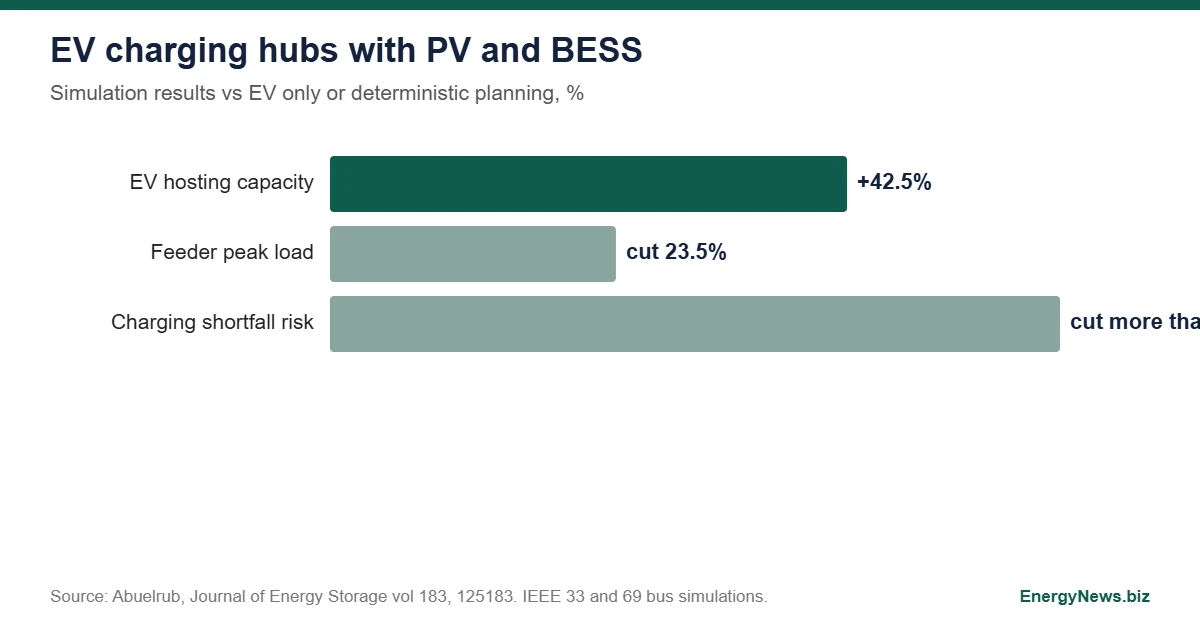
Relative to the EV only configuration, the integrated EV, photovoltaic and battery configuration raises hosting capacity by 42.5 percent, cuts feeder peak load by 23.5 percent and lifts the minimum bus voltage from 0.951 to 0.969 per unit. Compared with deterministic planning, the risk aware approach reduces the probability of a charging shortfall by more than 60 percent.
The comparison base matters. The 42.5 percent and 23.5 percent figures describe the whole integrated hub against an EV only layout, so they do not isolate what the battery adds beyond the solar panels. The highlights credit stationary storage with the peak reduction, and the paper includes comparative cases separating the solar and storage contributions, but the abstract does not split the numbers. On the vehicle side, the same uncertainty about real world behaviour shows up in work such as the LLM agent for EV battery faults tested on ten vehicles.
Limits for planners using EV charging hubs
Two test feeders and simulated scenarios are a proof of method rather than evidence of what a utility will see. The full paper is in Journal of Energy Storage, volume 183, article 125183. For planners the practical message is about process: treat storage sizing, charger mix and user response as one problem, and test the result against correlated charging and solar scenarios before committing to hub locations.
Add EnergyNews.biz as a preferred source on Google


