




Negative power prices have stopped being an anomaly in Spain. By 4 September the day-ahead market had already spent 681 hours at or below zero this year, more than in all of 2025, according to market data reported in early autumn. Renewables now supply about 60 percent of Spanish electricity, against roughly half across the EU, and the system is paying a price for its own success.
The easy reading is that solar has overbuilt. The more useful reading is that Spain has too much power at midday and too few places to put it. Generators that cannot store their output must curtail it or sell at a loss when demand is low, and that erodes the revenue that pays for the next project.
Storage is the missing half of the solar boom
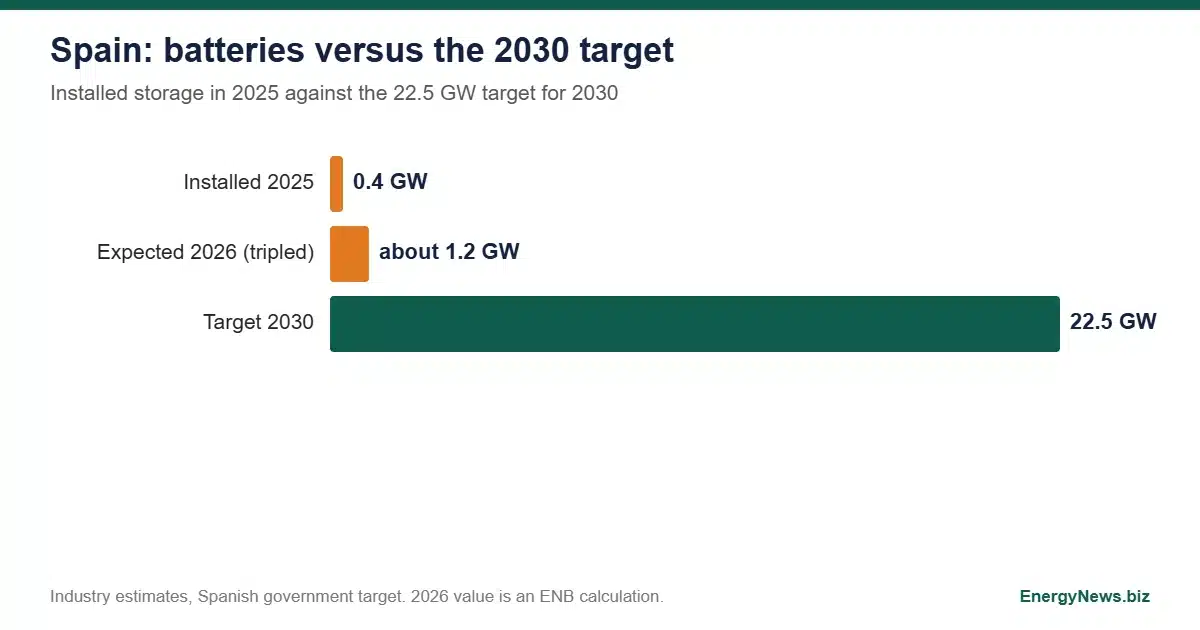
Spain had roughly 400 MW of batteries installed in 2025, according to industry analysts. The national target for 2030 is 22.5 GW, so the fleet stood at under 2 percent of where it is supposed to be. Analysts expect installed capacity to more than triple in 2026, but even a tripling would leave it near 1.2 GW, about 5 percent of the target, by simple calculation.
That gap explains why negative power prices keep stacking up. A midday surplus that cannot be shifted into the evening peak has nowhere to go, and the evening is still served by gas and nuclear at a higher price.
Approvals are not batteries
Madrid has not been idle. Close to 2 billion euros of support programmes have been announced over recent years, and the secretary of state for energy, Joan Groizard, has said there are thousands of megawatts of storage in different phases of approval.
The difficulty is that a permit does not earn money. Spain has no capacity market in place, and slow guidance from the EU on how such schemes should work has delayed one, leaving batteries to compete on price spreads alone against plants that already exist, even as negative power prices widen those spreads.
Investors read that as risk. Several Spanish solar projects and companies have reportedly been put up for sale in recent months, which is what a market looks like when returns are squeezed before the storage that would restore them has arrived.
The grid is the second constraint
Grid limits also feed negative power prices, because a surplus that cannot travel is a surplus that must be sold cheaply or wasted. The government plans 13.6 billion euros of grid investment through the end of the decade, aiming to raise high voltage capacity fourteen times over.
That is ambitious, yet network investment is capped at 0.3 percent of GDP, a ceiling that analysts say limits how fast the plan can move. Stronger links to the rest of Europe would also help, since a midday surplus in Iberia is worth more if it can be exported than if it is curtailed. The wider picture of capital chasing storage is covered in a review of this year’s renewables and storage deal flow.
What would change the picture
Three things would do more than any further solar auction. A capacity mechanism that pays batteries for being available, not only for arbitrage. A connection process that clears storage faster than it clears new generation. And grid spending that is allowed to follow demand rather than a fixed share of output. Hourly price data from the ENTSO-E Transparency Platform lets anyone check whether the count of zero and negative hours starts to bend.
Until then, negative power prices in Spain are best read as an invoice for delay. The 681 hours measure how long the country has waited to build the batteries and wires its solar fleet was always going to need.
Add EnergyNews.biz as a preferred source on Google


