





Electricity supplied 23% of global final energy consumption in 2025, up from 17% in 2000, and the COP31 Presidency has set 35% by 2035 as the target. A new industry paper argues that energy efficiency is the lever that decides whether that gap closes, because every unit not consumed needs no generation, no grid capacity, and no place in a connection queue. The argument is plausible, but several of its numbers need a second look.
The scale is not in dispute, and it is why energy efficiency matters now. Moving from 23% to 35% in ten years means going about five times faster than over the last quarter century, which the paper, citing IEA analysis, translates into around 1,400 TWh of added demand every year and grids expanded 40% faster than over the past decade. The IEA puts the payoff at more than USD 500 billion a year in avoided fuel imports by 2035. ENB tested the same target earlier in an assessment of the 35% by 2035 goal.
Energy efficiency against 1,400 TWh of new demand a year
The paper’s central claim is about speed and cost. Efficiency measures can be deployed in under a year, it says, while grid infrastructure projects often take 5 to 15 years, and energy efficiency often costs less than half as much per unit of electricity saved as new generation and grid. Both statements are attributed to IEA material and are general, so they describe a tendency, not a guarantee for any single site.
The case for energy efficiency is weakest on price. The paper itself reports that in the EU electricity costs companies almost three times as much as gas, and households about two and a half times as much, largely because electricity carries heavier taxes and levies, a figure it takes from the European Commission’s 2026 electrification action plan. Its own hospital case assumes a ratio of 1.5 to 2.0.
In an ENB calculation, a heat pump matches a gas boiler running at 90% efficiency on fuel cost when its seasonal coefficient of performance equals the price ratio times 0.9, which is 2.7 at a ratio of 3.0. The hospital system is reported at more than six units of heat output per unit of input, so that case survives the higher ratio.
The open question is whether other sites can reproduce a coefficient of performance that high.
A 2-year payback hospital and a 2.3-year aluminium plant
Energy efficiency here means reusing heat that was already being paid for. In Sønderborg, Denmark, a hospital replaced gas-based heating and cooling with two heat pumps that recover heat from the hospital’s own cooling loop, taking cooling water from 12°C to 8°C and delivering heat of up to 70°C. The paper reports a two-year payback, 28,300 MWh a year less energy purchased, and savings of about EUR 1.6 million a year, before counting the electricity the heat pumps use.
Once fully implemented, surplus heat of 15,800 MWh a year would go into the district heating grid, enough for more than 877 average Danish households. EUR 1.6 million over 28,300 MWh is about EUR 56 per MWh gross (ENB calculation).
At an aluminium plant in Tønder, Denmark, Hydro linked process cooling to space heating. One heat pump captures heat from cooling water, and a second raises part of it to about 90°C to preheat metal before induction heating. The project is expected to cut gas use by 205,600 m3 and CO2 emissions by 407 tons a year, with a payback of 2.3 years. The two figures are consistent: 407 tons over 205,600 m3 is about 2 kg of CO2 per cubic metre, in line with natural gas combustion (ENB check). Both energy efficiency cases are projections stated in the paper, not audited results.
Motors use 10,700 TWh a year, and 44 TWh is on the table in the US
Motor systems are the largest block of energy efficiency potential in industry. They use around 10,700 TWh a year, more than half of world electricity consumption and more than two-thirds of industrial electricity use, according to a 4E Technology Collaboration Programme policy brief the paper cites. About half of all motors could benefit from a variable speed drive, the paper says, often cutting their consumption by 15 to 40% by matching motor output to demand instead of braking it mechanically.
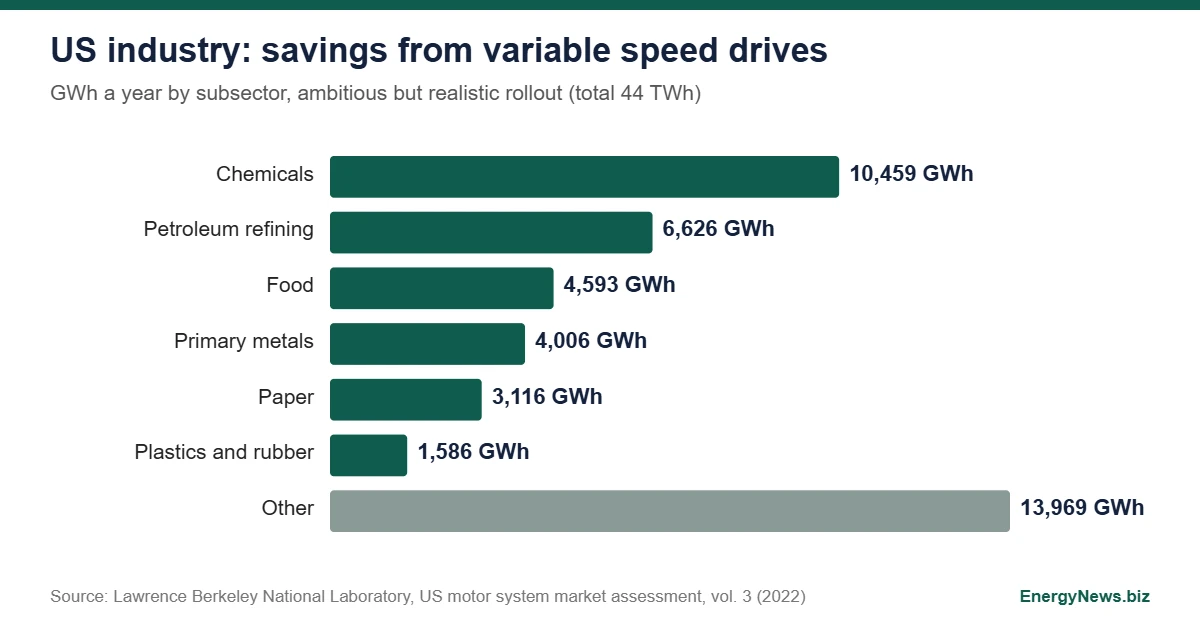
The most concrete number is American. A Lawrence Berkeley National Laboratory assessment of US industrial and commercial motor systems finds that an ambitious but realistic rollout of drives would save 44 TWh a year, USD 3.7 billion in costs and 31 million tons of CO2. That is about USD 84 per MWh saved (ENB calculation). Six subsectors hold over two-thirds of the potential, and chemicals alone almost a quarter, at 10,459 GWh.
The same logic is applied to mobile machinery, which emits an estimated 108 million tons of CO2 a year in the EU, about 3% of its total. A digital displacement pump, a kind of smart hydraulic pump, is reported in a conference paper to cut an excavator’s energy use by up to 30% against a conventional hydraulic system. Splitting the hydraulics into subsystems is claimed to add up to 10% more, based on the publisher’s internal measurements, which cannot be checked independently.
Two points of data center energy efficiency equal 19 TWh
The IEA projects global data center demand roughly doubling from 485 TWh in 2025 to 950 TWh in 2030, about 3% of global demand. At that level, each two percentage points of energy efficiency frees about 19 TWh a year (ENB calculation: 2% of 950 TWh), which the paper equates with roughly 90% of the annual electricity supplied to the city of Los Angeles, using US EIA sales data. A look at the Sharjah grid plan shows the same logic applied to a Gulf utility.
The larger claim concerns architecture. Moving from a conventional 415 V AC design to 800 V DC is said, in one analysis, to lift end-to-end facility efficiency from about 80% to 94% and to cut copper per megawatt by up to 60%. The paper notes that hyperscale operators are promoting the design, and it offers no measured installation. Fourteen points on 950 TWh would be 133 TWh, a ceiling nobody claims, because existing halls stay on AC and the gain applies only to new capacity. How much of the 950 TWh is new build by 2030 is not stated.
Ferries: 1,000 kWh in 23 minutes from an 8 MW berth
Molslinjen’s two electric ferries, Nerthus and Tyrfing, are the paper’s conversion case. Each ferry has 8,000 kW of shore power at the port, and the paper reports that recharging takes about 23 minutes using around 1,000 kWh per trip, with onboard converters operating above 98% efficiency. Those inputs imply an average of about 2.6 MW over the 23 minutes, roughly a third of the 8 MW connection (ENB calculation). The paper does not say whether the gap reflects charging taper, connection time or a grid constraint. The reported saving is about 10,000 tons of CO2 a year for both ferries.
The paper’s case for energy efficiency ends with requests. It asks policymakers to reform taxation and levies so that electricity is not structurally disadvantaged, and operators to plan for flexibility, not just capacity. The hospital’s two-year payback assumes a price ratio of 1.5 to 2.0, while EU companies pay almost 3.0 today. Whether the cases hold at 3.0 is the check that remains open.
Source: Danfoss Impact No. 10, Enabling electrification (2026). The views in the paper are those of its publisher. The IEA, European Commission, 4E, and Lawrence Berkeley National Laboratory figures quoted above are taken from the paper’s reference list.
Add EnergyNews.biz as a preferred source on Google


