




Repsol Tarragona will host the company’s largest electrolyser yet: a 150 MW plant, approved by the Repsol board on 12 November 2026, that is meant to produce more than 22,000 tonnes of renewable hydrogen a year for about €400 million. Set that output against the plant’s size and an unexpected requirement appears. The electrolyser would have to run close to nine hours in every ten, all year, on renewable power that Repsol has not yet described.
The project is a joint development with Enagas Renovable, which holds 25%. Enagas Renovable is itself owned 80% by the investment manager Hy24 and 20% by the gas grid operator Enagás. The two partners already work together on Repsol’s 100 MW electrolyser in Cartagena.
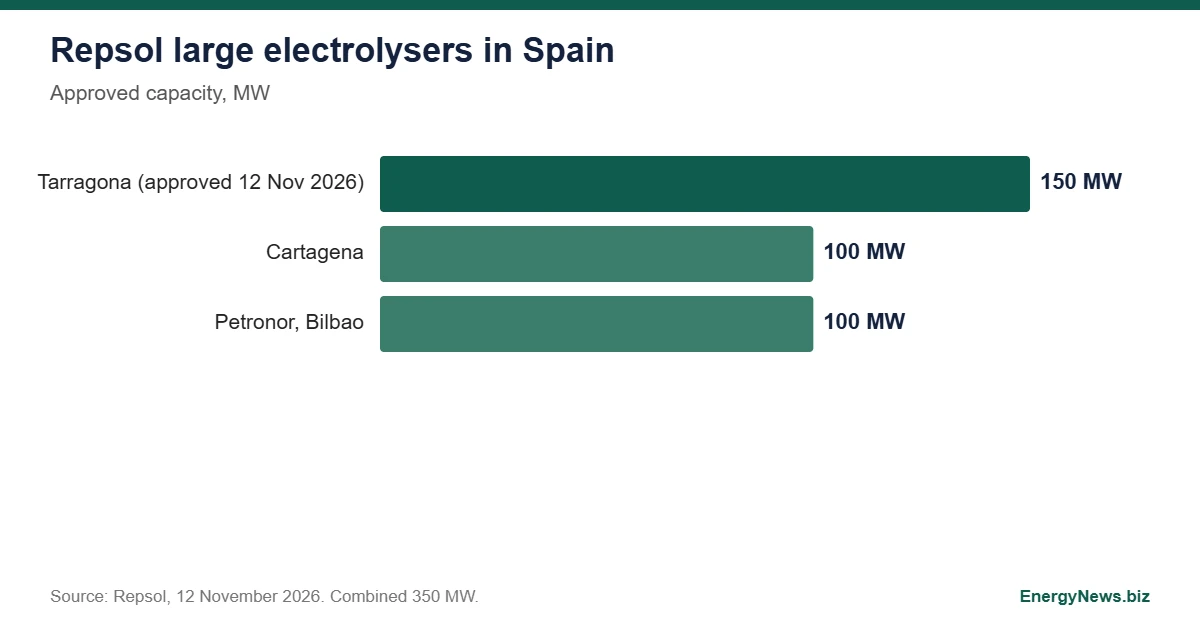
Repsol Tarragona joins Cartagena and Petronor for 350 MW
With the Repsol Tarragona unit, the company’s three large-scale electrolysers in Spain reach a combined 350 MW. Cartagena, approved in 2025, has a capacity of 100 MW and an investment of more than €300 million. The Petronor refinery near Bilbao will add another 100 MW for €292 million, with commissioning planned for 2029. A 2.5 MW electrolyser has been operating at Petronor since 2023, a 10 MW unit at the Port of Bilbao is nearing completion, and a 4 MW unit is being completed at Sines in Portugal.
The hydrogen from Repsol Tarragona has a defined buyer inside the group. It will go mainly to the Ecoplanta, the €800 million plant Repsol is building at El Morell to turn municipal waste into renewable methanol, due to operate in 2029, and to other refinery units in Tarragona. Repsol says the output could later be offered to the gas network and to the planned Spanish Hydrogen Backbone, but that is not committed.
Repsol Tarragona: 22,000 tonnes from 150 MW means about 87% load
An ENB calculation shows how demanding the target is. At about 52 kWh of electricity per kilogram, 22,000 tonnes of hydrogen needs roughly 1,144 GWh a year. Spread over 150 MW, that is about 7,600 full load hours, or a load factor near 87%. A solar-only supply would reach a fraction of that, so the plant will depend on a mix of renewable contracts and grid supply that meets EU rules for renewable hydrogen. Repsol’s release does not describe the power supply, the electrolyser technology supplier or the start-up date.
The cost per unit of capacity is lower than at the earlier projects. Another ENB calculation puts Repsol Tarragona at about €2,670 per kW, against about €2,920 per kW at Petronor and more than €3,000 per kW at Cartagena, based on the investments the company published. Public support reduces the burden further: Tarragona was selected for up to €104 million under Spain’s Hydrogen Valleys programme, funded through NextGenerationEU, or about 26% of the investment.
Repsol Tarragona CO2 savings against a 360,000 tonne baseline
Repsol says the plant will avoid up to 250,000 tonnes of CO2 a year, use only reclaimed industrial water, and create about 1,000 direct, indirect and induced jobs over the project’s phases. The CO2 figure equals about 11.4 tonnes per tonne of hydrogen, in the range typical of replacing hydrogen made from natural gas.
The scale of the task is visible in Repsol’s own baseline. Its industrial complexes can produce around 360,000 tonnes of hydrogen a year, about 60% of Spain’s production and 4% of European consumption. The Repsol Tarragona output equals about 6% of that, and the three large electrolysers together still cover only a modest share. Spain’s wider needs are far larger, as the estimate that the country would need 75 GW of electrolysers for aviation and shipping shows. Projects of a similar size are starting up elsewhere in Europe, such as Bad Lauchstädt in Germany.
“This electrolyser and the Ecoplanta represent an integrated industrial platform that places Tarragona at the heart of our transformation,” said Maribel Rodríguez, Repsol’s director of renewable hydrogen, in the company announcement. Luis Iglesias of Enagas Renovable said the project brings renewable hydrogen to locations where industrial demand already exists.
The open question for Repsol Tarragona is the one the release leaves blank: which renewable power contracts will keep a 150 MW electrolyser running at close to 87% load once the Ecoplanta starts taking hydrogen in 2029.
Add EnergyNews.biz as a preferred source on Google


