




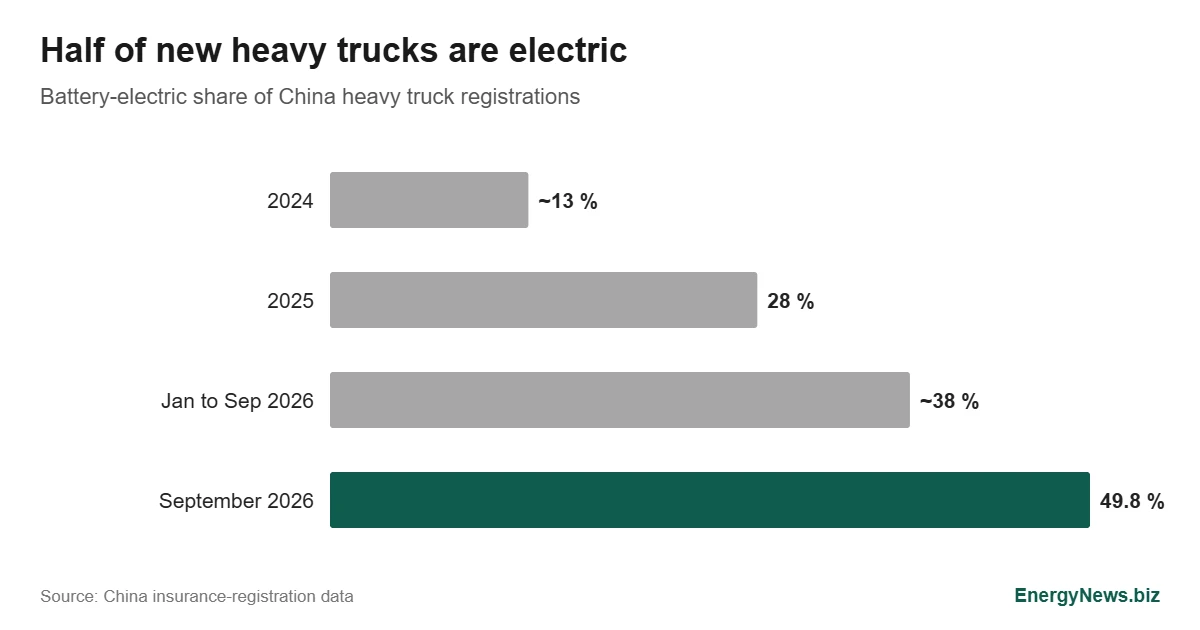
Electric heavy trucks made up 49.8% of China’s heavy truck registrations in September 2026, according to insurance-registration data. Of 65,800 heavy trucks registered that month, 32,800 were battery-electric. Fuel cell trucks, which received years of policy support, registered 36 units.
The speed of the shift is the story. The battery-electric share was about 13% in 2024 and 28% in 2025. It averaged about 38% from January to September 2026. New energy models have now held a share above 40% for five consecutive months, and in September they took 64.48% of tractor units, the long-haul segment that diesel was expected to keep the longest.
Electric heavy trucks versus fuel cells
The comparison with hydrogen is one-sided. From January to September 2026, China registered about 226,400 new energy trucks, up 64% on a year earlier. Fuel cell trucks accounted for 689 of them. In September alone, battery-electric registrations outnumbered fuel cell registrations by more than 900 to 1.
Battery swapping plays a smaller role than many expected. Swap-capable trucks were 20.09% of new energy heavy trucks in September and 22.92% for the year to date, down from 30.39% in 2025. Fast charging with larger packs is winning more fleet orders than standardised swap stations.
The adoption path started in niches. Early electric heavy trucks worked on short, fixed routes at mines, ports and steel plants, where vehicles return to the same charger every shift. The 64.48% share in tractor units in September shows the shift has now reached the longer routes that carry most of China’s freight.
The economics of electric heavy trucks
Operators buy these trucks because they cost less to run. The International Council on Clean Transportation has published total cost of ownership cases in which battery-electric heavy trucks come out 16% cheaper for a Guangdong fleet, 3% cheaper in a more conservative case and up to 19% cheaper in others. Low industrial power prices, high diesel taxes and cheap lithium iron phosphate packs all push in the same direction.
The fleet effect is starting to show in oil demand. Kpler estimates that new energy trucks will make up about 8% of China’s truck fleet by the end of 2026 and displace roughly 230,000 barrels a day of diesel. That number will rise every month that half of new sales are electric.
The diesel number is easier to grasp in litres. At about 159 litres per barrel, 230,000 barrels a day equals roughly 36.6 million litres of diesel that China’s trucks no longer burn every day. For refiners in Asia, that is a demand loss that will not return, because each electric truck sold replaces a diesel truck for ten years or more.
What the 2030 targets imply
China’s targets for 2030 call for 40% of new truck sales and 20% of the fleet to be new energy, supported by 30,000 km of charging corridors. On current registration data, the sales target for heavy trucks has already been passed four years early. The fleet target depends on how fast older diesel trucks are scrapped, which is slower, but the direction is no longer in question.
Chinese truck makers are also starting to offer these models abroad, which will test the same economics in other markets, and fleet operators in Europe will watch whether those export prices undercut local models.
The lesson for Europe and North America is about cost, not policy. China’s operators chose battery-electric trucks because the numbers worked, and hydrogen trucks did not reach scale despite subsidies. Western fleets are now building the infrastructure for the same choice, as with Terawatt Infrastructure’s 22 MW of US fleet charging and battery plants such as BMW’s new site in Woodruff. Detailed cost studies are available from the ICCT.
Add EnergyNews.biz as a preferred source on Google


