





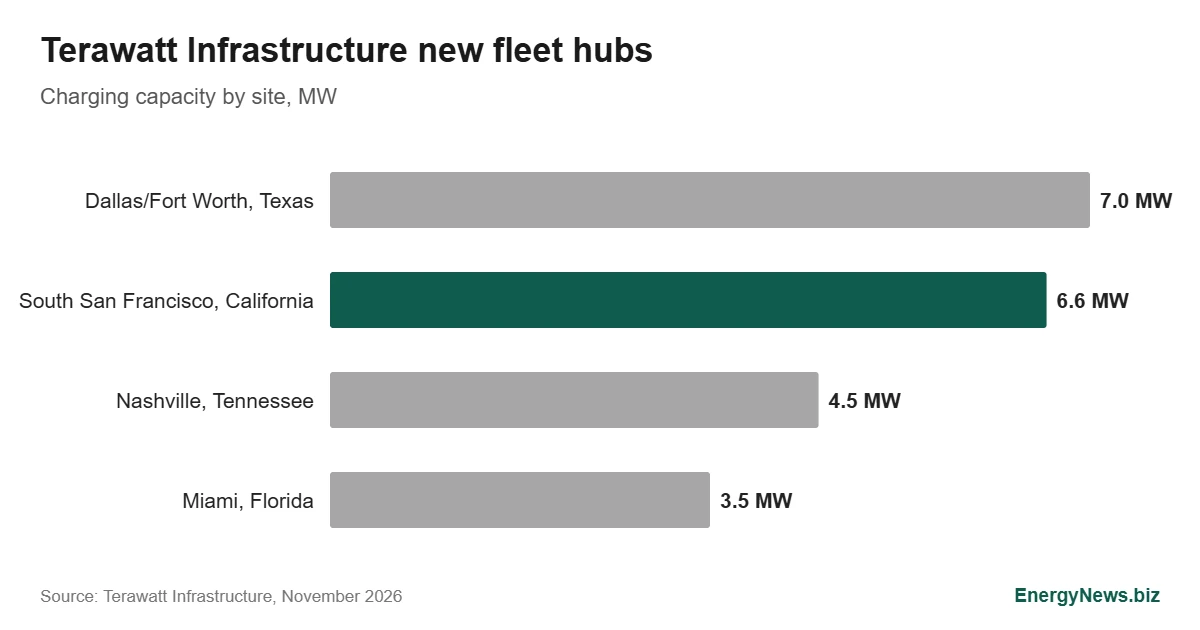
Terawatt Infrastructure has added four fleet charging hubs in the United States with a combined capacity of about 22 MW, the company announced on 12 November. Two sites, in South San Francisco and Nashville, are already operating, while hubs near Dallas/Fort Worth and in Miami are scheduled to open by the end of 2026. Together, the depots can charge more than 3,000 commercial electric vehicles a day, according to the company.
The largest new site, near Dallas/Fort Worth International Airport in Texas, is rated at 7 MW and will serve a commercial fleet operator. The South San Francisco hub near SFO has 6.6 MW for a single fleet, the Nashville depot near the city’s airport has 4.5 MW for local fleet operations, and a 3.5 MW site is being built in Miami’s Design District and Wynwood area.
How Terawatt Infrastructure cut grid costs
The company said it finished the South San Francisco project ahead of schedule and reduced development costs by a six figure dollar sum. It credited alternative site energisation methods and close coordination with the local utility, Pacific Gas and Electric, for the savings.
Grid connection is the main constraint for depot charging. A multi megawatt hub needs the same kind of service upgrade as a small factory, and utilities in high growth regions have long queues. Developers that can bring sites online in stages, or use interim power while upgrades are completed, gain months over competitors that wait for a full connection.
Who uses the hubs
Terawatt Infrastructure develops, builds and runs complete charging depots, covering land, permits, site design, grid connections and hardware, and manages operations through its own charging software. Customers include operators of light duty and autonomous vehicles, such as Waymo and Flexdrive, the fleet subsidiary of Lyft, as well as freight companies. The company opened its first truck charging hub in Southern California in April 2025.
The company says it has nearly 30 hubs in construction or development across 16 US markets and has delivered more than 30 million kWh of electricity, enabling over 93 million miles of electric driving. Chief executive and co-founder Neha Palmer leads the business, and more sites are planned for 2027.
Depot charging also changes how fleets buy power. Because vehicles return to base on fixed schedules, operators can spread charging across the night and avoid peaks that drive up demand charges. Software that staggers sessions and limits total site load lets a hub serve more vehicles from the same grid connection, which is why charging management is now as important as the hardware.
Autonomous ride hailing adds a further twist. Robotaxis can be dispatched to charge whenever the fleet algorithm decides, which makes their demand more flexible than that of human driven fleets tied to shift patterns.
Financing and the Terawatt Infrastructure model
In June 2026, the company secured a debt facility of up to $300 million from a group of international banks. Debt finance at that scale signals that lenders now treat fleet charging hubs as infrastructure with predictable cash flows, at least when anchored by long term contracts with large fleet customers.
The model differs from public fast charging. Instead of selling to drivers one session at a time, depot operators sign multi year agreements with fleets and plan capacity around known schedules. That improves utilisation and makes revenue easier to forecast, but ties each site to the health of a few customers.
Fleet electrification is moving on both sides of the Atlantic, from US ride hailing and logistics to European public transport, where cities such as Pescara are ordering electric buses. Public data on US charging infrastructure is available from the US Department of Energy Alternative Fuels Data Center.
Add EnergyNews.biz as a preferred source on Google


