




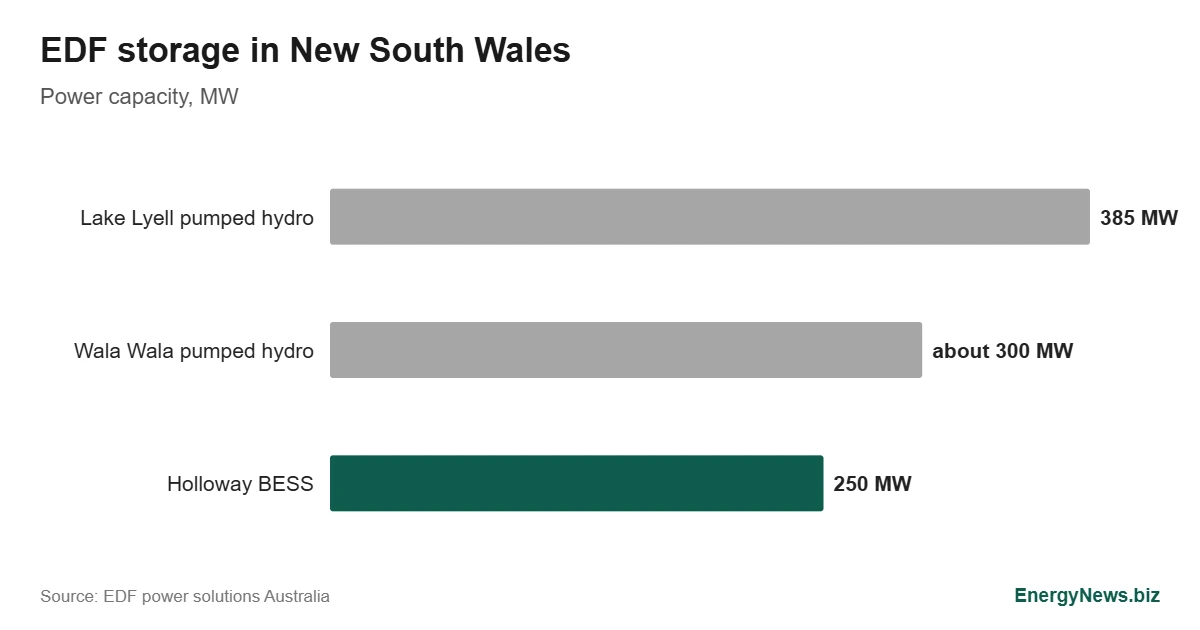
EDF power solutions Australia has acquired the Holloway BESS project from Australian developer SynCo Global. The proposed battery has a capacity of 250 MW and 1 GWh, equivalent to four hours of storage, and is designed with grid-forming inverters. The deal was announced on 19 November.
The project sits near Armidale in New South Wales, about 650 metres from the Armidale Substation, inside the New England Renewable Energy Zone. The site covers about 3 hectares and lies roughly 380 kilometres northwest of Sydney.
What the Holloway BESS adds
At four hours, the Holloway BESS can store a full afternoon of surplus solar output and release it during the evening peak. Grid-forming capability allows it to help stabilise voltage and frequency, a service the grid used to get from coal plants. The short distance to an existing substation reduces connection cost and time, often the deciding factor for batteries in Australia.
The project will go through further development before construction. EDF has not published a timeline for a final investment decision or the start of operations.
“The acquisition of the Holloway BESS represents another important step in EDF power solutions Australia’s commitment to delivering the energy infrastructure needed for a cleaner and more reliable electricity system,” said James Katsikas, chief executive of EDF power solutions Australia. He added that projects such as Holloway are essential to capture excess renewable generation and make it available when homes and businesses need it most.
EDF’s wider storage pipeline
EDF power solutions Australia, a subsidiary of the French state-owned EDF Group, is building a broad storage portfolio in New South Wales. It is developing the Wala Wala pumped hydro project in the New England zone, about 50 kilometres southeast of Tamworth, with an expected capacity of around 300 MW and ten hours of storage. It is also the majority partner, with 75%, in the Lake Lyell pumped hydro project with EnergyAustralia, designed for 385 MW and about 3 GWh.
The Holloway BESS adds a shorter duration asset to that mix. Batteries respond in milliseconds and suit daily cycling, while pumped hydro covers longer periods. Together they give EDF a portfolio that can serve different needs of the National Electricity Market.
The New England Renewable Energy Zone is one of five zones the New South Wales government has declared to coordinate new generation, storage and transmission. Large solar and other renewable projects are planned in the region, and new transmission lines are meant to carry their output to Sydney, Newcastle and Wollongong. Batteries inside the zone can soak up surplus power when the lines are congested and release it later, reducing curtailment. That makes sites such as Holloway BESS attractive both for energy trading and for network support contracts with the transmission operator.
A crowded market for four-hour batteries
The New South Wales market for four-hour batteries has become busy. In August, BW ESS acquired the 250 MW/1,000 MWh Yanco battery in the Riverina region, and other investors have bought projects across the state. The Australian Energy Market Operator expects new batteries to play a large role in the coming summer, as reported in our AEMO coverage.
For contractors and suppliers, the growing number of similar projects in the same state means competition for transformers, grid connection slots and construction crews. Developers that hold sites close to existing substations, as Holloway does, have an advantage.
SynCo Global, the seller, develops renewable and storage projects in Australia and has not said what it will do with the proceeds. The next milestone is planning approval for the Holloway BESS. More information is available from EDF power solutions Australia.
Add EnergyNews.biz as a preferred source on Google


