




Section 301 tariffs are back on the table for solar, this time aimed at almost every major manufacturing economy at once. On 25 November the US Trade Representative released the results of an eight-month investigation into what it calls structural excess capacity and proposed tariffs of 15% to 35% on the European Union and 13 other economies, rising to 20% to 40% if negotiations fail, as PV Tech reported. Solar manufacturing is singled out in the findings.
The headline rates look severe. The practical effect on US solar projects is narrower than it seems, for one reason: the US market has already moved most of its module purchases away from the countries on the list. The bigger risk sits in stacking, where the new duties land on top of existing ones, and in components that never faced trade cases before.
What the Section 301 tariffs proposal says
USTR opened the investigation on 11 March 2026 into 16 economies: China, the EU, Singapore, Switzerland, Norway, Indonesia, Malaysia, Cambodia, Thailand, Korea, Vietnam, Taiwan, Bangladesh, Mexico, Japan and India, according to the USTR notice. The proposal now covers 14 of them.
USTR argues that these economies promote excess industrial capacity that costs the US production, exports, jobs and investment. For solar, it cites three practices. It says China has threatened to use its control of supply chains as a weapon, including solar manufacturing equipment and battery technology. It links India’s Production Linked Incentive scheme to structural overproduction of PV. It names Cambodia as a hub for Chinese producers that allegedly circumvent the antidumping and countervailing duty orders on cells and modules in place since 2012.
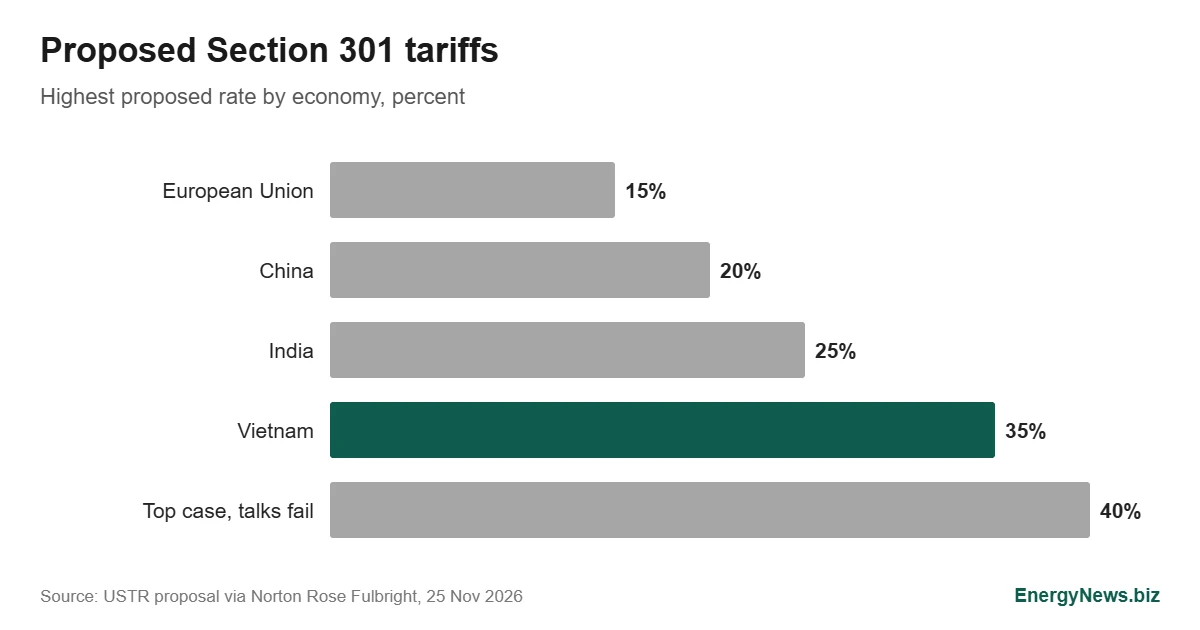
According to a summary by law firm Norton Rose Fulbright, the highest proposed rates are about 15% for the EU, up to 20% for China, up to 25% for India and up to 35% for Vietnam. The comment period closes on 5 January 2027 and public hearings start on 25 January 2027. Nothing is final.
The 71% that the list misses
US module imports have changed shape faster than trade policy. The value of crystalline silicon module imports fell 78% between the first half of 2024 and the first half of 2026, according to Crux data reported by Mercom. In the first half of 2026, the Philippines supplied 35% of module import value, Ethiopia 17%, and Nigeria, Kenya and Djibouti together 19%.
None of those five countries is among the 16 economies investigated. Added together, they account for 71% of module import value in the period. On these figures, the new Section 301 tariffs would leave most current module supply untouched, unless USTR widens the net or the products are found to be routed through listed economies.
That does not make the proposal irrelevant. Cells, wafers, inverters, trackers, glass, frames and batteries come from a wider set of countries, and US module capacity is largely assembly. The US had about 75.3 GW of module capacity in September 2026, but far less cell capacity, so its factories still import cells. Imports from India, Indonesia and Laos, where cells are made, fell to 19% of module imports by the first half of 2026 after the latest AD/CVD case.
What the Section 301 tariffs add per 100 MW
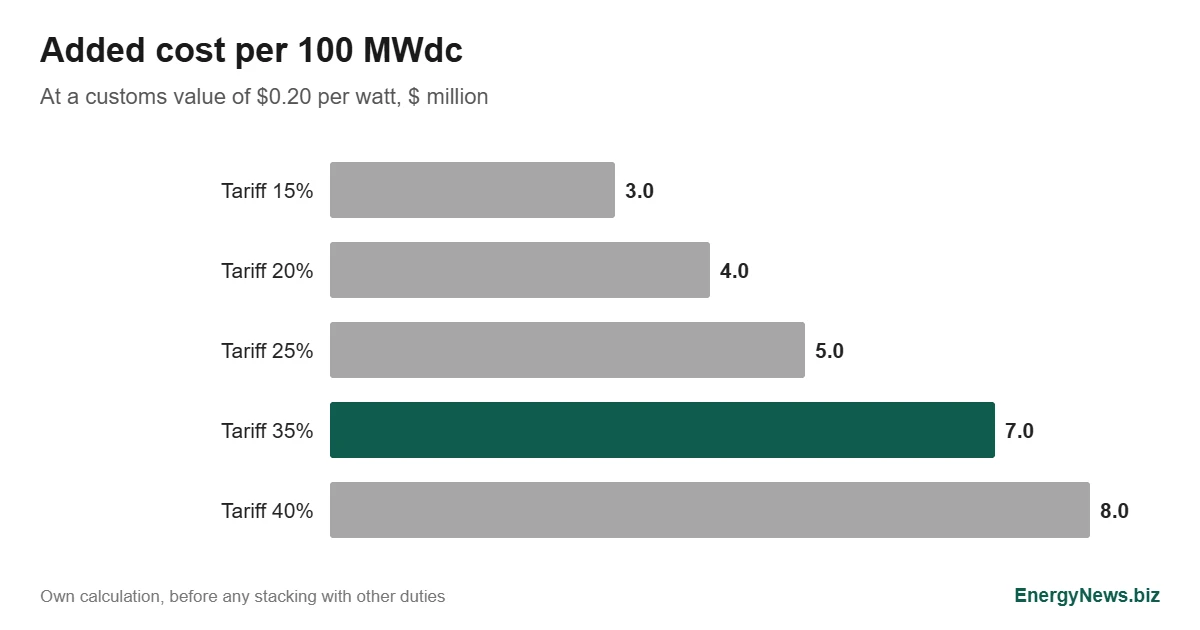
A simple calculation shows the scale for a project buyer. Assume 100 MWdc of modules with a customs value of $0.20 per watt, or $20 million. Each 10 percentage points of duty adds $2 million to that order. The proposed rates translate as follows.
| Proposed rate | Added duty on 100 MWdc | Added cost per watt |
|---|---|---|
| 15% | $3.0 million | $0.030 |
| 20% | $4.0 million | $0.040 |
| 25% | $5.0 million | $0.050 |
| 35% | $7.0 million | $0.070 |
| 40% (top case) | $8.0 million | $0.080 |
For comparison, the OPIS benchmark for TOPCon modules above 600 W stood at $0.088 per watt free on board China on 18 November. A $0.07 per watt duty on top of a sub-$0.10 product is large in percentage terms. On a utility project with all-in capital cost near $1 per watt, it is about 7% of the budget, enough to move an internal rate of return by roughly one percentage point but rarely enough on its own to cancel a project.
Stacking is the real exposure
The proposed Section 301 tariffs would not replace existing duties. Solar cells and modules from India, China, Cambodia and several South East Asian countries already face AD/CVD orders. For India, the Department of Commerce set final antidumping rates of 123.04% and countervailing rates of 126.09%, according to S&P Global. Adding up to 25% on top changes little for products already priced out.
The more important interaction is with Section 232. Tariffs on polysilicon and its derivatives under Section 232 take effect on 4 December 2026. Norton Rose Fulbright’s Keith Martin said the Section 232 duties “do not appear to be creditable on an entry-by-entry basis against the new Section 301 tariffs”. For most economies, the proposed Section 301 rates already account for Section 232. China and Singapore lack that offset language, so they are the most likely to face stacked duties. India and Vietnam remain open, as USTR will consider adjusting their rates.
China already pays a 50% Section 301 tariff on cells, and 50% on polysilicon and wafers since January 2025. A further layer of Section 301 tariffs would mostly hit equipment and components that still come from China, such as inverter parts, trackers, cell production tools and battery cells for storage.
Who is most exposed
- US cell and module factories. They rely on imported cells, wafers and equipment. Cells from listed economies such as Korea, Malaysia or Indonesia could face new costs, which would cut the margin from the 45X manufacturing credit.
- Storage developers. Batteries are named among the sectors with excess capacity. A storage project with Chinese cells already pays Section 301 duties; an extra layer would raise system costs further.
- EU and Japanese equipment suppliers. Inverters, transformers and switchgear from Europe and Japan face the 15% range for the first time under this case.
- Indian exporters. Already shut out of modules by AD/CVD, they may see the proposal as a signal against any future US supply deal.
Ryan Last of law firm Troutman Pepper Locke put it plainly: “Anyone with exposure should be going line by line through the annexes now”. The annexes, not the headline rates, decide which tariff lines are covered. Trade policy has also hit the US grid supply chain in other ways, as shown in this report on sodium-ion battery orders, where suppliers chose chemistry partly to avoid Chinese content.
How developers should respond before January
Section 301 tariffs are slow by design, which gives buyers time. Three steps follow from the numbers. First, map every component in 2027 and 2028 deliveries to its country of origin and tariff line. Second, model the stacked duty, not just the Section 301 rate, for anything from China or Singapore, because Section 301 tariffs there may not be offset. Third, check supply contracts for change in law clauses that move new duties to the seller. Contracts signed before 2025 often lack them.
Developers who buy from the Philippines, Ethiopia or African assemblers should also check the origin of cells inside those modules. If cells come from listed economies, US Customs may still apply the duty, depending on substantial transformation rules.
Comment filings matter. Section 301 tariffs have always been negotiable at the margin. In past Section 301 cases, exclusions for specific products, including solar manufacturing equipment, were won through public comments and later extended. USTR extended 178 exclusions under the older China case until 10 November 2026.
The number to watch
The number to watch is 71%, the share of US module import value in the first half of 2026 that came from countries outside the 16 investigated economies. If that share holds after the Section 301 tariffs take effect, the direct hit to module prices stays small and the pain falls on cells, equipment and storage. If USTR widens the list or targets transshipment, the $3 million to $8 million per 100 MWdc becomes the new baseline.
Add EnergyNews.biz as a preferred source on Google


