


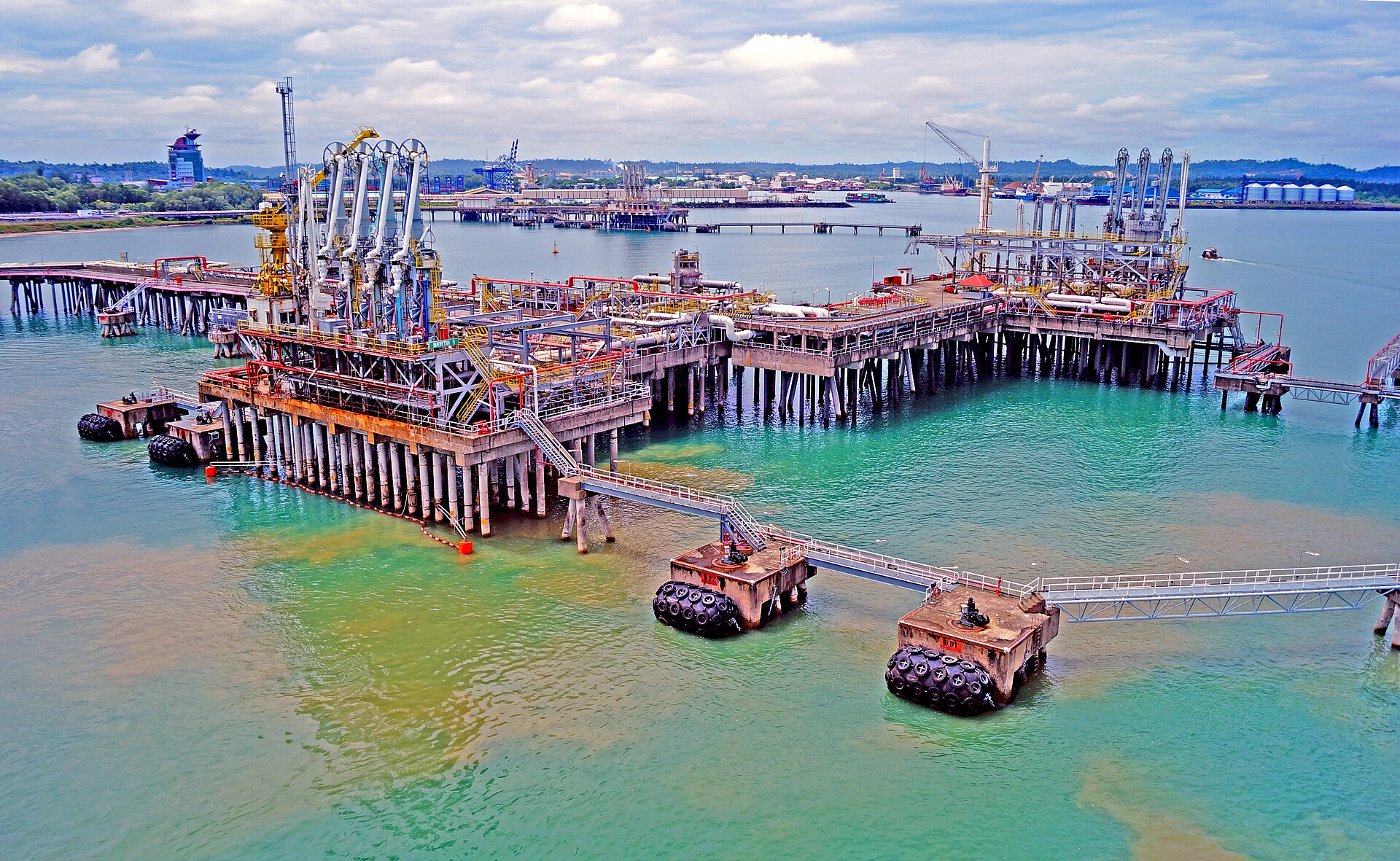


Malaysia’s Petronas has officially named PFLNG Tiga, its third floating LNG production unit, at the Samsung Heavy Industries yard in Geoje, South Korea, LNG Prime reported this week. The naming ceremony is one of the last steps before the unit sails to Malaysia.
What PFLNG Tiga is
Petronas ordered PFLNG Tiga in December 2022 from a consortium of Samsung Heavy Industries and Japan’s JGC, the same partners that built PFLNG Dua. Unlike its deepwater predecessors, Tiga is designed as a nearshore unit. It will be moored off the Sipitang Oil and Gas Industrial Park in Sabah, East Malaysia.
Sources give slightly different capacities. Petronas described the unit as designed to produce up to 2 million tonnes of LNG a year when steel was cut. Offshore Energy reported 2.1 million tonnes a year at the hull launch in February 2025. The difference is small but worth noting for buyers modelling supply. Start-up was targeted for the second half of 2027, with sail-away from Korea planned in February 2027, according to Korean reports at the launch.
How PFLNG Tiga changes Petronas’ fleet
Petronas already operates two floating LNG units, both off Sabah: PFLNG Satu with 1.2 million tonnes a year and PFLNG Dua with 1.5 million tonnes a year. With Tiga, Petronas’ floating capacity rises from 2.7 to about 4.7 million tonnes a year, an increase of about 74%.
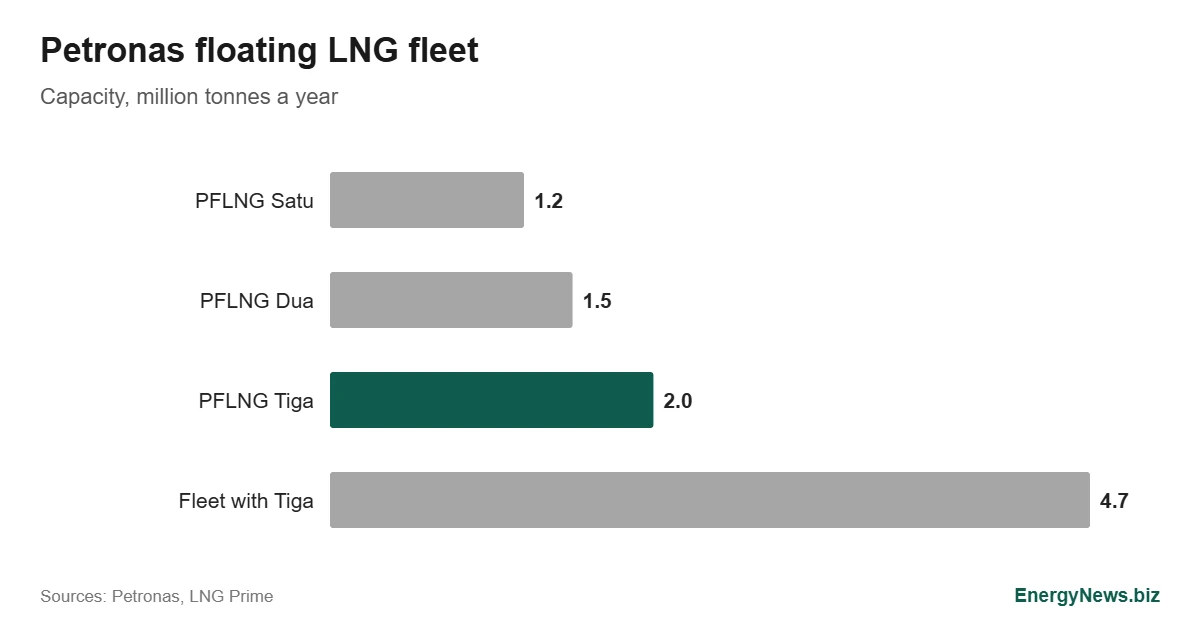
For comparison, 2 million tonnes of LNG a year is about 2.7 billion cubic metres of gas, enough to supply a mid-sized European country’s power sector for several months. In Petronas’ total LNG portfolio, which exceeds 30 million tonnes a year including the Bintulu complex in Sarawak and overseas interests, Tiga adds a modest but flexible block.
Why nearshore floating LNG
A nearshore unit sits close to existing infrastructure, in calmer water and with simpler mooring than a deepwater unit. That lowers cost and risk. It allows Petronas to monetise smaller gas fields in Sabah without building a new onshore liquefaction train, which would need more land, more time and a larger gas reserve to justify.
Floating LNG has become a growing segment. Golar LNG has reserved long-lead items for a possible fifth unit, citing strong demand, and several projects in Africa and the Americas use floating units to speed up start-up. Korean yards, led by Samsung Heavy, build most of the hulls and topsides.
Asian buyers and supply security
With Middle East supply disrupted in 2026, Asian buyers have looked for more LNG from sources that do not cross the Strait of Hormuz. Malaysian supply ships to Japan, Korea, China and Taiwan through regional waters. Additional volumes from Sabah fit that demand, even if 2 million tonnes a year is small against the 400 million tonne global market. Gas market developments in Europe are covered in this report on Equinor’s new German gas contract.
Samsung Heavy’s floating LNG record
Samsung Heavy Industries has built all three Petronas floating LNG units with JGC, as well as other floating LNG hulls for projects elsewhere. PFLNG Tiga’s hull is about 2.5 times the size of a football field, according to Korean reports at the launch, and its topsides were built from 11 modules of 2,000 to 7,000 tonnes lifted by a 9,000 tonne crane. The yard is also working on new LNG carrier designs, including nuclear propulsion concepts.
What to watch
- The sail-away date from Geoje and the tow to Sabah.
- First LNG cargo from PFLNG Tiga, targeted for the second half of 2027.
- The gas fields that feed the unit and their expected production life.
- Whether Petronas orders a fourth floating unit after Tiga starts up.
PFLNG Tiga makes Petronas one of the largest owners and operators of floating LNG capacity in the world. Its start-up in 2027 will add flexible supply in a market where Asian buyers are paying for security as much as for price.
Add EnergyNews.biz as a preferred source on Google


