




Zelestra and Statkraft have signed a long-term physical battery tolling agreement for a 175 MW/700 MWh storage project in Italy, which Zelestra will build and operate and which is due to start operating in 2028, Renewable Energy Magazine reported on 26 November. The project has four hours of storage. The term and the region were not disclosed in the summary.
Under a physical toll, the owner makes the battery available and receives a fixed payment, while the offtaker decides when to charge and discharge and keeps the trading income. Statkraft, which describes itself as Europe’s largest renewable energy producer, already holds a 10-year toll on 400 MW of batteries with Greenvolt Power in Poland.
Zelestra’s battery tolling book in Italy
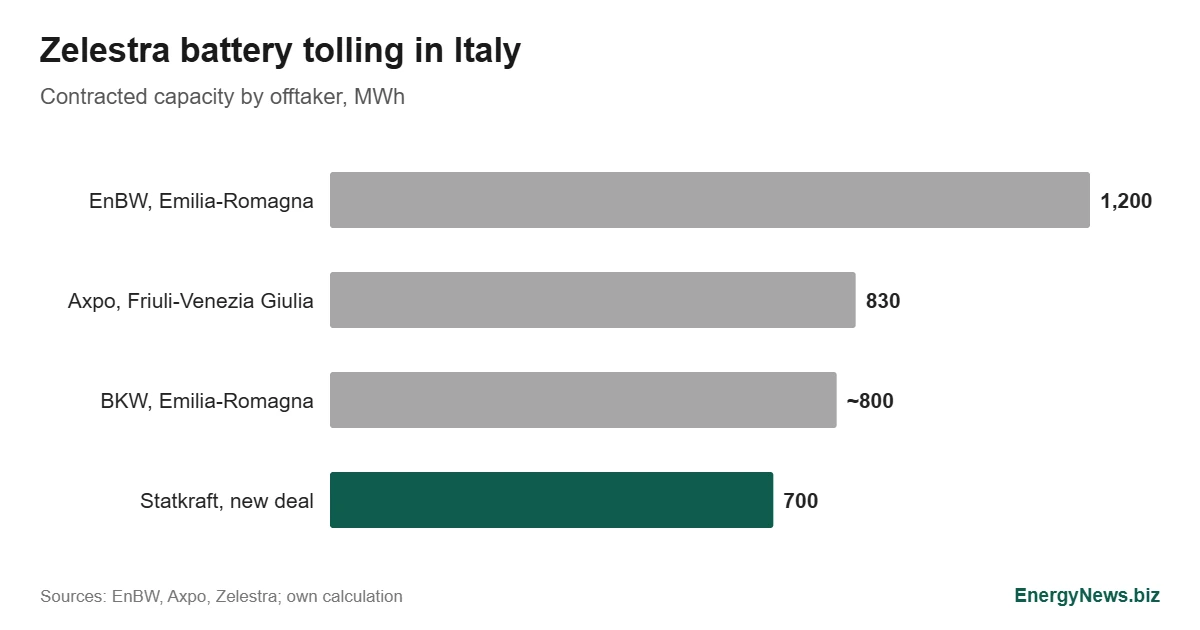
The Statkraft deal is Zelestra’s fourth battery tolling contract in Italy in about 14 months.
- In September 2025, Swiss utility BKW signed a financial toll for part of Zelestra’s 500 MW/2 GWh project in Emilia-Romagna, described at the time as the first of its kind in Italy.
- In July 2026, EnBW took 300 MW/1.2 GWh of the same project, fully contracting it, according to EnBW.
- Also in July, Axpo signed a 10-year physical toll for a 207 MW/830 MWh project in Friuli-Venezia Giulia.
- Now Statkraft adds 175 MW/700 MWh.
Added up, the four deals cover about 882 MW and 3,530 MWh. In July, Zelestra said the Axpo project lifted its authorised battery storage capacity in Italy to 970 MW, making it the second-largest owner of permitted storage in the country.
Battery tolling next to the MACSE auction
Italy’s state-run MACSE auctions have awarded about 26 GWh across two rounds, for delivery in 2028 and 2029, as covered in this analysis of the second MACSE auction. Zelestra’s private tolls, at about 3.5 GWh, equal roughly 14% of that volume. That is a large share for one developer outside the auction.
The two models suit different owners. MACSE pays a fixed premium for 15 years and hands trading income to the system. A toll pays a fixed fee for typically seven to ten years and leaves the trading upside with a utility that has a large portfolio to optimise. For a developer, a toll with a strong counterparty is bankable; for the utility, it adds flexibility to balance solar and wind.
What the battery tolling deals tell buyers
Utilities from Germany, Switzerland and Norway are paying for Italian flexibility. That reflects Italian price spreads: southern Italy has large midday solar surpluses and evening peaks, and the gap between low and high hours is among the widest in Europe. Prices for the tolls are not public, which makes it hard to compare them with the MACSE premium of about €11,382 per MWh a year in round two.
Developers in other markets can read the trend. Battery tolling is spreading from Great Britain and the Netherlands to Italy, Poland and Germany, and the counterparties are mostly large generators with trading desks.
Risks inside a battery tolling contract
A toll moves market risk to the offtaker but leaves performance risk with the owner. Contracts usually set availability guarantees, limits on cycles per day and a minimum state of health over the term. If the battery degrades faster than planned, the owner pays penalties or must add capacity. Developers who sign several battery tolling deals at once also face construction risk: four projects due in 2028 need grid connections, transformers and permits at the same time. For lenders, the strength of the offtaker matters most, and German, Swiss and Norwegian utilities rank among the strongest counterparties in Europe.
What to watch
- The term and location of the Statkraft project, once published.
- Whether Zelestra brings Italian battery tolling contracts to financial close in 2027, ahead of 2028 start-ups.
- Any disclosure of toll prices, which would allow a direct comparison with MACSE.
Add EnergyNews.biz as a preferred source on Google


