




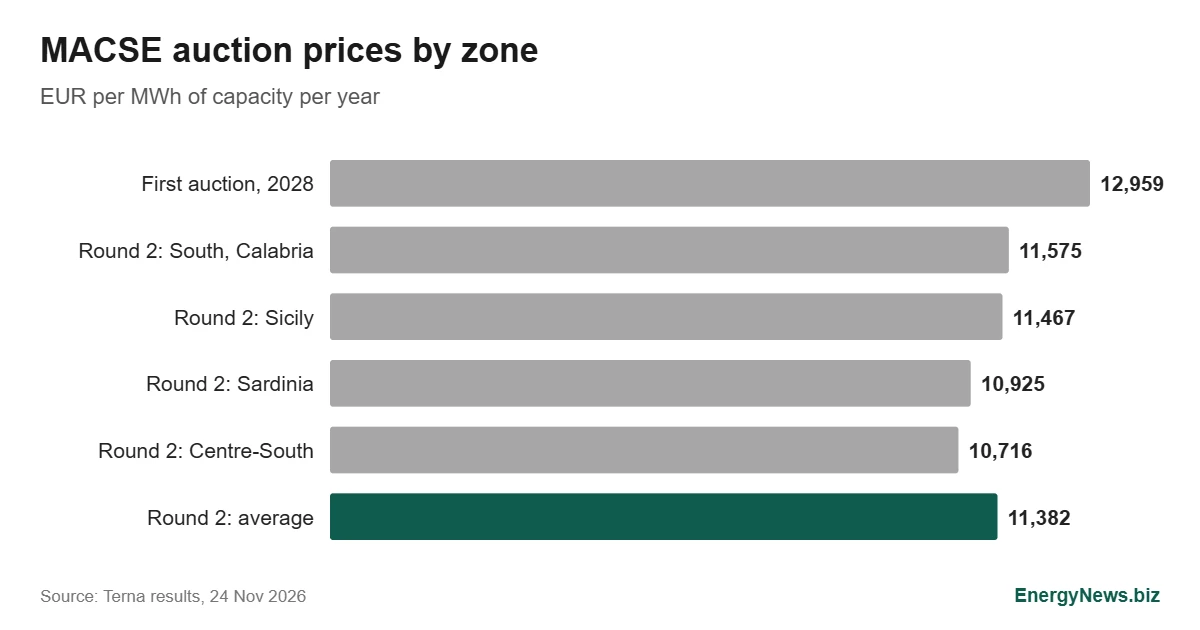
The second MACSE auction has cleared at a price that tells the market more about battery costs than any supplier price list. Italy’s grid operator Terna awarded all 16 GWh it was seeking for 2029 at a weighted average of €11,382 per MWh of storage capacity a year. That is 12% below the first auction and 58% below the reserve price of €27,000, according to Terna results reported by TaiyangNews.
Turned into an all-in cost, the price supports roughly €93,000 per MWh of installed battery at the 8.8% cost of capital that a recent Italian simulation assigns to contracted projects. Any bidder whose total cost of building and running a battery over 15 years sits above that figure has signed a contract that loses money unless other revenue or cheaper money fills the gap.
MACSE auction round two in numbers
Terna ran the MACSE auction on 24 November. About 67 GWh of projects qualified and about 43 GWh was bid, 2.7 times the volume sought, as Review Energy reported. Roughly 27 GWh of bids lost. All awarded capacity is lithium-ion and sits in the south and on the islands, where Italy’s solar build is fastest and curtailment risk is highest.
The first MACSE auction, held in September 2025 for delivery in 2028, awarded 10 GWh at €12,959 per MWh a year. Round two bought 60% more capacity for 12% less per unit. The result ran against predictions that a bigger volume would push prices up.
| Zone | Awarded | Average price, €/MWh per year |
|---|---|---|
| South and Calabria | 9.6 GWh | 11,575 |
| Sicily | 3.0 GWh | 11,467 |
| Centre-South | 2.8 GWh | 10,716 |
| Sardinia | about 0.5 GWh | 10,925 |
| Total, round two | 16 GWh | 11,382 |
| Round one (2025, delivery 2028) | 10 GWh | 12,959 |
The yearly bill for Italian consumers
MACSE pays a fixed premium per MWh of capacity for 15 years. In return, Terna pools the batteries and sells their time-shifting capability through products traded on a platform run by the market operator GME, so the spread income flows back to the system rather than to the owner.
The gross premium from the MACSE auction is easy to size. At €11,382 per MWh a year, 16 GWh costs about €182 million a year. Round one adds about €130 million a year. Together, the two auctions commit roughly €312 million a year before any trading income is netted off. Over a 15-year contract, round two alone adds up to about €2.7 billion in nominal terms.
Terna sizes the volume by comparing the cost of new storage with the benefit of burning less gas in power plants. That method matters: if gas prices fall, the case for the next tranche weakens; if solar curtailment in the south keeps rising, it gets stronger.
What a MACSE price of €11,382 can pay for
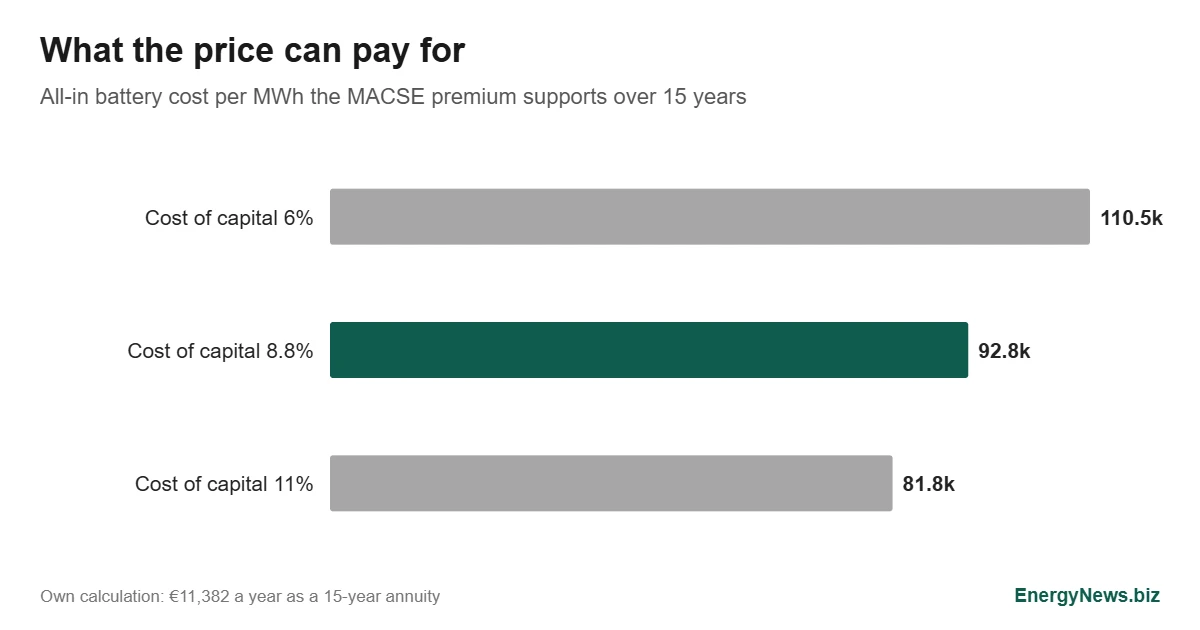
The more useful question for developers and lenders is what a battery must cost for this price to work. The calculation below treats the premium as a 15-year annuity and asks what upfront, all-in cost it can repay. All-in means hardware, construction, grid connection, operation and maintenance, augmentation and decommissioning, expressed per MWh of usable capacity.
- At a 6% cost of capital, 15 payments of €11,382 are worth about €110,500 per MWh today.
- At 8.8%, the figure falls to about €92,800 per MWh.
- At 11%, it falls to about €81,800 per MWh.
The 8.8% and 11% values are not arbitrary. The consultancy PTS, in a simulation reported by ESS News on 25 November, put the average cost of capital for MACSE-contracted Italian batteries at 8.8%, rising to 11% if government bond yields climbed by two percentage points. Merchant projects would face 12.1% to 14.6%.
A developer that budgets €150,000 per MWh all-in, including grid works, would need a cost of capital close to zero for this price to work. The auction result implies that winners either expect all-in costs well below today’s European average by 2029, expect to finance at the low end of the range, or plan to earn something on top of the premium. Under MACSE rules the room for extra income is limited, which leaves cost and financing as the main levers.
Duration changes the picture per MW, not per MWh. A four-hour battery earns about €45,500 per MW a year at the round two price. An eight-hour battery earns about €91,000 per MW. Longer systems spread fixed grid and site costs over more energy, which is why several winners bid six to eight hours.
Who won, and why concentration is now the debate
Enel Produzione won the largest share, about 7,336 MWh across three systems, or 45.9% of the total. Terna also listed BESS by Erry with 1,667 MWh, Field Melfi with 1,138 MWh and ACL SPV 2 with 888 MWh, and said it does not establish whether those entities are affiliated with Enel. Counted together, the six systems reach about 11,029 MWh, roughly 69% of the auction.
A2A won about 2,608 MWh through A2A Storage and A2A Energiefuture. ContourGlobal took 623 MWh in Apulia. FIVE-E Responsible Investment won 539 MWh, Whysol Investments 531 MWh in Sardinia, Cubico Sustainable Investments 430 MWh and Enlight Renewable Energy 240 MWh. Whysol’s Sardinian project also won 295 MWh in round one.
The industry federation ANIE has warned about concentration since round one, when a single operator took more than half of the awarded capacity. It has proposed capping any operator at 30% of the capacity awarded in each zone. On the round two figures, that cap would have forced a redistribution of several gigawatt-hours in the South and Calabria zone alone.
For smaller developers, the lesson is blunt. A utility with a large balance sheet, its own sites and cheap corporate debt can bid at prices that a project-financed newcomer cannot match. The background to the Italian revenue stack, and to the rule changes that already cut merchant income, is covered in this analysis of Italian battery revenues.
What it means for storage markets outside Italy
The MACSE auction is now the largest long-term battery procurement in Europe by energy volume. Italy reported 19.98 GWh of installed storage at the end of September 2026, according to Italia Solare. The 26 GWh awarded across the two auctions would more than double that base by 2029.
Other governments designing a MACSE auction of their own, or any capacity or storage auction, from Spain to Poland to the UK cap and floor scheme for long duration storage, will read the result as proof that a fixed premium plus a clear calendar brings prices down quickly. PTS argued the same point: fixed auction calendars and public data on deal terms cost less than the risk premium investors otherwise charge.
Suppliers should read it differently. If Italian winners need all-in costs near €90,000 per MWh by 2029, price pressure on cells, containers and power conversion will continue, and the margin for European assembly or non-Chinese supply chains narrows further.
What to check before the next round
- Whether partially accepted bidders decline their awards, which Terna says is still possible because the results are provisional.
- The final ownership picture behind the Enel-linked entities, and whether the ministry adopts a concentration cap.
- Italian ten-year bond yields, since a two-point rise would cut the supportable all-in cost by roughly €11,000 per MWh at the contracted cost of capital.
- Delivery risk: 16 GWh in 2029 on top of 10 GWh in 2028 needs grid connections, transformers and fire safety approvals in a short window.
How the MACSE auction compares with other storage contracts
The MACSE auction is not the only long-term revenue model for batteries in Europe, but it is the most transparent. In Germany and the Netherlands, developers sign private tolling agreements with traders and utilities, and the prices rarely become public. In Great Britain, batteries rely mainly on wholesale trading, balancing services and a capacity market that pays far less per MWh. Spain is moving towards capacity payments and grants. Against that background, the MACSE auction gives lenders a fixed, indexed and public number for 15 years, which is why the cost of capital for contracted projects sits several points below merchant projects.
The trade-off is upside. A MACSE battery hands its spread income to the system. A merchant battery keeps it, and in a year of high gas prices or extreme solar curtailment that income can exceed any premium. Investors choosing between the two are effectively choosing between a regulated infrastructure return and a trading business. The second MACSE auction shows that, at 2026 interest rates, plenty of capital prefers the first.
For grid operators elsewhere, the MACSE auction also offers a template for sizing. Terna links the volume to avoided gas generation and curtailment, so the procurement grows or shrinks with the value it creates. That is easier to defend politically than a fixed target set years in advance.
The number to watch
The number to watch is €92,800 per MWh, the all-in battery cost that the round two MACSE auction price supports at an 8.8% cost of capital. Equipment tenders and financial close announcements from the winners in 2027 will show whether real projects land below it. If they land above it, expect delays, declined awards or a higher clearing price in the next MACSE auction.
Add EnergyNews.biz as a preferred source on Google


