




Italy battery storage has become one of the fastest growing markets in Europe, supported by the MACSE auctions and the capacity market. Two separate changes now point in the same direction for the next two years: lower income for batteries that rely on price swings and capacity payments. Neither change is fatal, but together they are large enough to change project returns, especially in the south and on the islands.
The decree that lowers price spikes
The first change is the Energy Bills Decree, Law Decree No. 21 of 20 February 2026, which entered into force the next day. Its aim is to cut electricity prices. One key measure reduces the operating costs of gas plants by refunding carbon and gas tariff components, with the money collected from consumers through tariff charges. Because gas plants set the wholesale price in many hours, lower gas costs mean lower power prices and smaller gaps between cheap and expensive hours.
That is exactly the spread a battery earns on. When the decree was announced, Italian power for delivery in 2027 fell by almost €15/MWh to a low of €86.25/MWh, according to Argus, before the regional war pushed it back above €100. Part of the measure needs approval from the European Commission under state aid rules and is planned to start on 1 January 2027. Industry analysis reported this week by Energy-Storage.news expects it to reduce price spikes and battery revenues in 2027 and 2028, with limited effect after that.
The capacity rule that hits Italy battery storage by zone
The second change is quieter. In the capacity market auction for 2027, new and existing resources received €47,000 per MW per year. A battery’s payment is reduced by a derating factor that reflects how much it contributes to adequacy. Until 2027, one national curve based only on duration applied everywhere. From 2028, Terna will use four zonal curves.
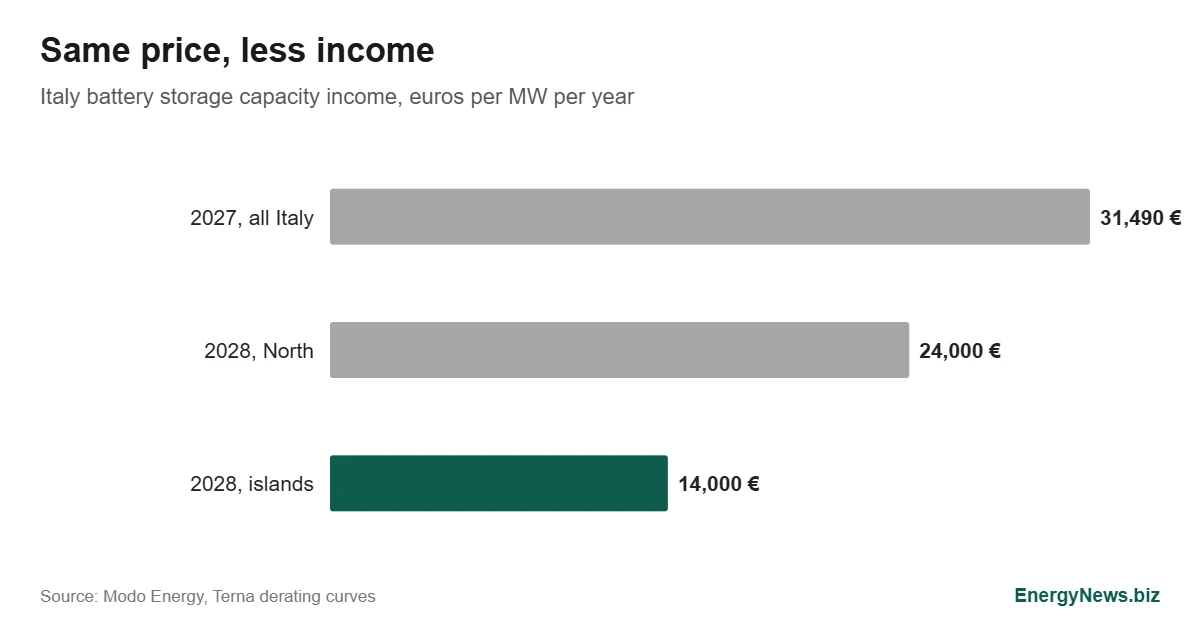
According to Modo Energy’s analysis of the new curves, at the same auction price a four-hour battery would earn about €14,000 per MW per year on the islands and about €24,000 in the North, against €31,490 anywhere in Italy for 2027. That is a cut of about €17,490 per MW per year on the islands, or 56%, and about €7,490 in the North, or 24%. For a 100 MW project on Sardinia or Sicily, capacity income would fall by roughly €1.75 million a year.
The logic behind the new Italy battery storage rule is that batteries in the same zone charge and discharge at similar times, so each new battery adds less to security of supply. Zones with many batteries already planned are hit hardest. Of the 10 GWh awarded in the MACSE auction for 2028 delivery, about 7 GWh sits in the South and Calabria.
What it means for projects
For Italy battery storage owners with MACSE contracts, the impact is limited, because those projects are protected by their long-term contracts. The exposure sits with merchant projects and with batteries that counted on capacity payments as a floor. Developers holding sites in the South and on the islands without MACSE contracts should rerun their models with lower spreads for 2027 and 2028 and the new derating factors from 2028. Lenders will do it anyway.
For Italy battery storage as a whole, the picture is not one of collapse. Italy still needs flexibility as solar grows, and the second MACSE auction is close. But the market is moving from easy revenues to competition by location, the same shift seen in Germany’s battery race and in markets where negative prices are falling.
The number to watch
The number to watch is the clearing price in MACSE 2.0. A higher price than in the first round would show that bidders are pricing in weaker merchant income, and would confirm that Italy battery storage is moving toward contracted revenue. Terna publishes auction results and rules on its website.
Add EnergyNews.biz as a preferred source on Google


