




The EU inverter ban for publicly funded projects has moved from guidance to practice. Under interim guidance adopted in April 2026, the European Commission barred EU-funded clean energy projects from using solar inverters and battery power conversion systems from countries it classifies as high risk, led by China. The requirements took effect this November for grid-connected projects and apply to off-grid installations from April 2027, according to S&P Global.
On 26 November Wood Mackenzie published an updated estimate: more than 21 GW of European solar inverter demand between 2027 and 2030 is exposed to the restrictions, as Renewable Energy Magazine reported. The hardware cost of switching suppliers turns out to be modest. The bigger risks are procurement delays and battery systems that must be redesigned.
What the EU inverter ban covers
The restriction applies to projects funded through EU instruments, including the European Investment Bank and the European Investment Fund. It covers solar PV inverters and the power conversion systems of battery storage. Projects financed privately or through national budgets are not covered, although the Commission has encouraged member states to apply similar rules, Wood Mackenzie said in July.
Pending revisions to the EU Cybersecurity Act could extend the EU inverter ban to all solar inverters and storage power conversion systems regardless of funding. That would change the scale completely: Chinese suppliers accounted for more than 80% of inverter shipments to Europe in 2025, according to Wood Mackenzie.
Some member states already act alone. Lithuania has restricted remote control of inverters since May 2025, and the rules applied to existing installations from May 2026, according to the IEA.
Exposure: July versus November
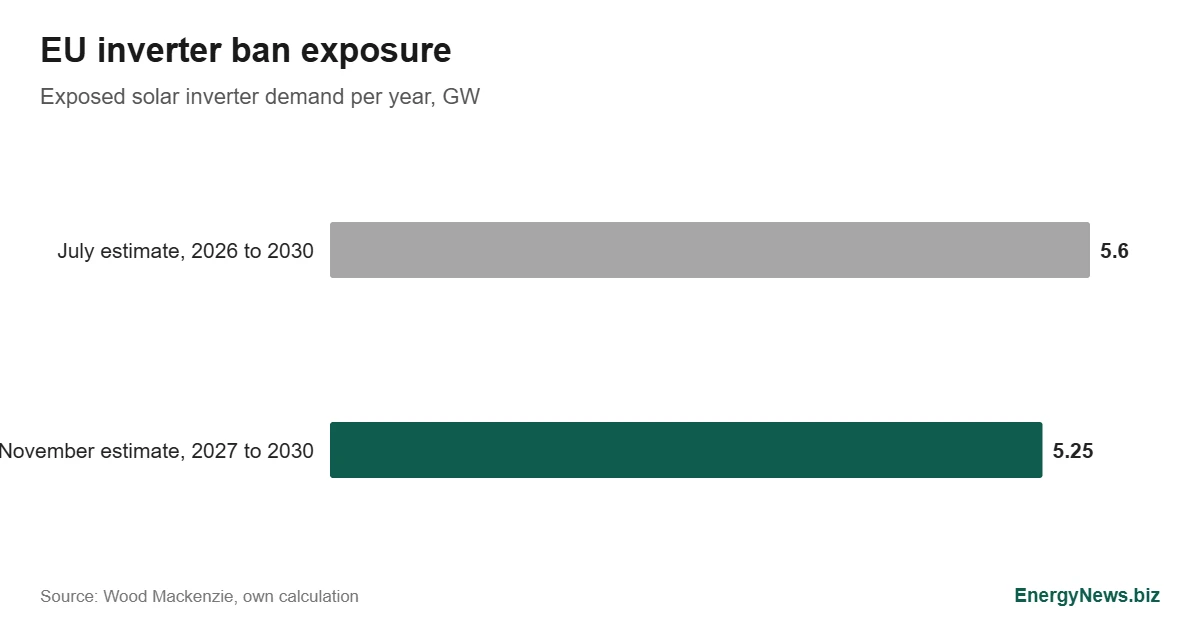
Wood Mackenzie’s July analysis put the exposure at 14% of forecast EU solar demand from 2026 to 2030, more than 28 GWdc of inverter demand, plus about 12% of energy storage deployments. Principal analyst Juan Monge described it as “around 4 to 5 GW per year of demand moving away from Chinese vendors through 2030”.
The November figure, over 21 GW for 2027 to 2030, is not directly comparable because the period is one year shorter. Divided by years, the two estimates are close: about 5.6 GW a year in July and 5.25 GW a year in November. The update narrows the window rather than changing the scale.
| Indicator | Value | Source |
|---|---|---|
| Exposed solar inverter demand, 2027 to 2030 | over 21 GW | Wood Mackenzie, Nov 2026 |
| Exposed share of EU solar demand, 2026 to 2030 | 14% | Wood Mackenzie, Jul 2026 |
| Exposed share of storage deployments | 12% | Wood Mackenzie, Jul 2026 |
| Chinese share of inverter shipments to Europe, 2025 | over 80% | Wood Mackenzie |
| European inverter demand, 2026 | about 60 GWac | S&P Global |
| European inverter manufacturing capacity | about 100 GWac | S&P Global |
| Utility projects with EU financing commitments | 9 GW | Wood Mackenzie via Reuters |
What the EU inverter ban costs per project
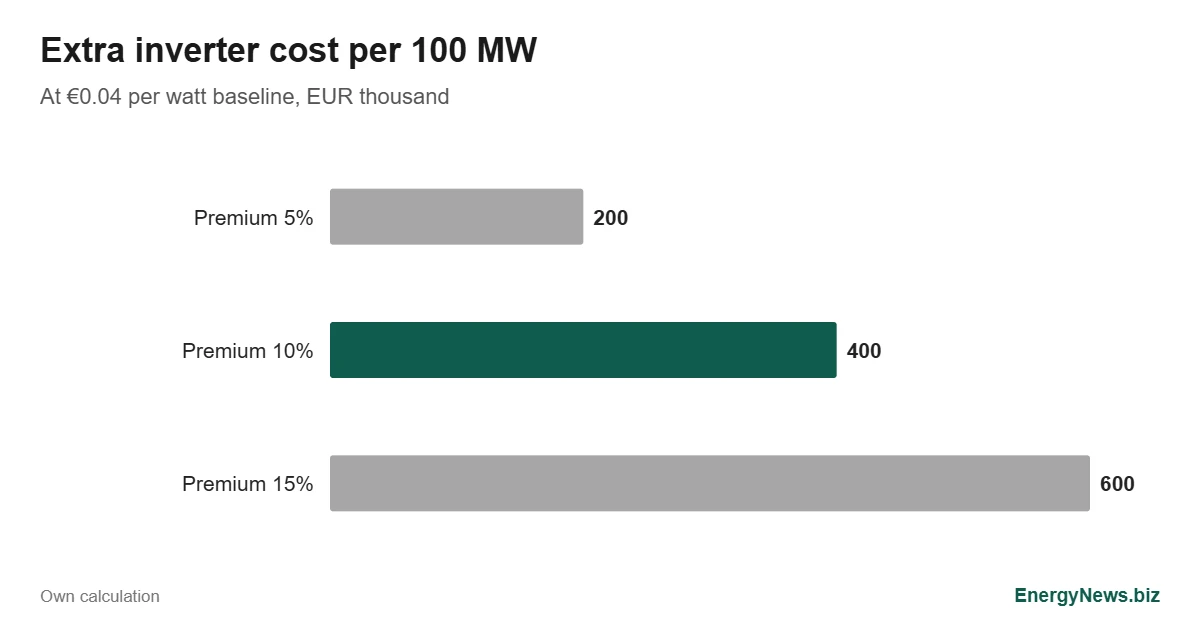
Wood Mackenzie estimates that replacing Chinese inverters with alternatives raises prices by about 10%. Utility-scale string and central inverters cost in the range of €0.03 to €0.05 per watt in Europe. Taking €0.04 per watt, a 100 MW project spends about €4 million on inverters. A 10% premium adds €400,000.
Under the EU inverter ban, against a total project cost of €50 million to €65 million for 100 MW of ground-mounted solar, that is under 1%. The hardware premium alone will not stop many projects. Across 21 GW, the premium adds up to roughly €84 million over four years, a small sum next to the EU funds involved.
The real cost: unbundling batteries
Storage is where the EU inverter ban bites. Many battery systems sold in Europe arrive as integrated units in which the cells, battery management and power conversion come from one Chinese supplier. Under the restriction, an EU-funded project cannot use the Chinese power conversion system, so the developer must split the system and buy the converter elsewhere.
Joe Shangraw, research analyst at Wood Mackenzie, said that “procurement complications, design changes and the forced unbundling of integrated battery-inverter systems present additional challenges”. Unbundling means new integration engineering, new testing, a new warranty structure and often a new grid compliance study. That can take months and cost far more than the 10% hardware premium.
Battery revenue models also matter. Projects with long-term contracts, such as those in Italy’s MACSE auction, have fixed delivery dates. A redesign that delays commissioning puts penalties and revenue at risk.
Who is most exposed to the EU inverter ban
- Central and Eastern Europe. These countries are the largest recipients of EU funding for renewables. In Latvia and Estonia, 70% of household solar installations receive some form of EU support, according to Reuters.
- Projects with EIB or EBRD loans. The EBRD lent Hungary €70 million this year for a 700 MW solar and storage project, Reuters reported.
- Rooftop programmes funded by EU cohesion money. Small inverters are the segment where Chinese brands dominate most.
Lenders will add their own checks. Banks that finance EU-funded projects already ask for confirmation that equipment meets the grant rules, and a breach could trigger repayment of the grant. Developers should expect covenants on inverter origin in new loan documents and a request for supplier declarations at financial close.
The winners are European and non-Chinese inverter makers. S&P Global data suggests Europe has about 100 GWac of inverter production capacity against about 60 GWac of demand, so supply is not the bottleneck. The question is whether those factories can offer integrated storage solutions at competitive prices.
Why the EU inverter ban is about grids, not only solar
The cybersecurity concern behind the EU inverter ban is grid stability. Inverters connect solar plants and batteries to the network and can be controlled remotely for updates and monitoring. The IEA notes that attacks on inverter fleets could range from local disruptions to long blackouts. With tens of gigawatts of solar on European networks, a coordinated switch-off at noon would remove more power than the largest nuclear plant produces.
That is why grid operators and regulators, not only funding bodies, are watching the rules. If the EU inverter ban extends to all projects, transmission operators may also require new testing of remote access, firmware updates and data flows for existing fleets. Retrofits would then become the larger market, not new projects. For grid operators, the measure is part of a wider effort to make distributed generation as secure as conventional plants, which are already covered by critical infrastructure rules.
What developers should do now
- Check every project in the pipeline for EU, EIB, EIF or national co-funding that follows the Commission’s guidance.
- For storage, ask suppliers now for a version with a non-restricted power conversion system and a full warranty.
- Price a 10% inverter premium and a three to six month delay into financial models for affected projects.
- Follow the Cybersecurity Act revision, which could extend the rules to all projects.
The number to watch
The number to watch is 5.25 GW a year, the solar inverter demand Wood Mackenzie now sees moving away from high-risk suppliers through 2030. If the Cybersecurity Act extends the EU inverter ban to private projects, that figure would rise towards the full European market of about 60 GWac a year, and the price and delay effects would multiply.
Add EnergyNews.biz as a preferred source on Google


