





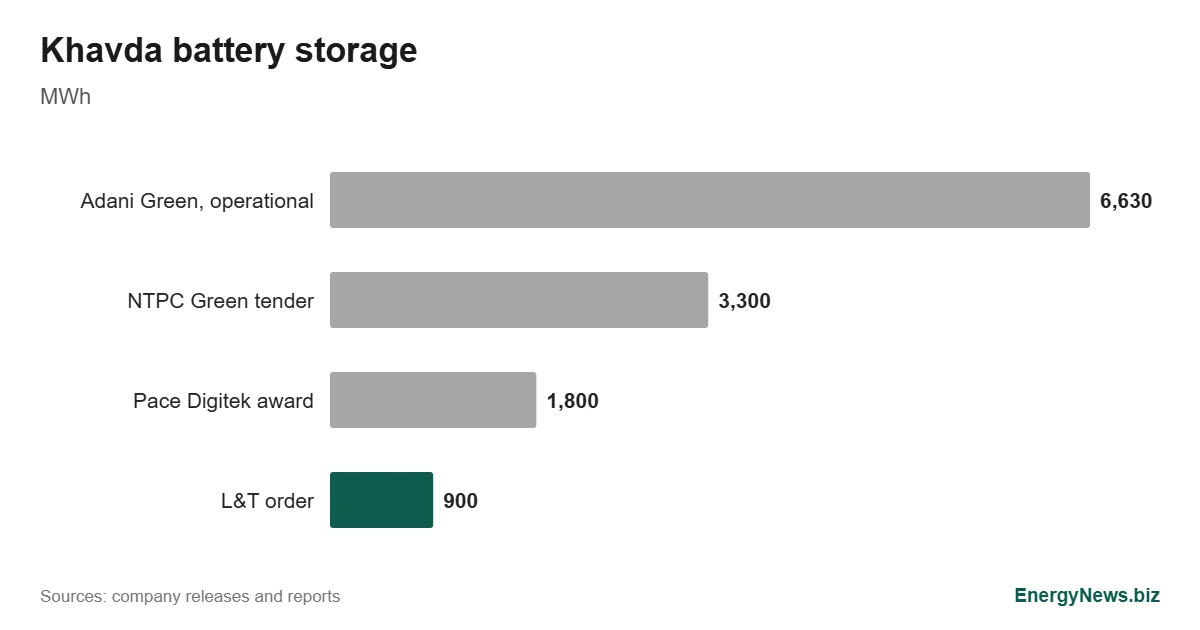
Khavda battery storage keeps growing. Larsen and Toubro’s Renewables business, together with L&T Electronic Products and Systems, has secured an order to develop a 300 MW/900 MWh battery energy storage system at Khavda in Gujarat, India, SustainabilityOnline reported on 26 November. The client and contract value were not given in the report.
Khavda battery storage in context
Khavda, in the Kutch district near the border with Pakistan, hosts one of the largest renewable energy parks in the world. Adani Green Energy is building 30 GW of renewable capacity there across 538 square kilometres and reported 6.63 GWh of operational battery storage at the site, up from 3.55 GWh in June 2026. The company says that is the largest operational battery installation at a single location in the world.
State-owned NTPC Green Energy is building its own Khavda battery storage. In June 2026 it tendered EPC contracts for 3,300 MWh at its Khavda solar plant. In November, Pace Digitek won 600 MW/1,800 MWh of that tender, in two blocks of 300 MW/900 MWh each, for ₹2,691 crore including GST, with completion due by September 2027, according to Construction World. The scope includes supply, integration, civil works and 15 years of operation and maintenance.
A price benchmark, as an illustration
The L&T order matches the block size in the NTPC Green tender, but the report does not say whether it is part of that tender. The Pace Digitek award gives a useful benchmark: ₹2,691 crore for 1,800 MWh is about ₹1.5 crore per MWh, including GST and 15 years of operation and maintenance. If L&T’s 900 MWh order were priced at a similar level, it would be worth roughly ₹1,350 crore. This is an illustration only; scope and terms can differ widely between contracts.
L&T classifies its orders by value, from Significant to Ultra-Mega, and usually states the category in stock exchange filings. The category, once published, will show whether the price is in line with the benchmark.
For buyers comparing Khavda battery storage bids, the inclusion of 15 years of maintenance matters. A contract that bundles operation and maintenance moves performance risk to the contractor and makes the upfront price look higher than a supply-only deal.
L&T’s storage record
L&T has installed 25.2 GW of solar capacity and deployed 12.8 GWh of battery storage, according to Mercom. In August 2026 it won a major order for three battery projects in the Middle East with a combined 6 GWh, valued at ₹5,000 to ₹10,000 crore under its internal classification. Its Indian battery orders include a 241 MWh system integrated with a 116 MWac solar plant in Bihar.
Why Khavda battery storage keeps growing
Khavda’s solar output peaks at midday, while Indian demand peaks in the evening. Without storage, much of the new solar capacity would be curtailed or would push midday prices down. Three-hour batteries, such as the 300 MW/900 MWh blocks, shift solar output into the evening peak and give the grid operator reserves for fast frequency response. Long transmission lines from Kutch to demand centres also benefit, since batteries can smooth the flow and make better use of line capacity.
India’s battery market grows fast on the back of viability gap funding and state tenders. Supply chains remain largely Chinese for cells, though Indian assemblers such as Pace Digitek’s Lineage Power build containerised systems locally. Battery chemistry choices are also shifting, as covered in this report on sodium-ion orders.
What to watch
- The client and value of the L&T order, once disclosed.
- Award of the remaining NTPC Green Khavda battery storage blocks.
- Commissioning dates against the September 2027 target set for the Pace Digitek blocks.
- Adani Green’s progress towards its target of more than 10 GWh of new battery capacity in the 2026 to 2027 fiscal year.
Add EnergyNews.biz as a preferred source on Google


