




The Trump administration’s October 2025 cancellation of ARCHES, California’s federal hydrogen hub agreement, is routinely described as the loss of 1.2 billion dollars. Court filings show only about 30 million dollars of that commitment had actually been disbursed before the termination. The distinction does not make the cancellation less damaging to a program built on the assumption that the remaining funding would eventually arrive, but it clarifies how much of California’s hydrogen buildout was already running on a fraction of its promised capital before the money was pulled entirely.
ARCHES, the Alliance for Renewable Clean Hydrogen Energy Systems, was structured as a 12.6 billion dollar program when California finalized its agreement with the Department of Energy’s Office of Clean Energy Demonstrations in July 2024, with 1.2 billion dollars of that total committed as a federal contribution and the remainder expected from private capital. When DOE terminated the agreement in October 2025 as part of a broader cancellation of more than 7.5 billion dollars in clean energy awards, only the initial 30 million dollar tranche had been paid out, alongside 27.5 million dollars for a parallel Pacific Northwest hydrogen hub cancelled in the same round. A federal court stipulation filed in a separate case, Thakur v. Trump, states that DOE selected grants for that October cancellation tranche based on the political identity of recipient states, a characterization the department disputes as describing every underlying termination decision. California, joined by a 13-state coalition led by Attorney General Rob Bonta, filed suit in February 2026 arguing the cancellations violated the separation of powers by undoing funding Congress had already appropriated, a case that remains unresolved. Whatever its outcome, the disbursement figures show that the vast majority of ARCHES’ promised federal backing existed only as a contractual commitment for future milestones, meaning the hub’s economics depended almost entirely on money that had not yet moved before the administration ended the agreement.
That funding structure matters because it explains why California’s hydrogen retreat was already visible well before the cancellation took effect. Registered hydrogen passenger vehicles in the state, roughly 14,000, declined for the first time last year, and the public station network had shrunk from 65 to 57 sites since 2023, with about a third of those non-operational at any given time even before this year’s disruptions. Bill Magavern of the Coalition for Clean Air summarized the underlying competitive dynamic bluntly: “There was a race between batteries and hydrogen, and batteries won.” That imbalance is stark in the heavy vehicle segment the state has pivoted toward as passenger cars faded: roughly 400 hydrogen buses and trucks operate in California today against about 20 times as many battery electric equivalents, served by just four public and ten private hydrogen filling stations for the entire commercial fleet.
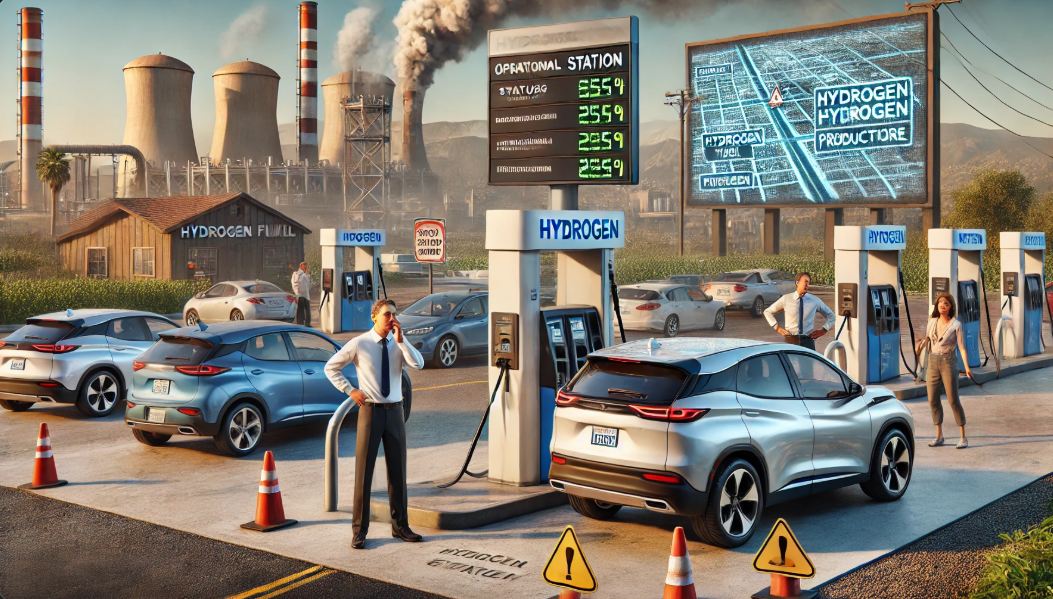
A single incident then compounded that already thin infrastructure base. On the night of February 24, 2026, a compressed hydrogen trailer owned by Pilot Company exploded at an industrial storage yard in Colton, killing one worker and seriously injuring another. The trailer supplied gaseous hydrogen deliveries to stations across the state, and its owner immediately suspended compressed hydrogen operations pending investigation. Within days, as much as 70% of California’s roughly 50 retail hydrogen stations went dark, and by March 23, nearly a month later, 32 sites remained offline according to Hydrogen Fuel Cell Partnership tracking. A logistics disruption at a single storage yard was able to idle a majority of the state’s retail hydrogen network for weeks, a fragility that reflects how centralized and thinly staffed the supply chain behind California’s hydrogen stations has become, not a one-time accident isolated from the network’s underlying structure.
The vehicle manufacturing side has consolidated just as sharply. Nikola, which had marketed itself as bringing the first commercially available Class 8 hydrogen fuel cell truck to the North American market and operated the HYLA refueling corridor connecting Northern and Southern California, filed for Chapter 11 bankruptcy after accumulating 3.3 million fleet miles across its hydrogen and battery electric truck platforms and dispensing more than 330 metric tons of hydrogen through HYLA. Its collapse, alongside other manufacturer failures, is what has left what the source reporting describes as only one truck maker and one bus maker still selling hydrogen vehicles in North America, a level of concentration that leaves fleet operators with little competitive choice even where they remain willing to commit to the fuel.
The cost gap underlying all of this remains the more durable obstacle than any single event. S&P Global Energy analyst Matthew Hodgkinson put California hydrogen at roughly four times the per-mile cost of gasoline even accounting for recent gasoline price increases, a spread wide enough that, as state Transportation Secretary Toks Omishakin put it, station investment and vehicle adoption remain stuck in a “chicken and egg” standoff neither side wants to resolve first. That leaves utilities, which recently gained permission to count green hydrogen blended into natural gas combustion toward state renewable energy targets, as one of the few buyers with a regulatory reason to keep purchasing the fuel regardless of transportation demand, a dynamic visible in the Los Angeles Department of Water and Power’s reaffirmed plan to blend hydrogen into its Scattergood Generating Station over objections from environmental groups who argue the water and energy required to produce that hydrogen make it a less efficient use of clean electricity than displacing fossil fuels directly. Whether that utility demand is enough to sustain production capacity built for a much larger vehicle market that has not materialized is, per the state’s own reporting, the open question the industry has yet to answer, and the events of the past twelve months, a funding cancellation that removed money largely uncommitted in practice, a fatal explosion that idled most of a fifty station network for weeks, and the bankruptcy of one of only a handful of remaining vehicle suppliers, have each landed on an ecosystem that was never operating at more than a fraction of the scale its original federal backing assumed.
Add EnergyNews.biz as a preferred source on Google


