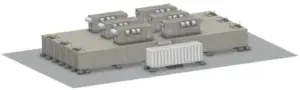






Mejillones Ammonia Energy has secured environmental approval for its $2.5 billion Volta project in Antofagasta, a planned 620,000 tonne per year green ammonia facility that now moves closer to final environmental qualification following clearance from the regional Environmental Assessment Commission in late December 2025.
The approval positions Volta among the larger ammonia proposals in Chile’s northern industrial corridor, a region increasingly targeted for export oriented hydrogen derivatives. Structured in two phases of 310,000 tonnes annually, the project is designed to combine a 600 MW solar park with battery storage and grid electricity, while sourcing process water from municipal wastewater streams in Mejillones that are currently discharged into the Pacific.
On capacity alone, Volta aligns with Chile’s ambition to reach 25 GW of green hydrogen production by the early 2030s. Converted to hydrogen equivalents, a 620,000 tonne ammonia facility would imply demand for roughly 110,000 tonnes of hydrogen per year, depending on conversion efficiency. That scale is material, but it also underscores the broader challenge facing Chile’s hydrogen strategy: aggregating dozens of similar projects while ensuring grid stability, water availability, port infrastructure, and offtake certainty.
Water sourcing has emerged as a critical scrutiny point for northern Chile, where arid conditions and community concerns have slowed or reshaped several energy projects. Volta’s reliance on treated municipal wastewater rather than freshwater abstraction directly addresses a regulatory and social risk that has stalled other developments. However, wastewater volumes and treatment reliability will need to scale consistently with electrolyzer operations, particularly as the project ramps from first to second phase.
Power integration remains another structural constraint. While the project’s 600 MW solar component covers a significant share of demand, reliance on the national grid introduces exposure to curtailment risk, congestion, and evolving transmission tariffs. Northern Chile already experiences periods of renewable oversupply and grid bottlenecks, a paradox that complicates long duration industrial loads such as electrolysis. Battery storage can smooth intraday variability, but it does not resolve seasonal or systemic grid limitations.
Construction is scheduled to begin in 2027, with first commercial production targeted for 2029. That timeline places Volta within a cohort of Latin American hydrogen projects aiming to synchronize startup with anticipated European import demand toward the end of the decade. Yet recent permitting delays and project suspensions elsewhere in the region suggest that schedules remain vulnerable to regulatory appeals, financing conditions, and infrastructure dependencies beyond the project boundary.
MAE has indicated that initial production will prioritize domestic demand before moving into export markets. This sequencing reflects a pragmatic acknowledgment of Chile’s nascent hydrogen offtake landscape. Domestic ammonia consumption in mining, chemicals, and potentially power generation offers nearer term demand, albeit at volumes well below export scale. Export ambitions, particularly toward Europe, will depend on certification alignment, shipping economics, and the ability to compete with Middle Eastern and North African suppliers that benefit from proximity and existing export infrastructure.
Policy support continues to underpin Chile’s hydrogen narrative. The government recently announced $2.8 billion in tax credits for buyers and producers of green hydrogen and derivatives, a measure designed to bridge early cost gaps and accelerate investment decisions. While material, these incentives will be spread across multiple projects and technologies, raising questions about capital allocation efficiency and long term fiscal exposure as more projects reach financial close.
The Volta approval also arrives against a backdrop of increasing selectivity among investors and offtakers. Early enthusiasm for large scale green ammonia has given way to more conservative assessments focused on execution risk, balance of plant costs, and downstream logistics. Environmental approval reduces one layer of uncertainty, but it does not resolve exposure to construction cost inflation, electrolyzer supply constraints, or evolving carbon accounting rules in destination markets.
For Chile, projects like Volta serve as a barometer of whether the country can convert renewable resource advantage into operational hydrogen assets rather than an expanding list of permitted developments. The ability to move from approval to steel in the ground, secure anchor offtake, and integrate with constrained infrastructure will determine whether Chile’s green hydrogen strategy translates into durable export capacity or remains aspirational.