


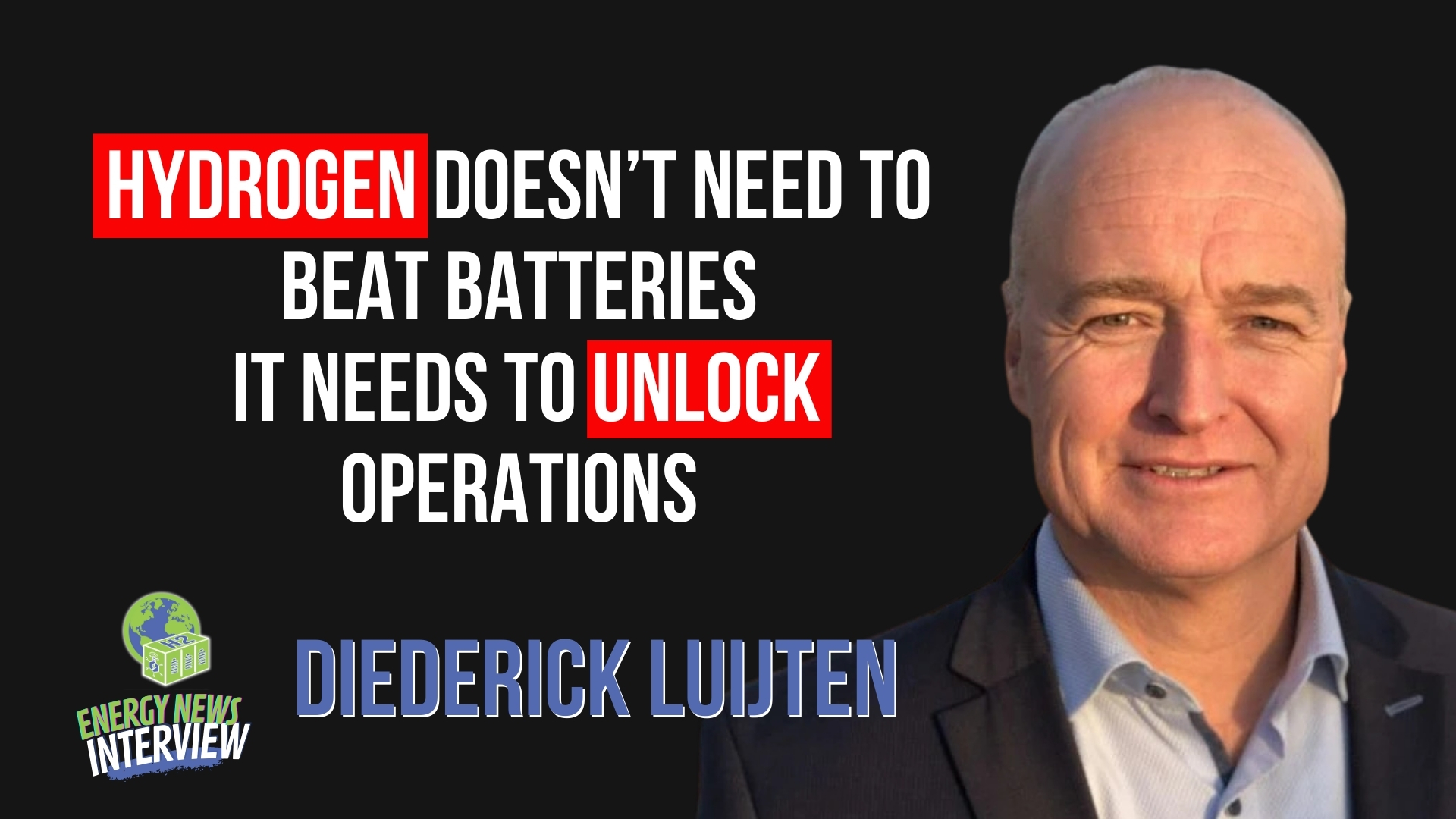

Most conversations about decarbonizing heavy transport are stuck in a childish binary: batteries good, hydrogen bad. It’s a comforting story because it’s simple. It also collapses the moment you leave a conference stage and step into a real logistics control tower.
Diederick Luijten has spent decades inside industrial gases and the last years deep in hydrogen mobility. He’s not selling a miracle molecule. He’s describing a system constraint: power availability. In parts of Europe, the grid is already saturated. Not “busy.” Not “strained.” Saturated. The punchline is brutal: you can have the best electric truck on the market and still be blocked by a single administrative sentence from the grid operator: no additional capacity available.
WATCH THE FULL INTERVIEW
That’s where hydrogen enters the chat, not as ideology but as operational math. Luijten doesn’t argue that hydrogen beats batteries on pure efficiency. He openly says battery-electric will likely dominate many use cases. The problem is that dominance assumes the grid can scale smoothly and predictably. In the Netherlands, he says, that assumption is a fantasy. Electrification is hitting everything at once: households, industry, heating, and transport. When all sectors line up at the same electrical buffet, somebody goes hungry. And trucking companies don’t have the luxury of missing delivery windows because a depot upgrade is stuck in a multi-year queue.
This is the piece the efficiency crowd conveniently ignores: logistics is not a physics classroom, it’s a schedule. A truck isn’t “decarbonized” if it can’t keep to the route plan. Luijten gives a concrete operational reason fleets start with battery-electric and then add hydrogen as the second pillar: predictability. Charging time becomes driver working time, and working time is money. On a route, “fast charging” is only fast until the second, third, and fourth truck plugs in. Power gets shared, charging slows, schedules slip, and the whole optimization model starts bleeding cost.
He describes a real retailer case: a warehouse with a large fleet trying to electrify. They got to a couple of dozen battery-electric trucks and then hit a wall. Not because the trucks failed, but because the site couldn’t secure more power. At that point, the conversation shifts from “what’s most efficient” to “what can actually scale inside the constraints we have.” Hydrogen becomes the pressure-release valve for fleets that must enter zero-emission zones and still operate minute-to-minute.
Policy is the accelerant, not the engine. Luijten makes it clear that OEM behavior is heavily driven by regulation and targets. Fleet transition isn’t happening because executives woke up enlightened. It’s happening because the rules are tightening, city centers are restricting access, and cost pressure will shift again as carbon pricing mechanisms bite harder. Subsidies matter early, but he’s blunt about the lesson from pilots: subsidizing isolated parts of the puzzle doesn’t move the market. Fragmented efforts create stranded assets. A station without trucks is a museum. Trucks without stations are a press release.
That’s why his view favors what he calls “echo islands” and captive fleets first. Build a station where trucks actually return every day, lock in baseline demand, then connect those islands into corridors. This isn’t romantic. It’s bankable. Investors don’t finance vibes; they finance utilization. Luijten claims the approach is already flipping the script versus the old strategy of building stations and waiting for customers to magically appear.
On the technology side, he’s pragmatic rather than purist. Fuel cells are the destination for zero exhaust, but hydrogen combustion engines can be the bridge because the entry cost is lower and the maintenance ecosystem is familiar. That matters more than Twitter engineers admit. A technology that is slightly less optimal but far easier to adopt can outperform in the real world because it actually gets deployed.
He also points to the boring truth behind “competitive hydrogen”: it won’t come from speeches; it comes from system integration. Curtailed renewables and off-peak power aren’t just a problem; they’re a feedstock. Electrolyzers can act as grid balancers, soak up excess generation, stabilize the system, and convert electricity into something storable and movable. That’s the hydrogen argument at its best: not as a replacement for electricity, but as a tool to keep an electricity-heavy world from breaking.
Then he says the quiet part: the transition is a value-chain coordination problem. Offtake is immature, final investment decisions stall, and everyone waits for everyone else. The only way through is consortia that align producers, station developers, OEMs, fleets, and shippers who ultimately pay. If you stay fragmented, you never load the assets, you never bring costs down, and you never reach scale.
And here’s the point that should make every “hydrogen is inefficient” commentator pause. Heavy transport is not one use case. It’s many. Short-haul depot-based fleets, long-haul corridors, city center deliveries, time-critical supply chains. Batteries will win some segments. Hydrogen will win over others. The future is not a single technology. It’s a portfolio shaped by constraints: grid access, time, payload, route design, and financing.
If you still insist it’s batteries versus hydrogen, you’re not doing analysis. You’re doing tribe politics.


