






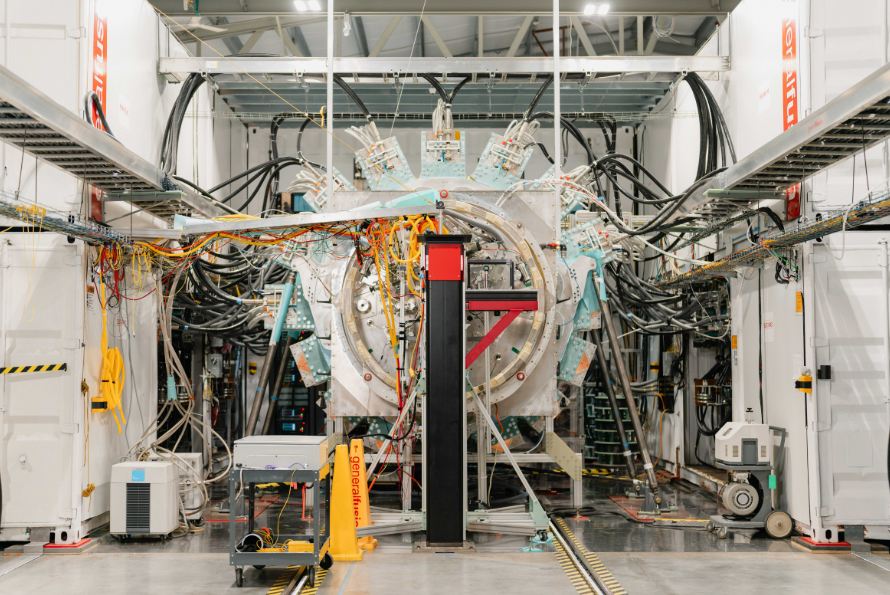
General Fusion says its Lawson Machine 26 has achieved electron temperatures of approximately 0.72 keV, or 8.4 million degrees Celsius, bringing the company closer to its first major milestone of 1 keV and offering one of the clearest demonstrations to date of its magnetized target fusion approach at commercially relevant scale.
The results, which have been submitted for peer review, arrive as competition intensifies across the fusion sector. While large magnetic confinement projects continue to pursue increasingly complex superconducting systems, several private companies are advancing alternative pathways designed to reduce capital intensity and shorten commercialization timelines. General Fusion’s strategy centers on mechanical compression using liquid metal rather than lasers or massive magnetic coils.
The latest experiments from LM26 provide a test of whether that proposition can scale beyond laboratory concepts.
According to the company, electron temperatures increased more than threefold during mechanical compression, reaching 0.72 ± 0.08 keV. Multiple diagnostic systems, including Thomson scattering and absolute extreme ultraviolet measurements, were used to validate the findings.
The significance extends beyond the absolute temperature achieved. General Fusion’s magnetized target fusion system relies on plasma heating generated primarily through mechanical compression after plasma formation, a departure from tokamak and inertial confinement architectures that require extensive external heating systems. Demonstrating meaningful compressional heating at larger scales addresses one of the central technical questions surrounding the approach.
The company also reported tenfold increases in both plasma density and poloidal magnetic field strength during compression. Those figures are comparable to, or exceed, results obtained in earlier experimental platforms despite LM26 operating at substantially larger dimensions.
Equally important for future scaling efforts was the reported stability of the plasma deep into the compression cycle. Fusion systems routinely confront instabilities that dissipate energy before useful reactions can occur. General Fusion stated that lithium from the surrounding liner did not significantly contaminate the plasma during the stable compression phase, suggesting that material interactions, a persistent challenge for liquid metal concepts, remain manageable under current operating conditions.
The experiments additionally recorded an increase in neutron production during compression. Although neutron yield alone does not indicate net energy gain, it serves as evidence that fusion reactions intensified as density and temperature rose.
The next benchmark remains 1 keV, equivalent to roughly 10 million degrees Celsius. Achieving that threshold would provide a stronger foundation for pursuing the more demanding target of 10 keV, or 100 million degrees Celsius, before eventually attempting to satisfy the Lawson criterion, the combination of temperature, density, and confinement time required for net energy production.
The gap between 0.72 keV and 1 keV may appear modest numerically, but in fusion development incremental advances often become increasingly difficult as systems move toward reactor relevant conditions. Whether LM26 can maintain stability while raising initial plasma parameters will determine how rapidly the company progresses.
General Fusion argues that its reliance on mechanical compression and liquid lithium could avoid some of the infrastructure requirements associated with superconducting magnets and high power laser facilities. That proposition carries economic implications as electricity demand forecasts continue to climb and governments expand support for low carbon generation technologies.
Yet commercial viability remains contingent on more than technical milestones. The company must ultimately demonstrate repeatable operation, acceptable component lifetimes, and a credible pathway to energy economics that can compete with increasingly inexpensive renewable power coupled with storage.
Those questions take on added importance as General Fusion prepares for a public market debut through its planned business combination with Spring Valley Acquisition Corp. III. Shareholders are scheduled to vote on the transaction in early July, with the combined company expected to list on Nasdaq under the proposed ticker GFUZ.
The timing places additional scrutiny on LM26’s progress. Fusion developers have historically faced criticism for ambitious timelines that outpaced engineering realities. Publishing technical data and submitting results to peer review may help address those concerns, but independent validation will remain essential as the company advances toward higher temperature regimes.
Support from institutions including the UK Atomic Energy Authority, Princeton Plasma Physics Laboratory, and General Atomics has strengthened diagnostic capabilities around LM26. For the broader fusion industry, collaborations between private developers and established research organizations increasingly reflect a recognition that commercialization efforts still depend heavily on scientific infrastructure built over decades of public investment.