




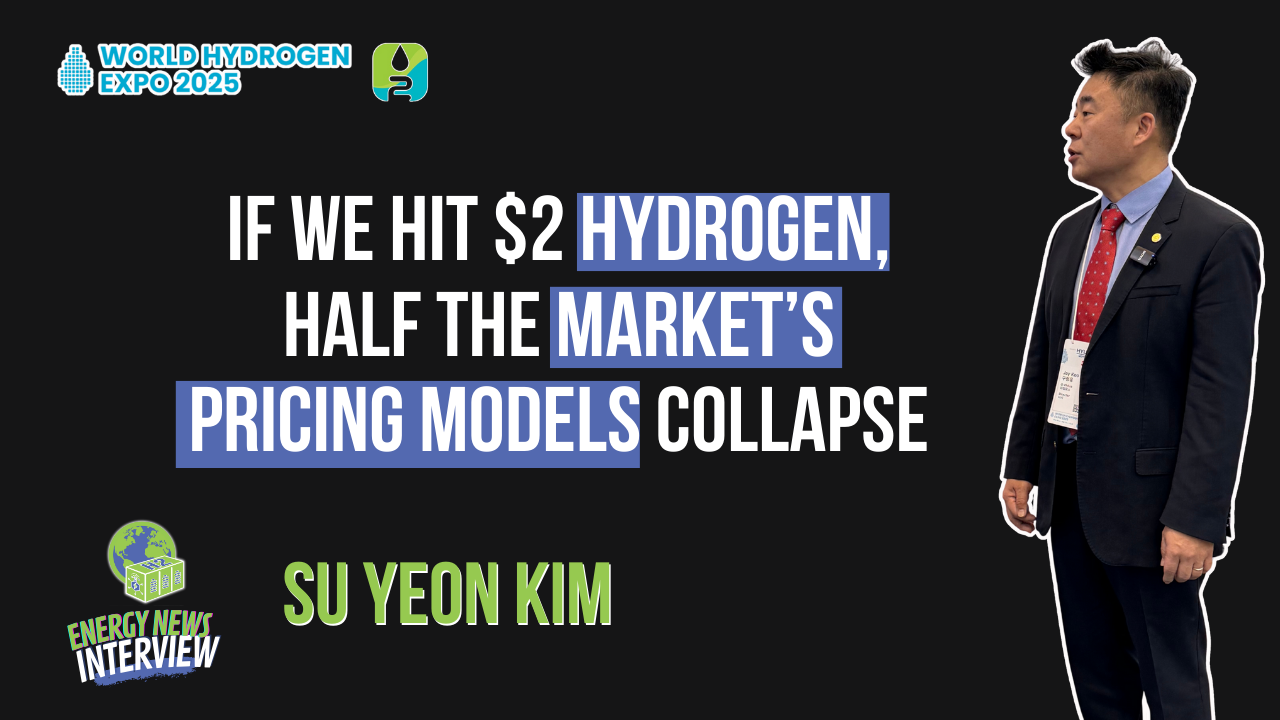
At H2 MEET 2025, South Korea–based GPhilos presented one of the more assertive performance claims in the green hydrogen sector: producing 1 kg of hydrogen using under 50 kWh of electricity.
WATCH THE INTERVIEW HERE

For an industry where many PEM systems still operate near the 52–55 kWh/kg range, this efficiency threshold is increasingly seen as a hard differentiator for project economics, particularly as renewable-powered electrolysis becomes the anchor of most national hydrogen strategies.
GPhilos’ system is built around PEM electrolysis, though the company maintains operational experience in alkaline and AEM configurations. According to Su Yeon Kim, the company’s value proposition is not only the performance metrics but the integrated design process. GPhilos engineers model each project starting from available renewable capacity, PV, wind, or hydropower, to define electrolyser sizing, system architecture, and maintenance planning. This full-cycle approach is becoming more relevant as developers weigh whether to store surplus electricity in battery energy storage systems (BESS) or convert it to hydrogen via hydrogen energy storage systems (HESS).
With more than ten project deployments in South Korea and active discussions in multiple international markets, the company is positioning itself within the segment of solution providers aiming to streamline both CAPEX and OPEX. The reference benchmark for a 1 MW green hydrogen plant remains several million dollars globally, but GPhilos argues that system-level optimization can drive meaningful cost reductions across procurement, construction, and operation.
As energy companies increasingly face curtailment challenges from high renewable penetration, the choice between electrified storage and hydrogen-based storage is shaping investment direction. GPhilos is positioning its offering at this intersection, where efficiency benchmarking and system cost reductions will determine which technologies scale fastest.
If adopted broadly, efficiency gains below the 50 kWh/kg mark would alter the competitiveness of green hydrogen projects, especially in markets where policymaking is increasingly tied to lifecycle emissions and operational transparency.