






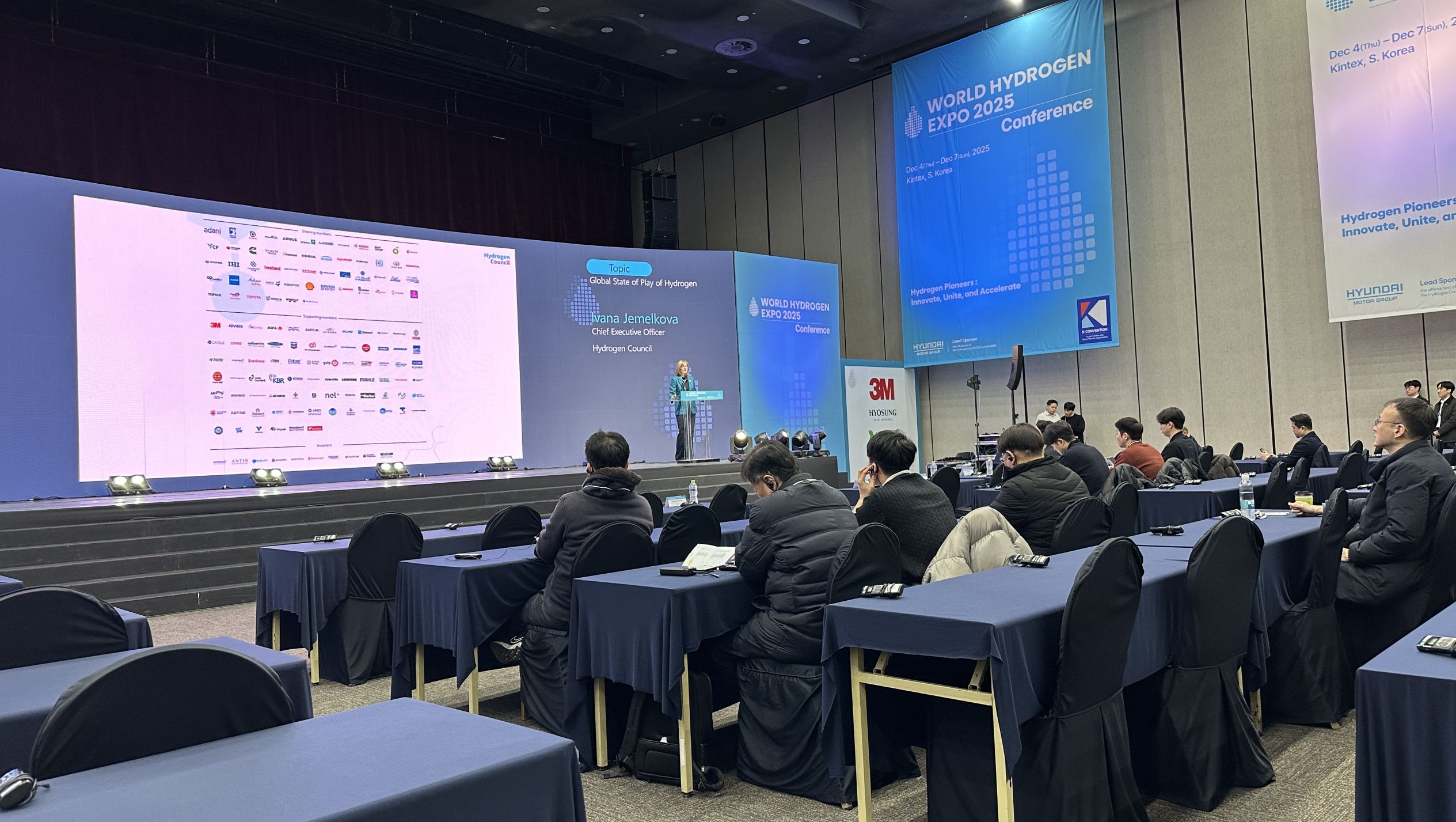
Hydrogen reached 110 billion dollars in committed capital in 2025, a tenfold increase since 2020, positioning it among the fastest-growing segments of the clean energy transition. Discussions at H2MEET in Korea highlighted an essential tension. Capital and supply are accelerating while market certainty, price mechanisms, and policy execution lag. The sector is expanding, but its trajectory now depends on a clearer definition of demand and the tools required to enable it.
Presenting insights from the Global Hydrogen Compass Report 2025, Ivana Jemelkova noted that hydrogen’s scale-up is tangible. More than 500 projects have reached final investment decision, with 83 added in the past year. Six million tonnes per year of production capacity are already committed, one million tonnes are operational, and adjusted forecasts suggest a pathway to nine to fourteen million tonnes per year by 2030. These figures show a maturing supply landscape, yet binding offtake remains significantly underdeveloped. Just 3.6 million tonnes per year are covered by firm contracts, creating structural uncertainty for both producers and investors.
Jemelkova pointed out that the solution lies in predictable and ambitious policy implementation. Europe faces delays in deploying its regulatory frameworks, North America relies on tax credit structures, and Asia is expected to provide stronger contract-for-difference mechanisms that can anchor long-term demand. Global investment patterns further complicate the picture. China accounts for 33 billion of the 110 billion dollars committed worldwide, leading in renewable hydrogen deployment and mobility uptake. North America follows with 23 billion and a dominant position in low-carbon hydrogen, while Europe remains at 19 billion and has yet to fully activate its potential as the central global demand hub.
CEO sentiment gathered for the report reinforces industry confidence but also exposes underlying dependencies. Seventy-five percent of surveyed executives reported a stable or growing appetite for investment. Ninety-seven percent view hydrogen as essential for hard-to-abate sectors, and sixty-five percent believe it will have a broad role across the economy. Yet the same group identified one overriding priority. Demand formation must accelerate, as supply growth alone cannot sustain long-term momentum.
Markus Exenberger of H2Global outlined the structural reason for this imbalance. The market suffers from an absence of reliable price signals. Without a clear reference price, producers hesitate to commit, and offtakers cannot evaluate long-term exposure. H2Global’s approach centres on simulating real market conditions through an intermediary trading model. It signs long-term ten-year offtake contracts with producers and resells the hydrogen or derivatives through annual contracts designed to generate fresh price signals each year. This model narrows the gap between production costs and achievable market prices, offering investors and developers a transitional framework while the broader market matures.
Exenberger argued that contract-for-difference mechanisms will become central but require functioning price discovery. H2Global’s auction structure, supported by more than nine billion euros in government commitments, reflects an effort to accelerate the market toward a tipping point estimated at seven to eight percent penetration. Once reached, he suggested, the hydrogen economy could become self-sustaining. Regional auctions active across the Americas, Africa, Asia, and Europe also demonstrate a shift toward diversified procurement strategies.
Neal Won of S&P underscored the importance of policy design across supply chains. Many major markets are now moving from fragmented to comprehensive support schemes, with incentives placed on both production and consumption. However, he noted that infrastructure support remains the least defined component globally. Infrastructure is essential not for initial activation but for sustained scale-up, and gaps in storage, transport, and conversion capacity risk slowing otherwise promising deployment curves.
The discussions at H2MEET converged on several shared insights. Supply growth is strong and accelerating faster than most forecasts from only a few years ago. Policy tools are becoming more sophisticated, and corporate confidence remains high. Yet supply strength cannot compensate for weak demand visibility. The next phase of the hydrogen economy will hinge not on project announcements but on an integrated approach to market design, policy execution, and price discovery.