



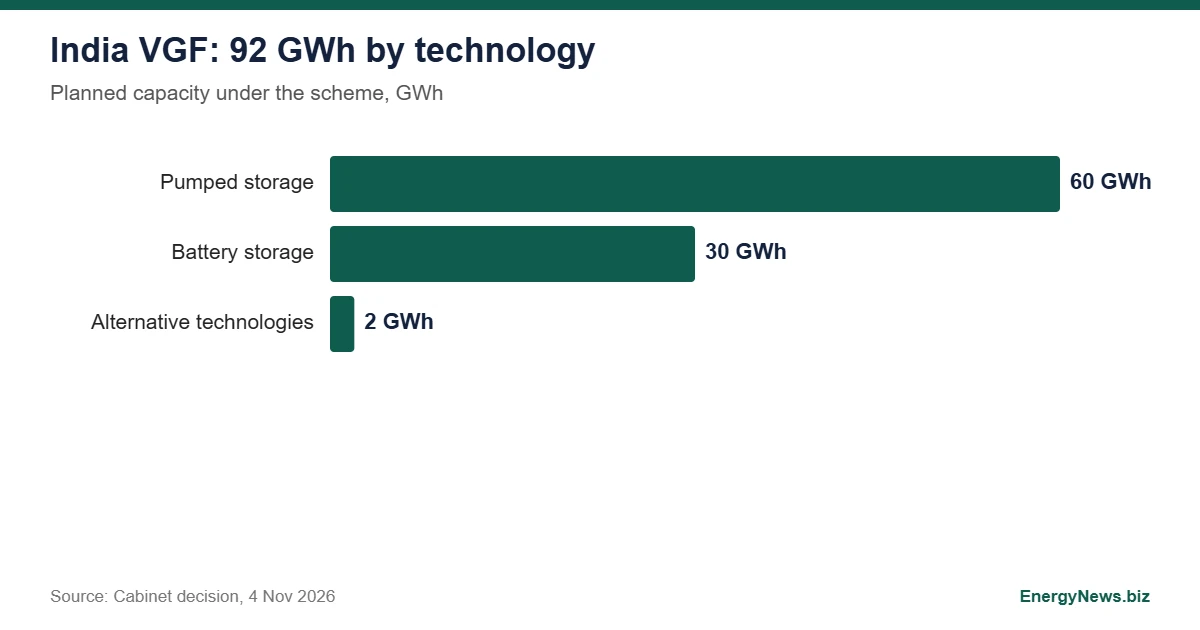
India’s Union Cabinet approved a Viability Gap Funding scheme on 4 November 2026 that commits Rs 14,500 crore to 92 GWh of grid-scale energy storage between FY 2026-27 and FY 2030-31. The India VGF scheme, as set out by the Prime Minister’s office, backs 60 GWh of pumped storage, 30 GWh of battery storage and 2 GWh of alternative technologies, against a total estimated investment of Rs 97,600 crore.
Pumped storage takes two thirds of the capacity
Most coverage of storage in India concentrates on batteries. The scheme tells a different story: 60 of the 92 GWh, or 65%, is pumped hydro, with batteries at 33% and alternative technologies at 2%. The announcement gives no split of the Rs 14,500 crore between the three, so the subsidy per technology is not known.
What the subsidy covers
The VGF amounts to 14.9% of the Rs 97,600 crore estimated investment, so developers and distribution companies carry the other 85%. Spread over 92 GWh, the support averages Rs 157.6 crore per GWh (ENB calculation, Rs 14,500 crore divided by 92 GWh, averaged across all three technologies even though pumped storage and batteries have very different capital costs per GWh).
Capacity will be allocated through tariff-based competitive bidding. Public and private electricity distribution companies are eligible for support on battery and pumped storage projects, while alternative technologies are implemented by public and private entities. Battery projects must meet a minimum domestic content requirement of 40%, a condition intended to push demand toward Indian manufacturing and reduce import dependence.
The 411 GWh target and the gap that remains
The government states that the scheme creates capacity equal to 170% of today’s grid-scale storage and supports the 411 GWh needed by 2031-32. Working backwards, 92 GWh at 170% implies about 54 GWh of capacity today (ENB calculation, which assumes the 170% refers to the existing capacity including pumped storage). The gap to 411 GWh is then about 357 GWh, and the scheme covers 26% of it.
That leaves roughly 265 GWh to come from projects outside this scheme: private merchant storage, existing pumped storage plans and further subsidy rounds. None is quantified in the announcement.
What is not in the announcement
There is no bidding calendar, no state allocation, no cap on subsidy per GWh and no penalty for delay. The scheme period runs to FY 2030-31 and the target date is 2031-32, which leaves one year between the last subsidised commissioning and the target. The announcement notes that the 92 GWh is capacity yet to be commissioned.
Coverage of storage policy on ENB continues in the energy storage section. The first dated check is the publication of bidding guidelines, which the announcement does not schedule.
Add EnergyNews.biz as a preferred source on Google


