





Japan is moving from hydrogen technology demonstrations toward commercial infrastructure with the development of the Kawasaki LH2 Terminal in Ogishima, about 30 kilometers south of Tokyo. Kawasaki Heavy Industries has selected ABB to supply the facility’s distributed control and safety systems as Japan works to establish an international liquefied hydrogen supply chain.
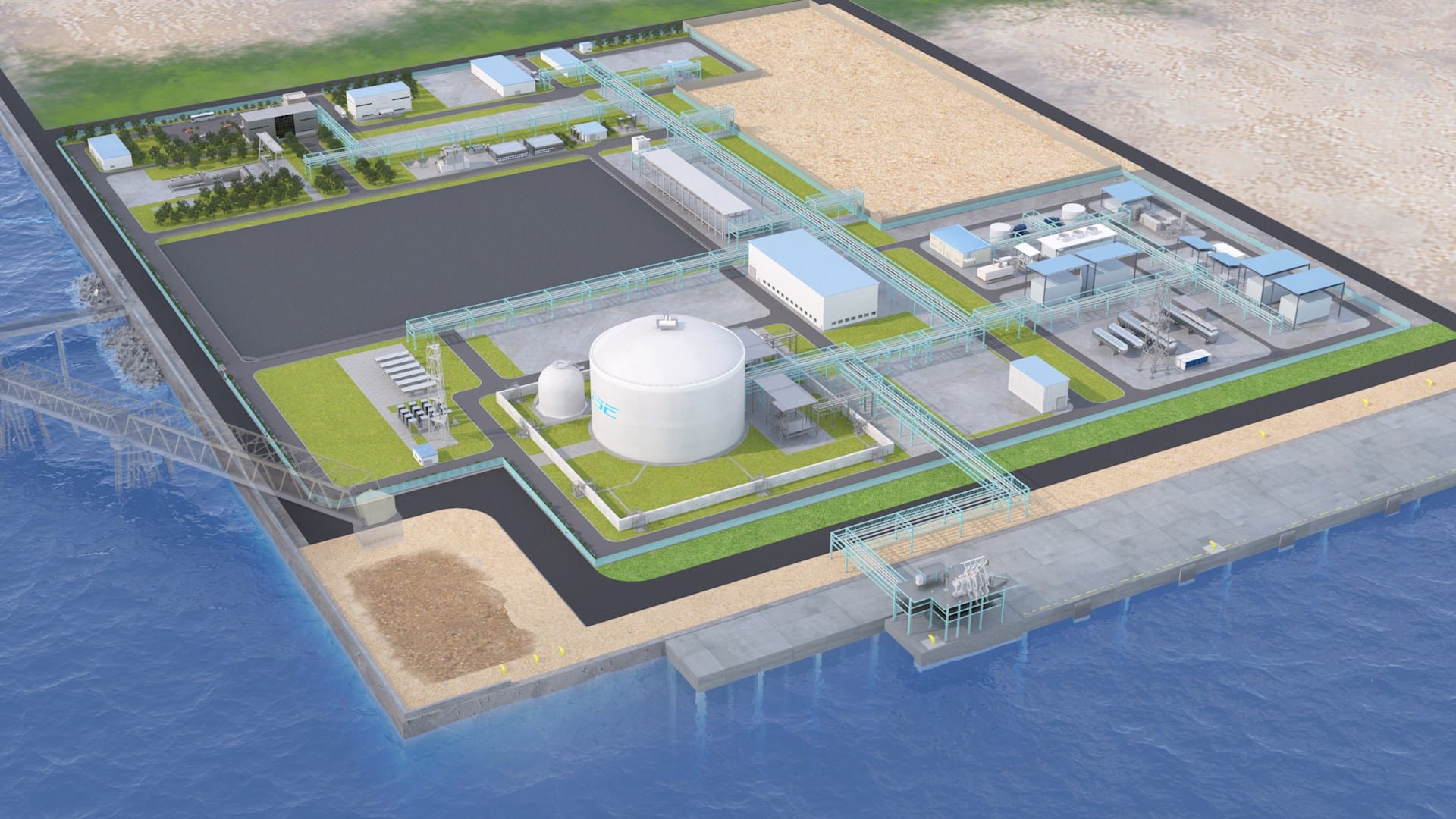
Supported by the New Energy and Industrial Technology Development Organization under its Green Innovation Fund, the project is expected to complete its demonstration phase by 2030. The terminal will include a 50,000 cubic meter liquefied hydrogen storage tank, cargo handling facilities, liquefaction and hydrogen gas supply systems, and lorry dispatch infrastructure.
The project addresses a central challenge for Japan’s hydrogen strategy: the country expects imports to play a significant role in meeting future demand because domestic energy resources are limited. Japan’s hydrogen targets call for hydrogen use to reach 3 million tonnes annually by 2030, 12 million tonnes by 2040 and 20 million tonnes by 2050.
Liquefied hydrogen offers a way to transport hydrogen over long distances because cooling it to approximately minus 253°C reduces its volume to around one eight-hundredth of its gaseous state. However, that advantage comes with significant energy and infrastructure requirements, including liquefaction, cryogenic storage, specialized vessels and receiving facilities.
The Kawasaki terminal is intended to demonstrate whether these components can operate as an integrated commercial supply chain. NEDO identifies safety, reliability, durability and economic performance as key requirements for commercialization.
ABB’s System 800xA will integrate process control, safety functions and operational data, supported by a SIL 3 safety instrumented system and redundant controllers. The system will cover critical processes from liquefaction and storage to loading, unloading and distribution.
The economics remain a central issue. Japan’s government has introduced financial support mechanisms to address the cost gap between low carbon hydrogen and conventional fuels, recognizing that hydrogen infrastructure requires substantial upfront investment.
The terminal also highlights the difference between producing hydrogen and delivering it as an energy commodity. The climate value of imported hydrogen will depend on its production pathway, electricity or feedstock source, and emissions across liquefaction and transportation. Infrastructure alone does not guarantee low carbon supply.
The Kawasaki project builds on Japan’s earlier Hydrogen Energy Supply Chain demonstration, including the Hy touch Kobe receiving terminal. Its next test is whether liquefied hydrogen can move beyond pilot operations into a reliable and economically viable international supply chain.
For Japan, the outcome will influence more than one terminal. It will help determine whether imported hydrogen can become a scalable component of the country’s energy system, linking overseas production with domestic industrial and energy demand.