





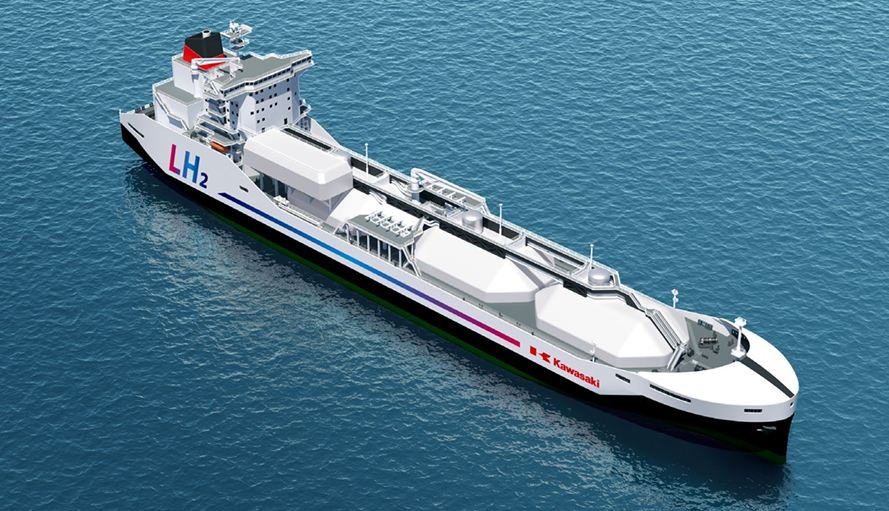
Kawasaki Heavy Industries and Japan Suiso Energy have signed a contract to build what they describe as the world’s largest liquefied hydrogen carrier, with a cargo capacity of 40,000 cubic meters.
The vessel will be constructed at Kawasaki’s Sakaide Works and deployed under the New Energy and Industrial Technology Development Organization Green Innovation Fund program, which aims to demonstrate a commercial scale liquefied hydrogen supply chain by fiscal year 2030. The scale-up is significant. Kawasaki’s first liquefied hydrogen carrier, the SUISO FRONTIER, completed pilot operations in 2022 with a capacity of just 1,250 cubic meters, underscoring how early the sector remains in its development.
Liquefied hydrogen transport presents challenges that differ materially from LNG shipping. Hydrogen must be cooled to around minus 253 degrees Celsius, far colder than LNG, and its low density reduces volumetric energy efficiency. The new carrier’s design focuses on addressing these constraints through high performance insulation systems intended to limit boil off gas generation during long voyages. Managing boil off is critical, as excessive losses would undermine the economics of liquid hydrogen transport over intercontinental distances.
Kawasaki’s design integrates a dual fuel electric propulsion system that can operate on conventional oil fuel as well as hydrogen. A dedicated hydrogen gas supply system, including compressors and heat exchangers, allows boil off gas from the cargo tanks to be used as propulsion fuel. This approach mirrors LNG carrier practices but introduces additional complexity due to hydrogen’s combustion properties and lower volumetric energy density. While the company highlights reduced carbon dioxide emissions during transport, the actual emissions benefit will depend on operational profiles and the carbon intensity of the hydrogen being shipped.
Cargo handling is another focal point. The vessel will be equipped with double wall vacuum jacketed piping to maintain cryogenic temperatures during loading and unloading between ship and shore. This system is designed to support high throughput transfers while minimizing heat ingress, a requirement for scaling beyond demonstration projects. Japan Suiso Energy plans to pair the vessel with the liquefied hydrogen terminal under construction at Ogishima in Kawasaki City, creating an integrated ship to base demonstration environment.
From an efficiency perspective, the vessel’s hull form and draft have been optimized for the low density of liquefied hydrogen, allowing lower propulsion power requirements than would otherwise be expected for a ship of this size. The carrier is designed for a sea speed of approximately 18 knots, comparable to large LNG carriers, suggesting that Kawasaki is aiming for compatibility with existing maritime logistics expectations.
Safety remains a central issue for hydrogen shipping. The hydrogen fuel system, cargo handling systems, and associated gas supply infrastructure have undergone risk assessments, with safety measures intended to protect crew, vessel integrity, and the surrounding environment. However, large scale liquid hydrogen shipping has limited operational history, and insurers and regulators are likely to scrutinize real world performance data as demonstration projects progress.
The project reflects Japan’s broader industrial policy. Kawasaki and Japan Suiso Energy are using public funding to de risk early commercialization while building domestic expertise in hydrogen maritime infrastructure. The choice to scale directly to a 40,000 cubic meter vessel signals confidence that future hydrogen trade volumes could justify assets approaching commercial relevance, even though global hydrogen demand today remains dominated by captive industrial use rather than international trade.
Whether liquefied hydrogen shipping can compete economically with alternatives such as ammonia or synthetic fuels remains an open question. Liquefaction energy penalties, specialized vessels, and terminal infrastructure all add cost. The demonstration program is therefore less about immediate competitiveness and more about validating performance, durability, and system integration under ocean going conditions.