


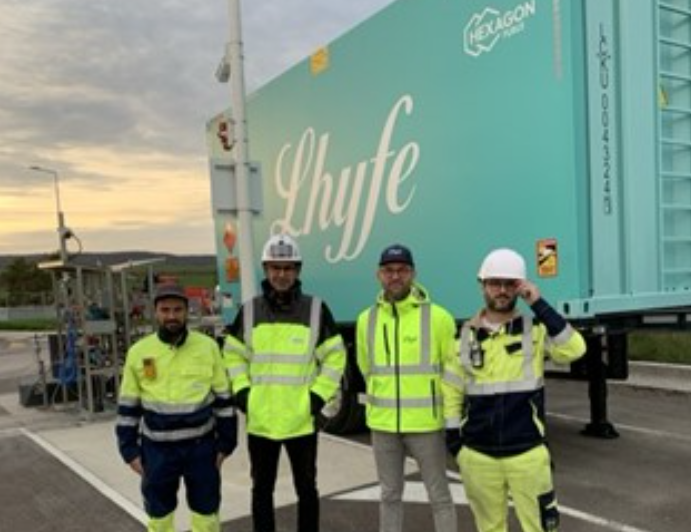

Lhyfe’s supply of France’s first motorway hydrogen station accessible to heavy goods vehicles marks a tangible shift from hydrogen mobility pilots to operational logistics infrastructure.
Since November 2025, Lhyfe has been supplying renewable hydrogen to a station operated by TEAL Mobility on the A4 motorway in France’s Grand Est region. The location is strategically positioned on one of Europe’s busiest east-west freight routes, connecting Paris to Germany and the Benelux countries while intersecting north-south corridors critical for long-haul trucking. For hydrogen mobility, geography matters as much as production, and motorway access has been a persistent bottleneck for fuel cell trucks.
The agreement between Lhyfe and TEAL Mobility is structured as a multi-year supply contract, signaling a move away from short-term demonstration deployments. While the station itself does not change the economics of hydrogen trucking overnight, it addresses a core structural constraint: the lack of refueling infrastructure compatible with heavy-duty vehicles operating on trans-European routes. Industry data from ACEA show that fewer than 10 hydrogen refueling stations in Europe are currently designed to accommodate trucks, despite OEMs such as Daimler Truck, Volvo Group, and Hyundai accelerating fuel cell truck rollouts.
Production scale remains the central challenge. Lhyfe currently operates four renewable hydrogen production sites in France and Germany with a combined installed capacity of 21 MW. The company has indicated that this capacity is set to increase by around 70 percent in 2026, reflecting broader industry pressure to align supply growth with emerging demand from mobility and industrial offtakers. Even with that expansion, volumes remain modest relative to projected freight sector needs, underscoring why corridor-based deployment is favored over nationwide coverage at this stage.
Certification is another differentiator in an increasingly crowded hydrogen market. In May 2025, Lhyfe became the first French producer to deliver hydrogen certified as RFNBO, the EU’s most stringent classification for renewable hydrogen under the Renewable Energy Directive. Between May and September 2025, all four of its operating sites achieved RFNBO certification. For mobility applications, this is not a branding detail but a regulatory one, as only RFNBO-compliant hydrogen qualifies toward renewable transport targets and avoids future penalties under tightening EU climate rules.
Logistics capability often determines whether hydrogen projects scale or stall. Lhyfe operates a fleet of 70 type IV high-pressure containers, positioning it among the larger dedicated hydrogen transport fleets in Europe. In a market where production sites are often distant from end users, transport reliability directly affects station uptime and total cost of ownership for fleet operators. This operational layer is frequently overlooked in project announcements but remains decisive for commercial viability.
From a market perspective, the Reims Champagne Nord station illustrates how hydrogen mobility is evolving unevenly across Europe. Germany, the Netherlands, and parts of Scandinavia have already seen early deployment of fuel cell trucks supported by regional subsidies and industrial demand. France has lagged in motorway-accessible infrastructure, making the A4 station a notable inflection point rather than a symbolic addition. Its role as a connector between national hydrogen ecosystems may prove more significant than its standalone throughput.
Lhyfe’s positioning as a supplier to heavy-duty hydrogen stations also reflects a strategic bet that freight transport will adopt hydrogen faster than passenger vehicles, where battery-electric solutions are already dominant. While fuel cell trucks still face cost hurdles, particularly around vehicle pricing and hydrogen supply costs, regulatory pressure on diesel freight and expanding zero-emission zones are narrowing the window for incremental solutions.


