




Poland’s government adopted the updated Polish Nuclear Power Programme on 29 September 2026, and the headline is a delay: the first plant at Lubiatowo-Kopalino to reach commercial operation in 2036, three years after the 2033 of the 2020 programme, and a second plant in 2040, one year later than planned. The date is not new, though. The 2036 target for the first unit has been in official documents since March 2025.
The update therefore confirms a schedule rather than moving it. The risk that matters sits in the sequence between now and 2036: a construction permit that the regulator has not yet issued, first nuclear concrete scheduled for 2028, a PLN 178 billion investment that depends on state guarantees, and a second plant with neither a site nor a technology partner chosen.
PLN 178 billion, PLN 60 billion of it public equity
The European Commission cleared Polish state aid for the first plant on 9 December 2025. The package is a PLN 60 billion (€14.2 billion) capital injection into the state owned developer Polskie Elektrownie Jądrowe between 2025 and 2030, state guarantees covering all of the project’s debt, and revenue stability over a 40 year plant life through a two way contract for difference. The Commission’s statement puts total investment at PLN 178 billion (€42 billion) for up to 3.7 GW, built as three AP1000 reactors of 1,250 MW each.
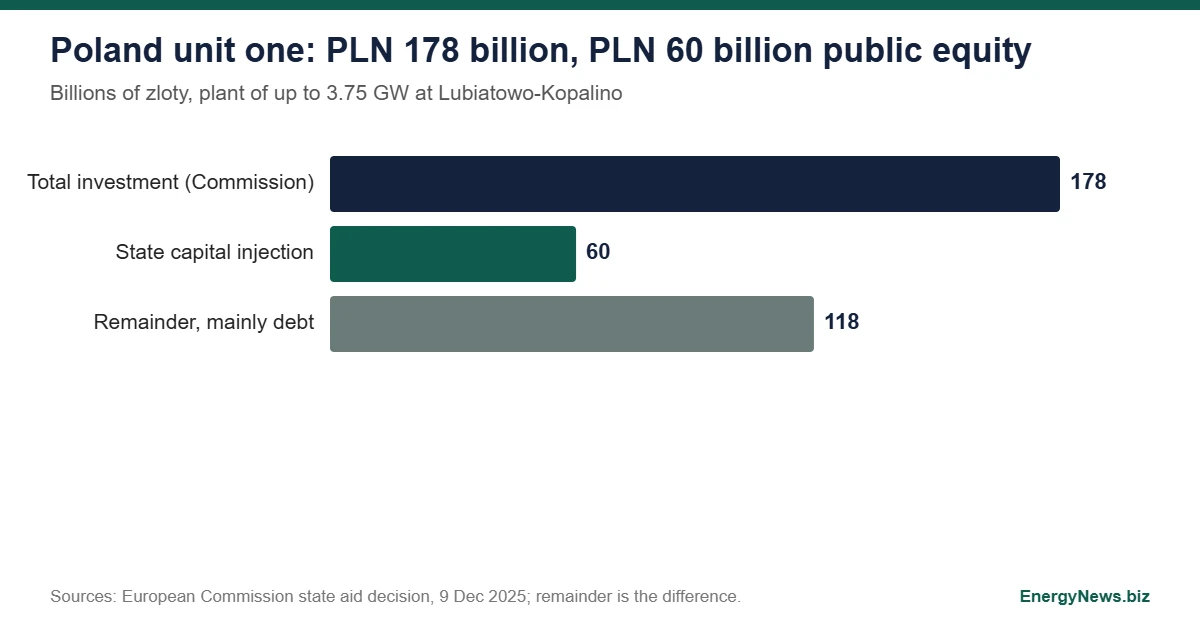
Divided by the 3.75 GW of the three units, €42 billion is about €11,000 per kW. That is an investment estimate for a first of a kind build in a country without a commercial reactor, not a price, and the Commission’s equity share of roughly 30 percent leaves about PLN 118 billion to be raised as guaranteed debt. The guarantee is what makes the number financeable and what places the exposure on the Polish state.
Four documents, one date
In March 2025 a director in the then Ministry of Industry presented the update assumptions with first power from unit one in 2036 and construction works from 2028. A June 2025 draft, open for consultation until 25 July 2025, stated commercial operation of the first unit in 2036 and first nuclear concrete in 2028. The Ministry of Energy published the draft update on 24 June 2026, and a commentary from the Łukasiewicz research network that month described a more realistic schedule that accounts for dependencies between the two plants, grid infrastructure, the regulator and staffing. The government adopted the final text on 29 September, with energy minister Miłosz Motyka describing up to 9 GWe of new nuclear capacity in total.
Against that record, three years of delay is a comparison with 2020, not news from this week. What changed on 29 September is that the date is now government policy, not a draft.
The permit clock against first concrete in 2028
The developer applied to the National Atomic Energy Agency for a construction permit in March 2026. The dossier runs to more than 40,000 pages, and according to reports the regulator has up to 24 months to rule. If it takes the full window, the decision lands around March 2028, only months before the fourth quarter 2028 date for first nuclear concrete. A shorter review would buy margin, and the programme does not say how much.
The programme’s own sequence after that: unit one in commercial operation in 2036, units two and three in 2037 and 2038. The second plant, with construction from 2032 and a first unit in 2040, still lacks a final site and a technology partner. Companies from the United States, France and Canada are reported to be competing.
The small reactor track runs separately
The same week produced a second nuclear signal that does not depend on the 2036 date. On 23 September the US State Department welcomed an industry initiative among GE Vernova, Hitachi, Samsung C&T and Poland’s SGE to advance deployment of the BWRX-300 small modular reactor across Europe, and said the consortium aims to promote over $150 billion in reactor investments in the coming years. That is a claim of intent from a government that supports the consortium. For the economics of the reactor itself, see how the BWRX-300’s European fleet plan rests on a $5.6 billion first unit.
The test for Poland is dated. The permit decision from the regulator, first nuclear concrete in the fourth quarter of 2028, and the choice of site and partner for the second plant are the three checks the 2036 date has to pass. Source for the programme commentary: Łukasiewicz commentary on the draft update, June 2026; the European Commission statement of 9 December 2025; US State Department statement of 23 September 2026; Motyka announcement of 29 September 2026.
Add EnergyNews.biz as a preferred source on Google


