




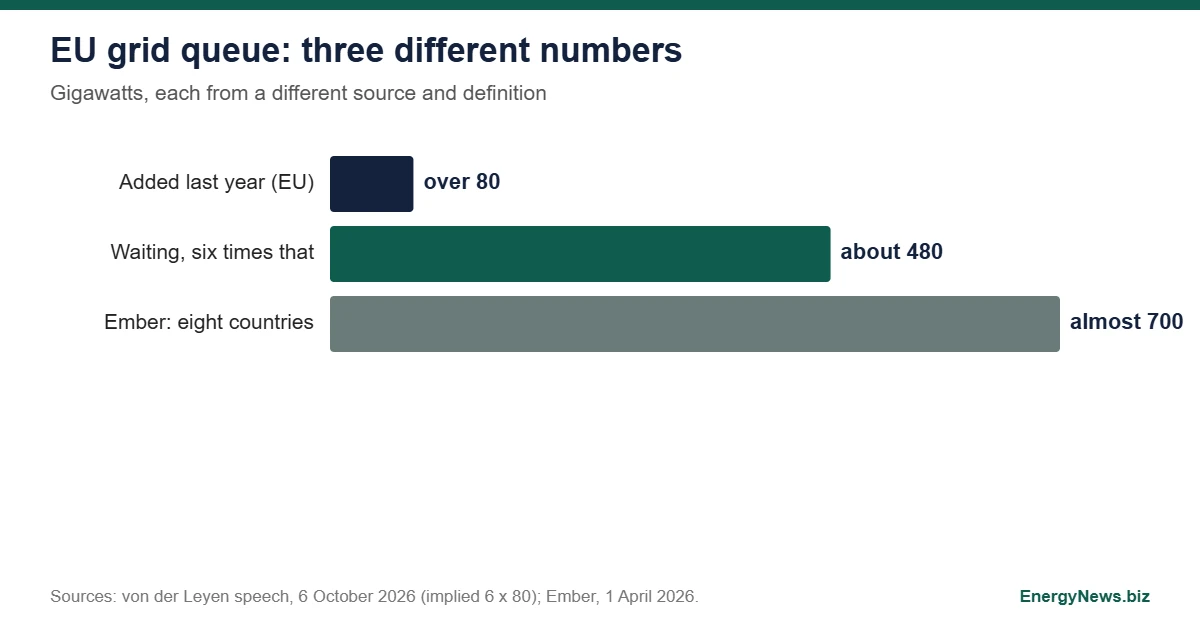
More than 80 GW of renewable capacity installed in the EU last year, and six times that waiting for a grid connection. Commission President Ursula von der Leyen used those two figures in her speech to the European Parliament on 6 October 2026, and drew the conclusion in two words: it is wasted. The EU grid queue she described is the case she makes for the Grids Package, which she asked Parliament to agree by the end of the year.
The speech set the figure against a price shock. Gas prices have risen 140 percent since the end of February, she said, diesel prices have doubled, and imported fossil fuels have cost Europe an extra €100 billion. In that setting a grid queue reads as unused cheap power. Whether it is depends on what the queue is made of, and the speech does not say.
80 GW built, six times that waiting
Six times 80 GW is about 480 GW, or roughly six years of building at last year’s pace if every queued project connected. The speech gives no breakdown by technology, country or permit status. It pairs the grid figure with a wider claim: wind and solar together produced more electricity last year than all fossil fuels combined, and more than 70 percent of EU electricity now comes from renewables and nuclear.
The remedy sits in the Grids Package that the Commission published on 10 December 2025. Its press release promises EU level infrastructure planning, faster permitting and a fairer split of cross border costs, selects eight Energy Highways for priority treatment, and proposes a five fold increase in the Connecting Europe Facility energy budget, from €5.84 billion to €29.91 billion in the 2028 to 2034 budget.
Ember’s almost 700 GW in eight reporting countries
The think tank Ember counted differently. Its 1 April 2026 analysis found almost 700 GW of renewables stuck in grid connection queues across the eight countries that report the data. Eight countries therefore already exceed the figure implied for the whole EU, so the two numbers measure different things: one is derived from a speech, the other from published queue data in a subset of countries. Neither says how much of the queued capacity holds land rights, financing or a permit.
Ember also reported that only four countries keep headroom for new large loads, and that Denmark’s transmission operator Energinet paused new grid connections in March 2026 after a surge of requests from data centres, batteries and power to X plants. The queue problem is already one of rationing at the operator level, not just a delay in building lines.
Finland: 68 GW of consumption against 13 GW of generation
Queues are not only about generation. Fingrid, Finland’s transmission operator, said in its half-year report of 23 July 2026 that over the previous 12 months it received connection enquiries of about 68 GW for electricity consumption, about 13 GW for generation and about 32 GW for energy storage. It concluded some 50 new connection agreements in that period, around a third for data centres.
Consumption enquiries outnumber generation enquiries by more than five to one. A queue measured in generation alone misses most of the pressure on at least one Nordic grid, and a package that fixes generation connections while leaving demand connections to national rules leaves the larger queue untouched.
€145 against €70 a megawatt hour, and a 15 percent interconnection target
The speech gave a price comparison to make the same point from the consumer side: in one member state a megawatt hour of electricity costs around €145 and gas sets the price, while in another it costs around €70 and nuclear and renewables set it. The Commission’s December 2025 release adds that several member states are not on track for the 15 percent interconnection target for 2030, that industrial electricity cost €0.199 per kWh in the EU in 2024 against €0.082 in China and €0.075 in the US, and that household prices in the first half of 2025 ran from €0.3835 per kWh in Germany to €0.1040 in Hungary. The Commission links a key part of that gap to insufficient investment in and integration of infrastructure.
Single projects show the same clock. LionLink’s rise to 2 GW still has to pass a development consent examination, and Tata Steel’s grid connection, contracted for 2027, is now not due until 2029.
From the 15 to 16 October summit to a year end deadline
The speech was given in preparation for the European Council meeting of 15 to 16 October 2026. Von der Leyen said the Commission will bring forward measures to deliver the Electrification Action Plan in the coming months, a plan that aims to double electricity’s share of final energy consumption by 2040 from under a quarter today and that she says could cut fossil fuel imports by €260 billion a year.
Great Britain shows what a queue reform looks like in practice: NESO cut a queue of more than 700 GW to a 283 GW pipeline and then warned that an offer is not a project. On the EU side, member states agreed the Council’s negotiating position on the Grids Package on 26 June 2026, and talks with Parliament start once Parliament adopts its own position, with a final agreement targeted for 2026 (Council of the EU, 26 June 2026).
The test for the queue figure is specific. Any published count has to state technology, voltage level and permit status, and the Grids Package has to show whether queues shrink because projects connect or because requests are removed. Until then 480 GW, almost 700 GW and the Finnish 113 GW of combined enquiries describe different things, and none of them is a measure of power that was built and left idle.
Sources: Speech by President von der Leyen at the European Parliament plenary debate, 6 October 2026; European Commission press release IP/25/2945 of 10 December 2025; Fingrid group half-year report, 23 July 2026; Ember analysis of 1 April 2026.
Add EnergyNews.biz as a preferred source on Google


