




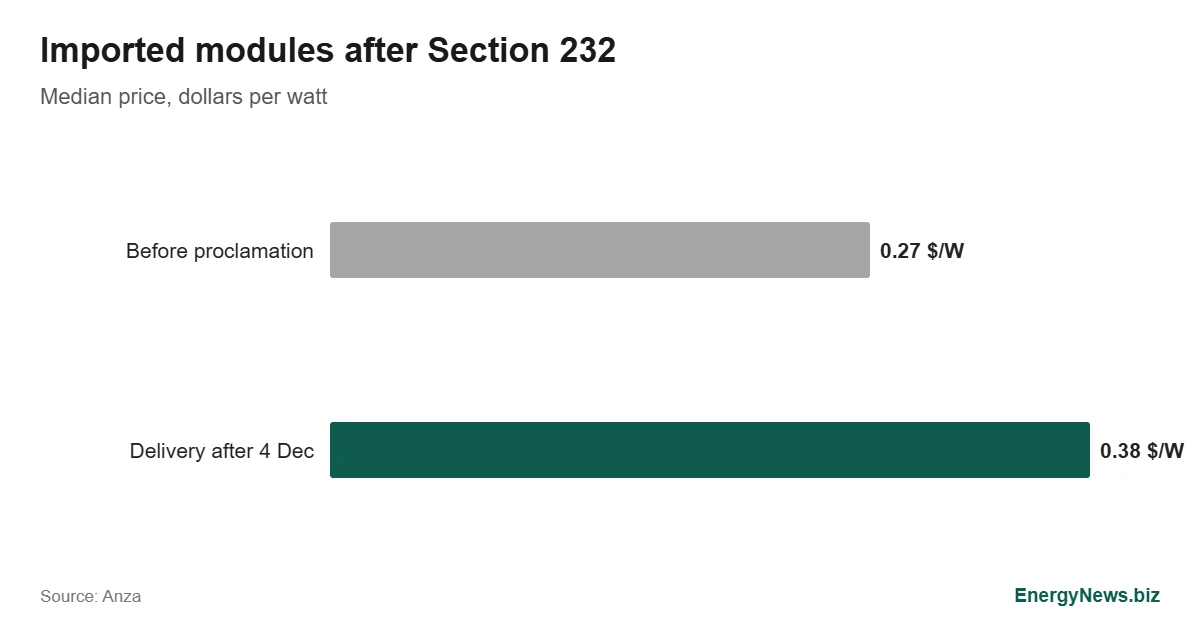
US Section 232 trade measures on polysilicon and its derivatives take effect on 4 December at 12:01 a.m. Eastern Time, and the solar market has already moved. According to data from the procurement platform Anza, the median price of imported solar modules rose from $0.27 per watt before the August proclamation to $0.38 per watt for delivery after 4 December, among suppliers that have repriced. That is an increase of more than 40%.
President Trump signed the proclamation on 6 August 2026 after a 13-month investigation by the Department of Commerce.
What Section 232 does
The measures set minimum import prices at every stage of the solar value chain: polysilicon, ingots and wafers, cells and modules. They also add a 15% tariff on products made with polysilicon. Unlike earlier safeguards, the minimum prices apply regardless of the country of origin. The Section 201 safeguard on solar imports expired in February 2026, and Section 232 replaces it with a much broader regime.
Products that enter the US before 4 December are not subject to the new rules. To stop importers from building up large stocks before the deadline, the Commerce Department introduced anti-stockpiling rules that can restrict imports from companies found to be hoarding polysilicon products.
What it means for a 100 MW project
An increase of $0.11 per watt sounds small. For a 100 MW solar plant, it adds about $11 million to the module bill. For utility-scale developers working on thin margins, that can decide whether a project still meets its power purchase price.
Anza said that by early September, 55% of active suppliers on its platform had already adjusted prices, covering 65% of the modules listed. It also reported that quotes for delivery after 4 December were up about 15% in a later round of data, suggesting that prices will keep rising after the start date.
“The industry has been preparing for potential Section 232 impacts for months, and we are now entering the most critical procurement window,” said Aaron Hall, president of Anza. The company advises developers to prioritise inventory already in the US and to check which shipments can clear customs before the deadline. Delays at ports could leave cargoes on the wrong side of the cut-off.
Section 232 also changes how procurement contracts are written. Developers are adding clauses on who carries the risk if a shipment misses the deadline, and some suppliers are offering prices only for modules already in US warehouses. Module prices had fallen to about $0.34 per watt in the first quarter of 2026, compared with $0.43 a year earlier, so the new measures reverse more than a year of falling costs for projects that rely on imports.
Winners and losers
Manufacturers with US production, especially those integrated from cell to module, stand to gain. First Solar’s chief executive has called for bipartisan support for the tariff programme. Analysts at Wood Mackenzie say the measures will materially raise the cost of solar in the US and strengthen the case for integrated domestic manufacturers. Developers and buyers of solar power will carry most of the higher cost.
The Section 232 action comes as Congress debates permitting reform, covered in our report on the BAAJA vote. Cheaper permitting and more expensive equipment pull project economics in opposite directions.
For buyers, the practical advice from procurement firms is to lock in supply now and to check the origin documents of every shipment. The figure to watch is the share of US module demand met by imports in the first quarter of 2027. Proclamation details are available from the US Department of Commerce.
Add EnergyNews.biz as a preferred source on Google


