


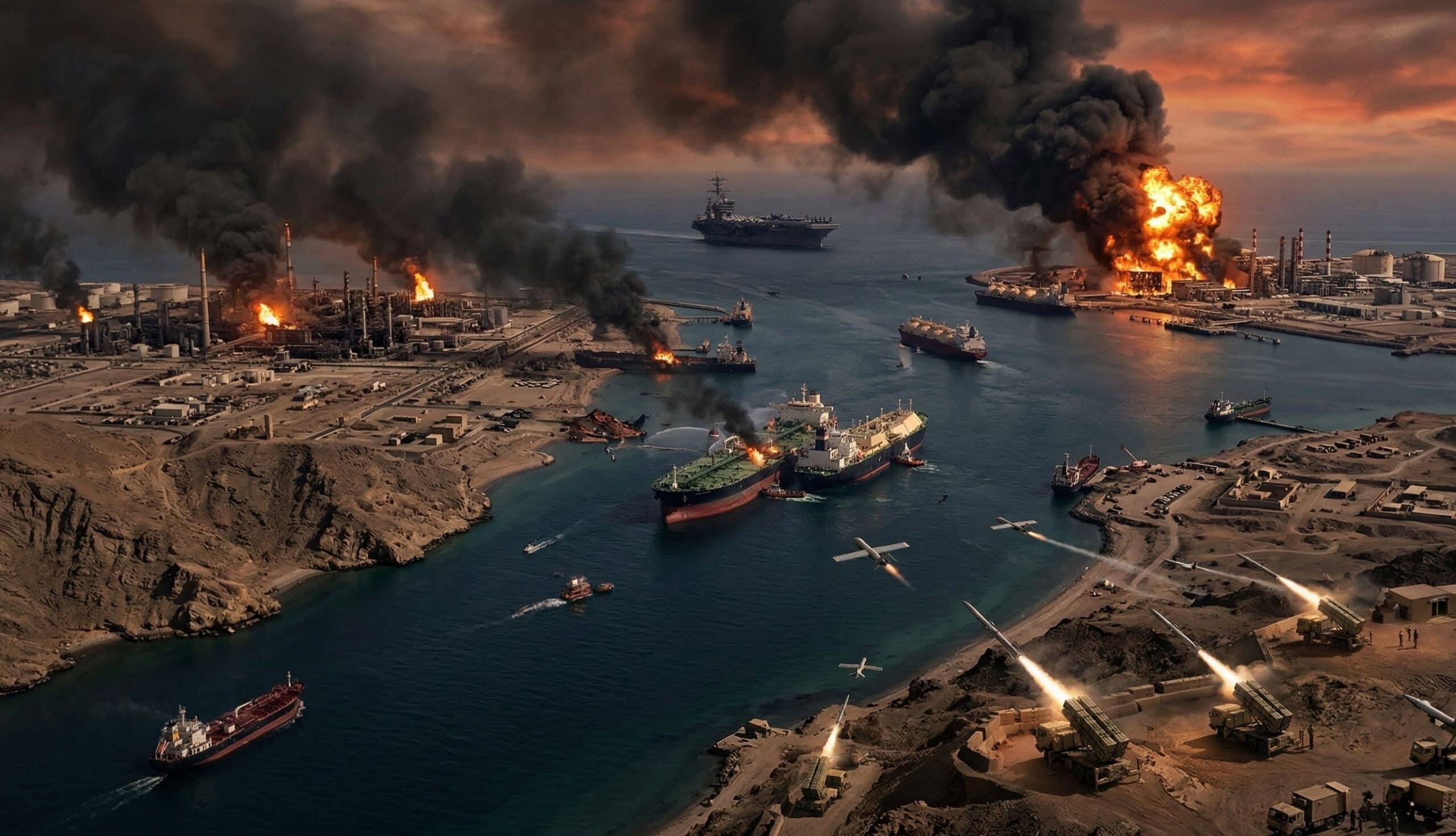

Tanker transits through the Strait of Hormuz have fallen by 90 percent since the conflict began, removing approximately 20 million barrels of daily oil flow from a waterway that also carries a fifth of global LNG production. The disruption is not primarily a shipping bottleneck. It is a simultaneous assault on the physical infrastructure that turns hydrocarbons into tradeable commodities, and the damage already inflicted on refineries, liquefaction plants, and storage systems reveals how quickly the architecture of global energy supply degrades when its most concentrated node comes under sustained attack.
The strike on Saudi Arabia’s Ras Tanura refinery, one of the largest in the world, forced a shutdown that Energy Aspects’ head of geopolitics Richard Bronze estimated would keep the facility offline for at least a week in base-case modeling. Fears of a follow-on attack on Dhahran, where Saudi Aramco is headquartered and which serves as the kingdom’s primary oil production hub on the east coast, prompted the U.S. embassy to issue an imminent threat warning to residents. A strike on Dhahran’s production infrastructure would represent an order of magnitude more severe disruption than the Ras Tanura refinery hit, given its centrality to Saudi output capacity.
QatarEnergy’s declaration of force majeure following Iranian drone strikes on the Ras Laffan natural gas plant, which accounts for nearly a fifth of global LNG production, marks the most consequential single event for gas markets since Russia’s pipeline supply cuts to Europe in 2022. The force majeure declaration legally releases the company from contractual supply obligations for the duration of the shutdown, cascading the disruption downstream to buyers who had contracted for volumes that will not arrive. China and India are the largest Qatari LNG importers by volume. Pakistan sources 99 percent of its LNG imports from Qatar and the UAE. More than half of India’s and Bangladesh’s LNG supplies originate from the Middle East. The duration of the Ras Laffan shutdown will determine whether this represents a severe but recoverable supply interruption or a protracted reorientation of global LNG trade flows.
Even in the absence of physical damage, QatarEnergy faced operational constraints from the Hormuz closure itself. With available LNG storage at Ras Laffan filling and specialized LNG carriers unable to transit the strait to take on cargo, production would have had to be curtailed regardless of facility condition. This storage-driven shutdown dynamic is a structural feature of liquefaction operations that receives less attention than the physical infrastructure risk: LNG cannot simply be held in the ground the way crude can be deferred from production, and without an export outlet, onshore storage capacity becomes the binding constraint within days rather than weeks.
Goldman Sachs and Wood Mackenzie have both warned that sustained Gulf supply disruption could push crude prices above $100 per barrel. The transmission mechanism from oil price to broader economic damage runs through inflation, debt service costs, and industrial input prices simultaneously. Insurance costs for vessels attempting Hormuz transit have increased twelvefold since the conflict began, a price signal that reflects underwriter assessment of total-loss probability rather than normal geopolitical risk premiums. U.S. President Trump’s commitment to backstop insurance costs through the International Development Finance Corporation has not reversed this pricing, indicating that market participants do not regard the government guarantee as sufficient coverage against current threat levels.
The bypass infrastructure that Saudi Arabia and the UAE maintain for exactly this contingency has significant but bounded capacity. Saudi Arabia’s East-West pipeline carries up to 5 million barrels per day, equivalent to roughly half of the kingdom’s output, and can supplement crude transport by repurposing the adjacent LPG pipeline as it did in 2019. Rystad Energy data shows Saudi Aramco has been loading 2.5 to 3 million barrels per day from the Yanbu terminal on the Red Sea since early March, with a peak rate of 4.8 million barrels per day reached in the opening days of the crisis. Whether that peak rate is sustainable over a prolonged period remains unclear, and the East-West pipeline’s own vulnerability to drone attack was demonstrated in 2019 when Houthi strikes temporarily disrupted its operation. The UAE’s Habshan-Fujairah pipeline to the Gulf of Oman provides additional bypass capacity, but its maximum throughput is less than half of normal UAE production, and shipping constraints at the Fujairah end limit its effective utilization further.
Iraq’s position is more immediately precarious than either Saudi Arabia’s or the UAE’s. With no meaningful bypass infrastructure and limited domestic storage capacity, Iraqi crude production is at risk of collapsing by nearly three-quarters if the conflict continues and fields are forced to curtail output because storage tanks reach capacity with no export outlet available. Antoine Halff, co-founder of French research group Kayrros, framed the storage constraint as the central operational variable: oil producers reaching tank tops for lack of export routes face a binary choice between curtailment and physical overflow that has no market solution.
The commodity exposure extends well beyond crude oil and LNG. The Middle East accounts for close to a tenth of global aluminium production, most of which is exported through Hormuz. The region supplies roughly a third of globally traded fertilizer volumes, according to Kpler, with Gulf urea and sulphur underpinning approximately half of global food production inputs. A disruption of sufficient duration to affect fertilizer planting-season availability in South and Southeast Asia would compound the energy price shock with an agricultural input shock, adding food security pressure to economies already absorbing higher fuel costs.
Water infrastructure represents the regional vulnerability that receives the least international attention relative to its consequences. The Gulf states depend on desalination plants for the overwhelming majority of their freshwater supply. A 2008 U.S. diplomatic cable, released by WikiLeaks in 2011, assessed that residents of Riyadh would need to evacuate within a week if the Jubail desalination plant were destroyed. Saudi Arabia and the UAE have invested in expanded water storage capacity over the past decade, specifically to reduce this vulnerability, but the resilience that storage provides is measured in days to weeks, not in the months that a major infrastructure reconstruction program would require.
The LNG market’s global interconnection means that even Europe, which sources only about a tenth of its LNG from Qatar, is not insulated from the supply shock. A vessel carrying Nigerian LNG bound for France reversed course off West Africa and redirected toward Asia mid-voyage, illustrating how spot market repricing immediately reallocates available cargoes toward the highest-priced destination regardless of contracted origin. LNG represents only 7 to 8 percent of global gas supply by volume, but its role as the marginal source in numerous markets gives it disproportionate influence on price formation. European gas storage heading into the disruption was already below comfortable seasonal norms, and additional competition for non-Gulf LNG cargoes will tighten that position further.
The drone campaign’s strategic logic is precisely calibrated to this vulnerability. Inexpensive drone munitions targeting the physical infrastructure of LNG liquefaction, refinery operations, and pipeline transit create disruption costs that are vastly disproportionate to the cost of the weapons employed. Aditya Saraswat of Rystad Energy noted that these latest strikes have significantly raised the risk profile across Middle Eastern energy infrastructure more broadly, shifting the threat from shipping interdiction, which is addressable through naval escort and insurance backstops, to physical destruction of onshore and offshore facilities, for which there is no equivalent mitigation available in the near term. The asymmetry between attack cost and disruption impact is the defining feature of the current threat environment, and it substantially reduces the effectiveness of the conventional deterrence and escort mechanisms that the United States is deploying in response.


