


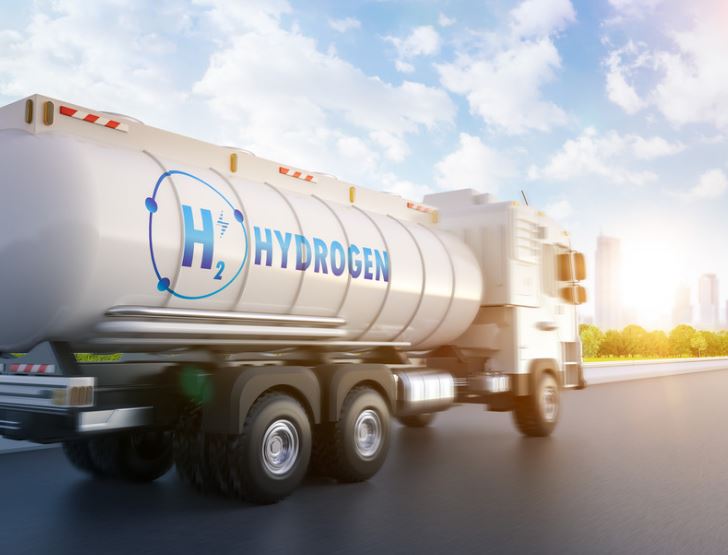


Southwest Research Institute (SwRI) has made headlines with the development of a hydrogen internal combustion engine (H2-ICE) designed to decarbonize heavy-duty, long-haul trucking.
The engine promises ultra-low NOx and CO2 emissions while delivering sufficient torque and power for trucking applications.
The H2-ICE was developed under a consortium that included engine and truck manufacturers, fuels and lubricants providers, and Tier-I suppliers. This collaborative effort aimed to demonstrate the viability of hydrogen-powered vehicles as a complement to other zero-emission vehicles. The goal was to meet the California Air Resource Board’s (CARB) Ultra-Low NOx standard of 0.02 g/hp-hr.
The hydrogen engine powers a Class-8 demonstration vehicle, showcasing its potential in real-world applications. The engine, producing 370 horsepower and 2,025 Newton-meters of torque, achieves an efficiency above 40%, peaking at 43%. These specifications are notable, yet it is crucial to compare them against established benchmarks in the heavy-duty trucking industry.
The H2-ICE’s emissions of about 1.5 grams of CO2 per horsepower-hour are a significant reduction compared to traditional diesel engines. However, when compared to battery-electric and hydrogen fuel cell technologies, which produce zero tailpipe emissions, the H2-ICE still emits CO2, albeit at much lower levels.
The efficiency of 43% is commendable but falls short of the 50-60% efficiency range typically seen in hydrogen fuel cells. This discrepancy raises questions about the long-term competitiveness of hydrogen internal combustion engines in a market increasingly focused on maximizing efficiency and minimizing emissions.
Hydrogen internal combustion engines, like H2-ICE, can leverage existing engine manufacturing infrastructure, potentially lowering initial adoption costs. However, the hydrogen refueling infrastructure is still in its infancy, particularly for heavy-duty applications. This presents a significant barrier to widespread adoption, similar to the challenges faced by hydrogen fuel cell vehicles.
In the short term, the H2-ICE offers a practical solution for reducing emissions from heavy-duty trucks without the need for entirely new manufacturing processes. Its compatibility with existing engine designs could facilitate quicker deployment compared to hydrogen fuel cell vehicles.
However, for long-term decarbonization goals, hydrogen fuel cell technology and battery-electric vehicles might offer more sustainable solutions due to their higher efficiencies and zero-emission profiles. The success of H2-ICE will largely depend on advancements in hydrogen production and refueling infrastructure, as well as ongoing improvements in engine efficiency.
Add EnergyNews.biz as a preferred source on Google


