


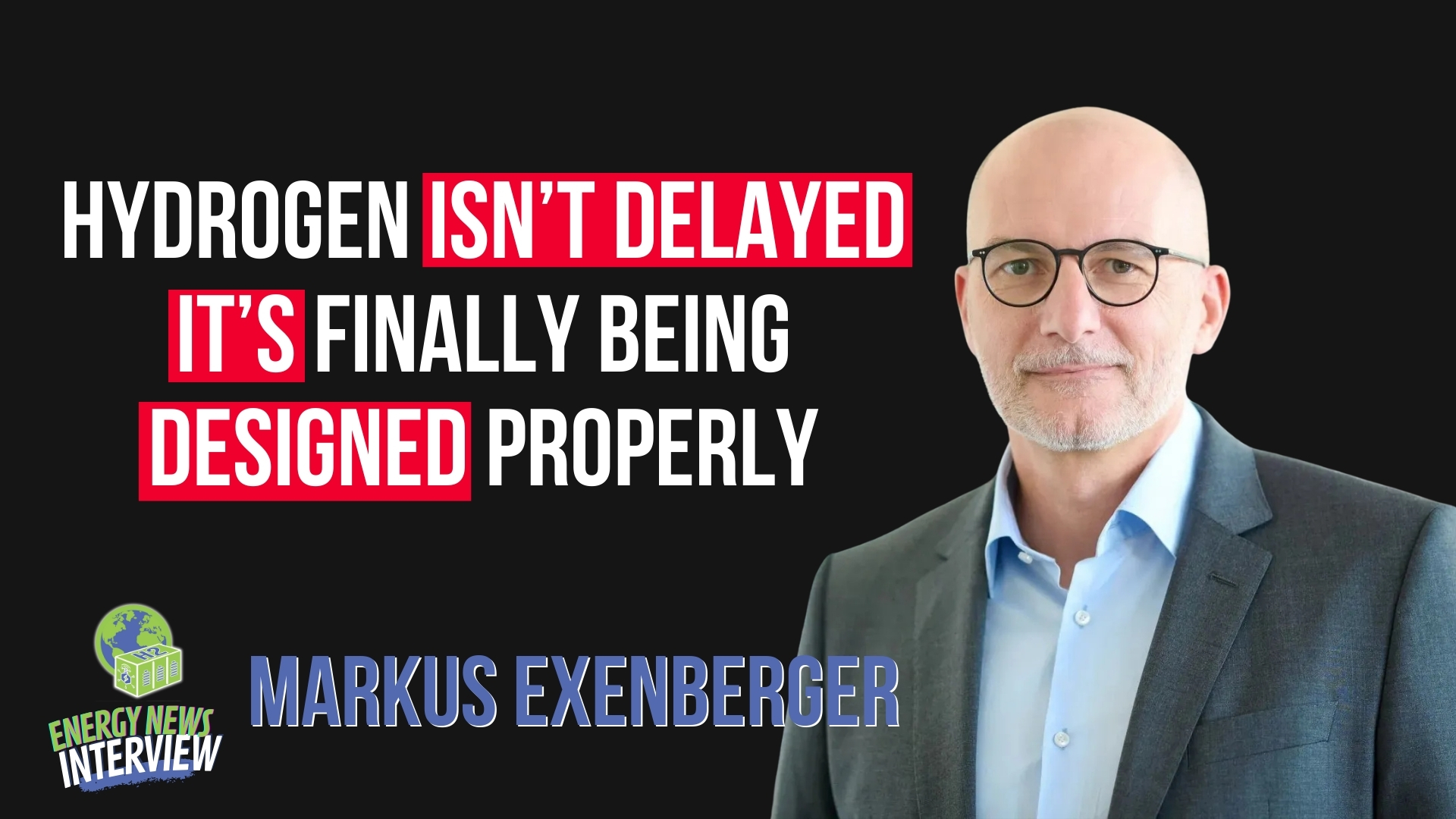

For years, the hydrogen world has behaved like a teenager hopped up on optimism: big promises, loud declarations, and the belief that the whole planet would run on H₂ by “next summer.” Markus Exenberger, Executive Director at H2Global, puts that fantasy to rest. In our conversation at H2 MEET, he was brutally clear: the real work is only now being done — the slow, meticulous, bureaucratic, deeply unsexy work that turns hype into functioning markets.
WATCH THE FULL INTERVIEW HERE
And that’s exactly why this moment matters more than anything that came before.
Markus started by reminding us that the value chain can’t be rushed. H2Global learned quickly that the entire upstream dream collapses without one thing: secured offtake. No offtake, no financiers. No financiers, no production. No production, no global market. This is the real chicken-and-egg of hydrogen, and we’ve been feeding the wrong animal for years.
What the sector is starving for now is certainty. Not another glossy national strategy. Not another press release about a gigawatt someone will build “someday.” We’re talking real regulatory certainty, real certification clarity, real standardization, and real signals to both capital and customers. Stakeholders don’t need fireworks; they need confidence that the rules won’t change mid-project.
Markus was refreshingly blunt about timelines: forget the idea that hydrogen becomes global in two years. It took centuries for coal, oil, and gas to become structured markets. Hydrogen has the advantage of hindsight, he says, meaning it can do the job in two decades. But even with that acceleration, the real inflection only comes in the 2030s, when today’s groundwork finally compounds.
Until then, we’re laying pipes, planning ports, fighting over definitions, and shaping a market architecture that has never existed before. It’s messy. It’s political. It’s bureaucratic. And it’s essential.
International collaboration will shape who wins. East Asia and Europe already behave like early hydrogen allies, Japan and Korea as offtakers, Europe as both off-taker and policy engine. Add resource-rich regions such as Latin America, the Middle East, Africa, and Australia, and global supply chains start making sense. But only if regulation, certification, and standardization align. Without that, we don’t have global trade; we have global confusion.
That’s why H2Global now positions itself as the world’s first true green market maker, an intermediary that absorbs early-stage risk, runs auctions, and covers the price gap between expensive production and still-immature demand. It is not meant to exist forever. Its job is to disappear once real markets take over.
The real bottleneck? Early-stage capital. Markus calls this the sector’s most painful choke point. Even major industrials are hesitant to fund pre-FEED and FEED work unless offtake is guaranteed. Without risk capital, megaprojects remain megadrawings.
And technological “winners”? Markus refuses to crown any. Ammonia, methanol, aviation fuels, and shipping fuels all will matter. The coming years will decide if a single champion emerges. For now, hydrogen’s future is plural, not singular. It isn’t hype collapsing. It’s hype maturing. Hydrogen is finally entering adulthood — and adulthood begins with boring, necessary certainty.


