





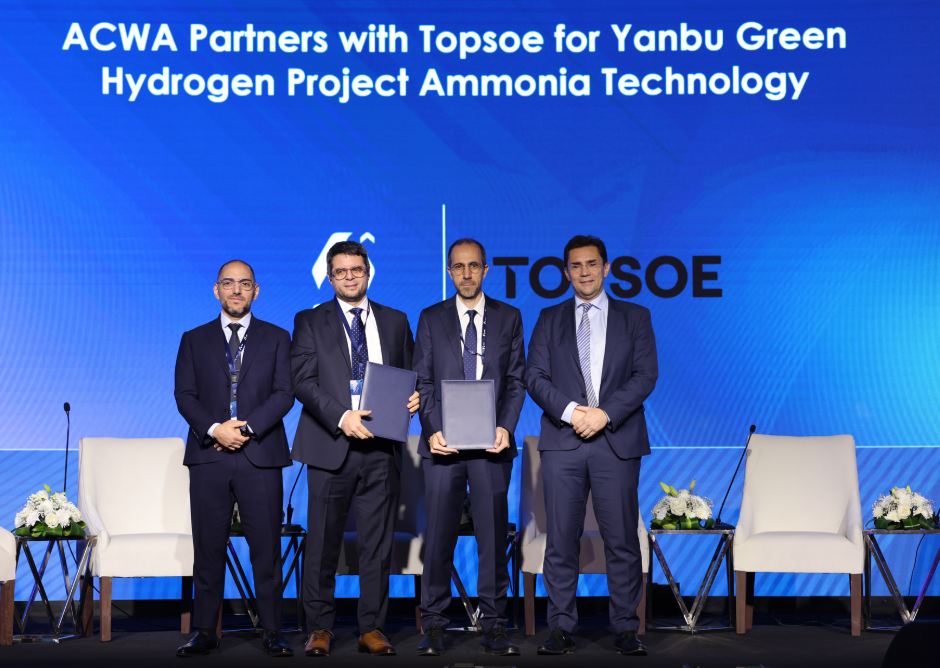
Saudi Arabia is accelerating its push into the global hydrogen economy with the Yanbu Green Hydrogen Project, where Topsoe has been selected as the ammonia technology licensor.
The agreement positions Topsoe’s dynamic ammonia technology at the core of one of the Kingdom’s first utility-scale green ammonia facilities, supporting ACWA’s broader strategy under Vision 2030 to transform industrial energy use and decarbonize key sectors.
The project will convert green hydrogen produced from renewable energy into ammonia at a scale of 2,700 metric tons per day (MTPD), with plans to replicate the approach in subsequent units. Topsoe’s contribution goes beyond licensing; the company will also provide engineering services, proprietary equipment, and catalysts to Sinopec and Tecnicas Reunidas, which hold the FEED (Front-End Engineering Design) contract for the project.
Yassir Ghiyati, Chief Commercial Officer at Topsoe, emphasized the global significance of green ammonia. He noted that it can reduce emissions from energy-intensive industries and serve as a low-carbon carrier for long-distance energy transport. “Deploying decarbonization solutions at scale is critical, and ACWA’s project will deliver a strong contribution,” Ghiyati said.
The collaboration aligns with ACWA’s goal of developing full-scale, utility-level green hydrogen and ammonia facilities, said Driss Berraho, Executive Vice President of Business Development Green Hydrogen at ACWA. The Yanbu Project is designed to connect renewable energy resources with global demand centers, creating industrial-scale hydrogen corridors that support both domestic and international decarbonization efforts.
Topsoe’s dynamic ammonia technology is a key differentiator. It allows the plant to adjust ammonia production rates bidirectionally at a minimum of 3 percent per minute, responding to fluctuations in hydrogen supply from renewable sources. This flexibility reduces the need for hydrogen storage, lowering both capital and operational expenditures, and enables renewable electricity to be stored efficiently as a zero-carbon chemical.
Green ammonia is increasingly viewed as a versatile tool in achieving net-zero targets. It can be transported using existing infrastructure and has multiple industrial applications, from serving as a fuel or hydrogen carrier to decarbonizing sectors such as steel, cement, and chemical production. By integrating renewable energy into chemical production at scale, the Yanbu Project demonstrates a practical pathway for linking GW-scale green hydrogen generation to industrial decarbonization and global energy markets.