


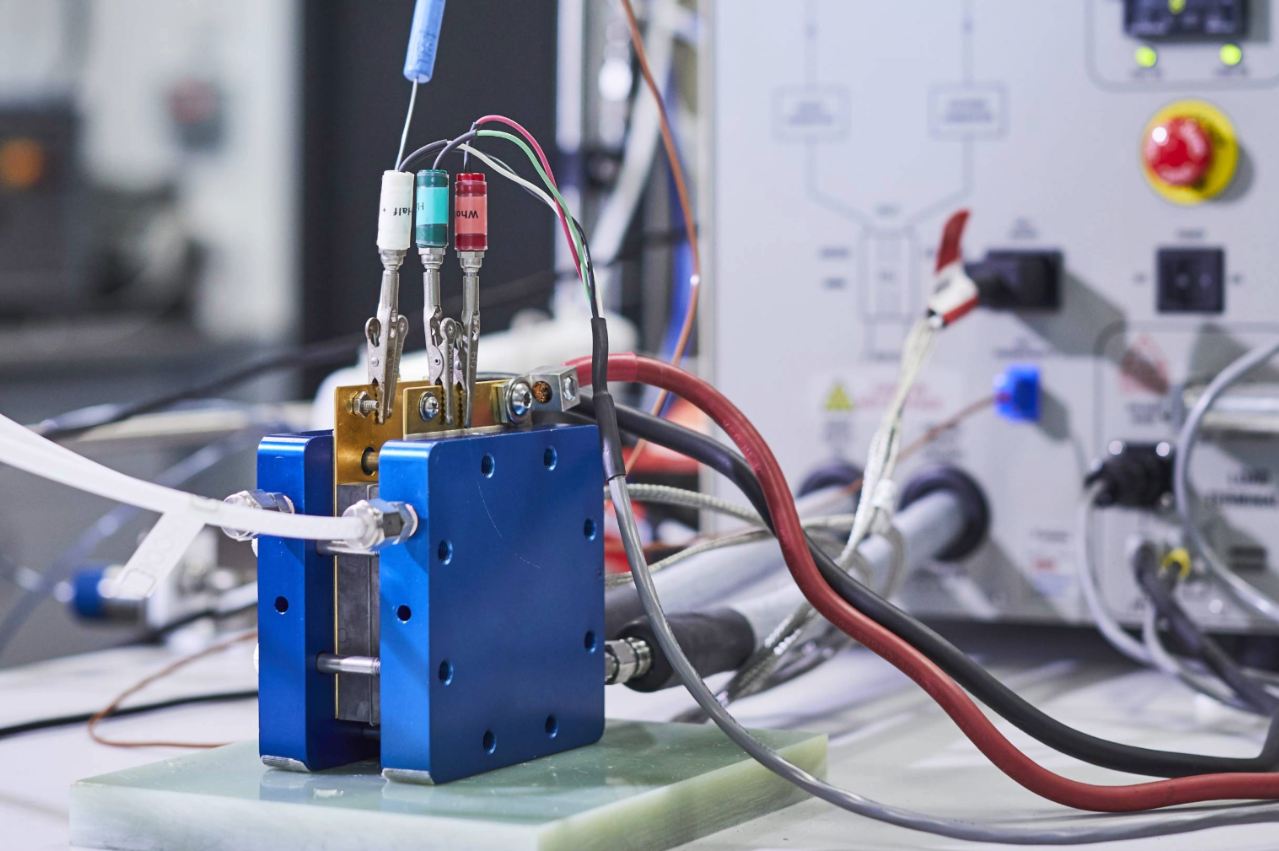

Research from the University of New South Wales suggests that one of the technology’s most fundamental constraints, internal water accumulation, may be addressed through relatively simple design modifications, with reported performance gains of up to 75 percent.
During operation, proton exchange membrane fuel cells generate water as part of the electrochemical reaction. While necessary for membrane conductivity, excess water can accumulate within the cell’s porous structure, blocking oxygen pathways and reducing power output. Conventional mitigation strategies rely on external systems to remove water, increasing system complexity, energy consumption, and cost.
The UNSW team, led by Quentin Meyer and Chuan Zhao, has taken a structural approach instead. By introducing micro-scale channels within the cell architecture, described as lateral bypasses, the design enables water and gas to escape before accumulation disrupts performance. These channels, approximately 100 micrometers wide and spaced at similar intervals, alter internal flow dynamics without requiring additional external components.
This shift from system-level mitigation to embedded design addresses a central commercialization barrier. Water management has historically imposed a trade-off between efficiency and system complexity. If performance improvements can be achieved through minor structural changes, as claimed, the implications extend beyond incremental gains, potentially reducing both capital and operational costs.
The reported 75 percent increase in power output requires careful contextualization. Laboratory-scale improvements do not always translate directly into commercial systems, particularly when scaling introduces new thermal, mechanical, and durability challenges. However, the direction of improvement aligns with broader industry efforts to simplify fuel cell systems while maintaining or enhancing performance.
The research also intersects with another constraint in hydrogen fuel cell deployment, material cost. Platinum group metals remain a significant contributor to overall system expense. While the UNSW design does not eliminate the need for such catalysts, improved efficiency could reduce the quantity required per unit of output, indirectly lowering cost barriers.
From a market perspective, the timing of such developments is notable. Hydrogen fuel cells are increasingly positioned as a solution for sectors where battery electrification faces limitations, particularly in long-duration or weight-sensitive applications such as aviation and heavy freight. Batteries, while effective for short-range transport, face energy density constraints that limit their viability for long-haul operations.
The UNSW team has pointed specifically to aviation as a near-term application, particularly in low-altitude aircraft where hydrogen systems can already offer longer operational ranges compared to battery alternatives. This aligns with broader industry activity, where early hydrogen aviation concepts are targeting regional and short-haul segments before scaling to larger aircraft.
However, efficiency improvements at the cell level do not address the full value chain challenge. Hydrogen production, storage, and distribution remain capital-intensive, and the cost of green hydrogen continues to exceed that of conventional fuels in most markets. Even with more efficient fuel cells, overall system economics will depend on parallel progress in electrolyzer costs, renewable energy pricing, and infrastructure development.
The UNSW design has been patented, and efforts are underway to scale the technology beyond laboratory conditions. Scaling introduces its own risks, particularly in maintaining uniform microstructures across larger उत्पादन volumes and ensuring long-term durability under real-world operating conditions. Fuel cells deployed in aviation or heavy transport must meet stringent reliability and safety standards, which can extend development timelines.
The broader significance of this work lies in its focus on internal efficiency rather than external system expansion. As hydrogen strategies increasingly emphasize end-use applications, incremental improvements in core technologies can have outsized impacts on overall viability. By addressing a long-standing operational constraint through design rather than add-on systems, the research reflects a shift toward simplification as a pathway to commercialization.


