


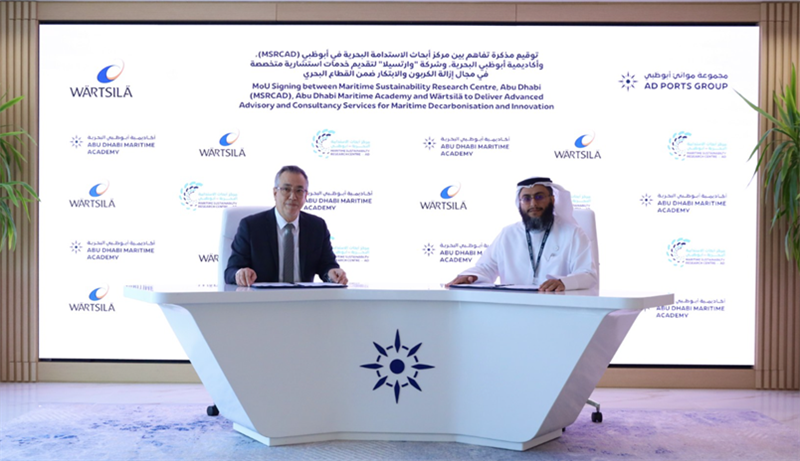

Wärtsilä and Abu Dhabi Maritime Academy have signed a five-year memorandum of understanding aimed at addressing structural barriers to sustainable maritime operations across the UAE and potentially the wider GCC.
The agreement establishes a formal framework focused on four interlinked areas that continue to constrain maritime decarbonization efforts: training, digitalization, port optimization, and early-stage integration of low-carbon technologies. While shipping accounts for roughly 3 percent of global CO₂ emissions, regional hubs like the UAE face additional complexity due to rising vessel traffic, expanding port infrastructure, and the need to align international emissions standards with national industrial growth strategies.
Rather than centering on near-term hardware deployment, the Wärtsilä ADMA partnership emphasizes upstream capability building. This includes maritime training programs designed to close skills gaps around energy-efficient vessel operations, alternative fuels, and digital performance monitoring. Industry data consistently shows that operational measures such as optimized routing, fuel management, and predictive maintenance can deliver efficiency gains of 10 to 20 percent, often at lower cost than retrofitting alone. The collaboration positions training and operational intelligence as primary levers for emissions reduction.
Digitalization and smart port development form another core pillar. Wärtsilä’s advisory role is expected to cover data-driven fleet optimization, port energy management, and system-level efficiency improvements. For Gulf ports, where throughput growth remains strong, digital integration is increasingly viewed as essential for managing congestion, fuel consumption, and emissions intensity simultaneously. However, the success of such initiatives depends less on software availability and more on institutional readiness and workforce competence, areas the MoU explicitly targets.
The Maritime Sustainability Research Centre Abu Dhabi is set to play a supporting and advisory role, linking academic research with applied projects. This structure allows pilot initiatives to be tested within a controlled framework before potential replication across other GCC markets. The inclusion of government-to-government collaboration as a possible extension reflects a recognition that maritime decarbonization in the region will require policy coordination alongside technical solutions.
Statements from both parties underscore a strategic shift away from isolated technology deployment toward early-stage engagement in project design. Wärtsilä Marine’s leadership has emphasized that influencing vessel and port decisions at the planning phase is critical, as retrofits become progressively more expensive and less effective once assets are operational. This aligns with broader industry findings that early integration of efficiency and fuel flexibility can significantly reduce lifecycle emissions and compliance costs.


