


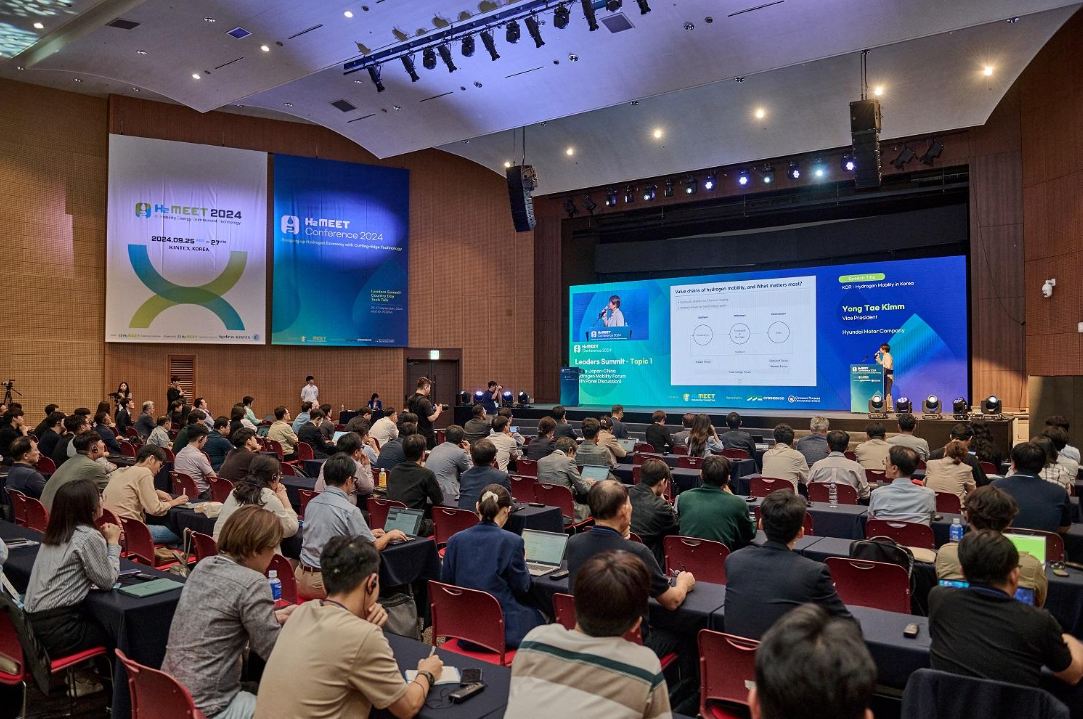


A projected 30,000 visitors, more than 250 companies from over 20 countries, and an international conference drawing 5,000 industry professionals are converging on a single platform in early December. This consolidation signals an accelerating shift in how Korea is positioning itself within the global hydrogen value chain. The World Hydrogen Expo 2025, running December 4 to 7 at KINTEX, integrates exhibition and conference programming into what organizers describe as a comprehensive hydrogen platform. The event’s expansion reflects a broader industry trend: hydrogen’s commercialisation increasingly requires aligned policy frameworks, investment pipelines, and coordinated supply-chain development rather than isolated demonstrations of technology.
Growth in scale is visible across all components of WHE 2025. Last year’s exhibition drew more than 320 companies and over 30,000 visitors. This year’s format goes further by merging the former H2 MEET exhibition with the national hydrogen conference, producing a single event that spans the entire hydrogen value chain from production to end-use. The exhibition area alone covers 22,000 square meters and includes systems for electrolysis, liquefaction, transport infrastructure, mobility applications, and safety technologies. Hyundai Motor Group is the largest domestic exhibitor, showcasing PEM electrolysis systems, fuel-cell platforms, charging infrastructure, and a test-drive program for the new NEXO designed to increase both industry engagement and public familiarity with hydrogen mobility.
The concentration of new technologies is one of this year’s defining features. Korean manufacturers are presenting innovations in ammonia electrolysis, corrosion-resistant components for water electrolysis, advanced hydrogen-ready instrumentation, and cryogenic transport systems. International firms, including major industrial gas, chemical, and materials companies, are highlighting catalysts, liquefaction systems, storage solutions, and engineering polymers that support durability and cost reductions. The breadth of technology confirms that Korea’s role as host is evolving toward that of a regional nexus where upstream and downstream suppliers align with policy developments and industrial strategy.
The conference program demonstrates a similar maturation. With more than 100 speakers and around 200 global industry figures participating, the event is structured to connect policy direction with market formation and industrial deployment. The Leadership and Market Insight track presents demand-creation and supply-expansion strategies from hydrogen-importing and exporting countries. Korea, Japan, and Germany outline mechanisms such as clean hydrogen portfolio standards, bidding markets for renewable hydrogen, and EU-linked integration pathways. Supplier nations, including the United States, Australia, and Canada, introduce production expansion strategies supported by tax credits, hubs, and export-oriented development. These discussions reflect the current global pivot toward refining early-stage hydrogen policies into clearer market signals.
The Hydrogen Deep Dive expands this perspective through analysis from international agencies and financial institutions on technology deployment, cost trajectories, and emerging trading mechanisms. Insights on the evolution of clean hydrogen markets, potential export corridors, and the timing of industrial demand help situate Korea’s own ambitions within broader global transitions. Corporations from the steelmaking, energy, and fuel-cell sectors add strategies for supply-chain diversification, synthetic fuels, and decentralised power systems. Country Day programming further contextualises national strengths and cooperation prospects from Australia, Canada, and the United Kingdom.
Business matchmaking remains central to the expo’s structure. The H2 Business Partnership Fair connects 36 international buyers from nine countries with more than 80 Korean hydrogen companies in targeted consultations and investment briefings. The format supports export-oriented growth and ensures that domestic technology suppliers engage directly with real demand from markets in regions such as Australia, South Africa, Spain, and Canada. A dedicated technology and investment briefing complements these meetings by aligning Korea’s hydrogen sector with global capital flows and networked industrial expansion.
Innovation incentives further shape the competitive landscape. The H2 Innovation Award identifies ten companies with technology readiness across production, transport, and utilization segments. Beyond prize funding, award recipients gain promotional exposure and cost benefits for future exhibition participation. By focusing on technologies ready for near-term field application, the program addresses the persistent challenge of bridging the gap between R&D milestones and commercial deployment.
Sustainability commitments extend beyond the technologies on display to the operation of the event itself. For the second consecutive year, organizers are quantifying the exhibition’s carbon footprint through a formalized emissions calculation program that covers electricity use, waste management, and visitor transport. Last year’s overall footprint, 214.36 tCO₂eq, was reduced by 18.4 percent through higher reliance on public transport among attendees. The addition of a second year of data allows the creation of a long-term emissions baseline for exhibition operations, reinforcing the industry’s emphasis on verifiable reductions aligned with hydrogen’s decarbonisation objectives.
Public engagement remains a strategic pillar of the expo. Discounted pre-registration, youth access programs, and consumer-focused content such as weekend Talk Concerts aim to broaden understanding of hydrogen technologies among general visitors. These initiatives complement high-level engagements, including the Hydrogen Council CEO Summit and the General Assembly of the Global Hydrogen Industrial Associations Alliance, both of which strengthen Korea’s intent to anchor itself as a central player in global hydrogen cooperation.
Taken together, the scale, international representation, and strategic integration of exhibition, conference, investment facilitation, and public programming position WHE 2025 as a platform that mirrors the evolving needs of the hydrogen sector. Korea’s consolidation of these elements into a unified event underscores an ambition not merely to host a showcase but to shape the architecture of regional and global hydrogen development.
Add EnergyNews.biz as a preferred source on Google


