


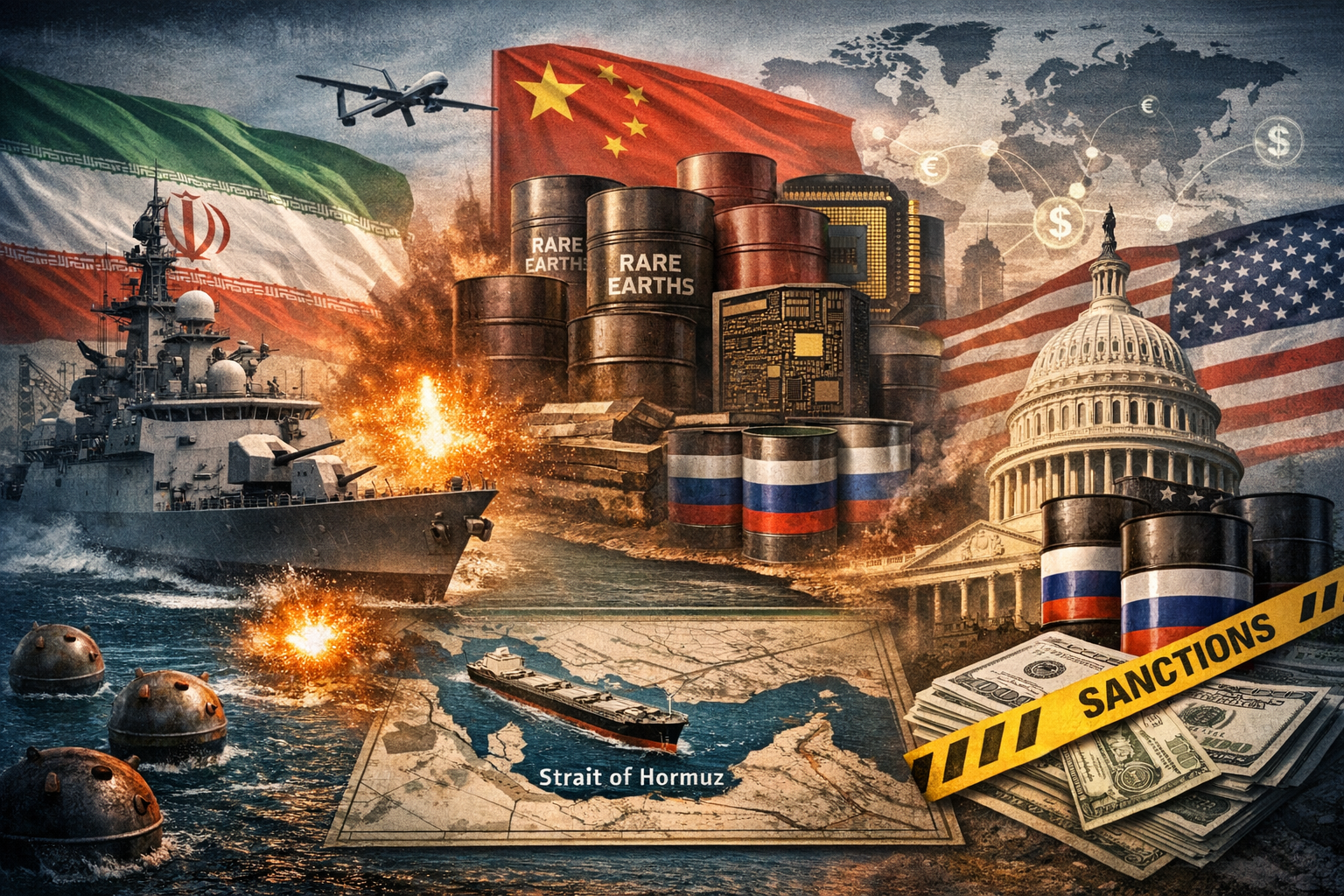


The closure of the Strait of Hormuz by Iran, affecting roughly 20 percent of global oil and gas flows and one-third of worldwide fertilizer trade, underscores a shift in the architecture of international economic power.
Once the exclusive domain of Washington, the tools of economic coercion are now being wielded effectively by other state actors, forcing the United States to confront trade-offs previously deemed avoidable.
Iran’s blockade is emblematic of a broader trend in which US adversaries replicate the logic of economic pressure, albeit with different mechanisms. Where Washington leverages dollar-clearing networks, secondary sanctions, and export controls to isolate targeted states, Tehran has imposed physical restrictions on global trade, using missiles, drones, and mines to enforce control over a chokepoint less than 21 nautical miles wide. The effect on global markets mirrors the outcomes the United States has long sought through sanctions: disruption, economic cost, and strategic leverage.
The precedent for this asymmetric response was first demonstrated by China. In reaction to US tariffs and semiconductor export controls under the Trump administration, Beijing restricted rare earth exports critical to defense, aerospace, and automotive manufacturing. The impact on North American production illustrated that economic coercion could be met with credible countermeasures, producing mutual costs rather than unilateral compliance. The eventual de-escalation in October 2025 highlighted that US sanctions were no longer guaranteed to produce desired outcomes without reciprocal vulnerabilities.
Iran’s deployment of economic leverage follows a parallel logic but operates through kinetic control rather than financial channels. Sustained US sanctions against Tehran under the so-called “maximum pressure” campaign failed to compel behavioral change, illustrating a growing empirical gap in sanctions as a substitute for military action. By controlling maritime access, Iran can impose economic pain on global buyers without relying on financial networks, forcing Washington to balance its objectives in the Gulf with broader sanctions frameworks, including those targeting Russia.
The policy consequences for the United States have been immediate and tangible. In response to the Hormuz closure, Washington temporarily eased sanctions on approximately 100 million barrels of Russian oil, undermining coordinated pressure intended to penalize Moscow for its 2022 invasion of Ukraine. Similarly, the European Union may face a de facto extension of Russian energy imports to mitigate global price shocks, demonstrating that overlapping economic confrontations constrain the unilateral application of coercion.
Historical evidence suggests that while economic instruments can inflict short-term costs, their long-term effectiveness is limited. Regional sanctions, including the 2017–2021 Gulf blockade on Qatar and ECOWAS sanctions on West African military regimes, have rarely produced compliance or political change. Targeted states frequently respond by diversifying supply chains, accelerating domestic production, and establishing alternative trade networks, reducing vulnerability to coercion even as immediate disruptions persist.
The proliferation of sanctions as a foreign policy tool generates structural challenges, including diminishing returns and heightened escalation risk. When multiple actors employ coercion simultaneously, the global trading system increasingly bifurcates into parallel networks that circumvent traditional dependencies, undermining the efficacy of future measures and amplifying collateral damage on third-party economies. The Iranian and Venezuelan cases reveal that sustained economic pressure can catalyze, rather than prevent, kinetic conflict, eroding the conceptual separation between sanctions and warfare that defined post-Cold War strategy.
In this evolving landscape, US economic statecraft faces a dual challenge: managing immediate disruptions while recalibrating expectations about the limits of coercion in a multipolar environment. As Iran and China have demonstrated, the instruments of economic leverage are no longer monopolized by Washington, and their deployment carries consequences that reverberate across global markets, alliances, and the very assumptions underpinning post-Cold War sanctions policy.


