


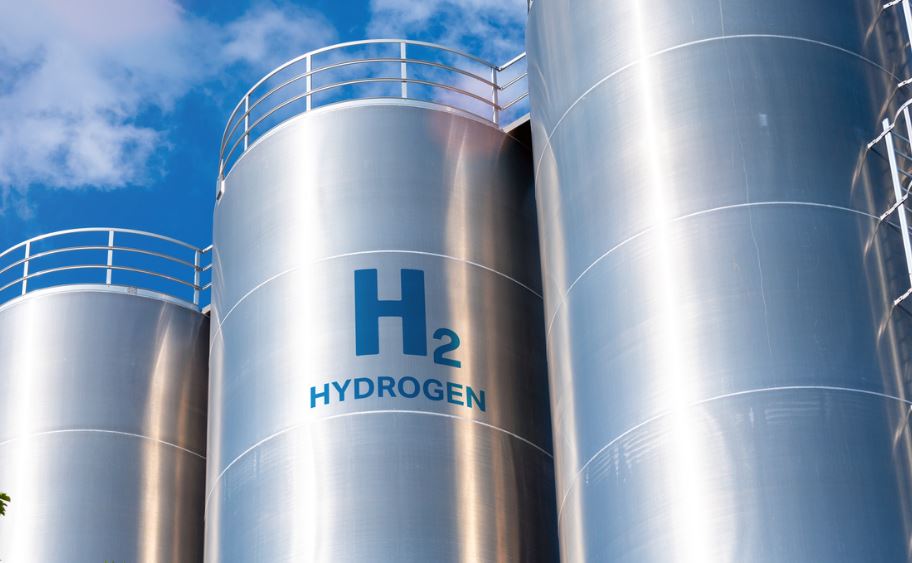


Hyundai Engineering & Construction’s development of the South Korea’s first flat-bottom liquid hydrogen storage tank signals a shift toward rethinking storage design as a lever for scaling the hydrogen economy.
The company’s approach departs from conventional spherical and cylindrical tank geometries that dominate liquefied gas storage. Flat-bottom tanks, widely used in liquefied natural gas infrastructure, offer higher volumetric efficiency and simpler construction logistics. By adapting this concept to hydrogen, Hyundai E&C is attempting to address one of the sector’s persistent challenges: the high capital cost associated with cryogenic storage systems, particularly when scaled for industrial applications.
At the core of the design is a layered insulation system combined with vacuum gaps to limit heat ingress and reduce boil-off losses, which remain a key operational inefficiency in liquid hydrogen systems. While similar insulation strategies are standard in LNG storage at approximately −162 °C, hydrogen’s significantly lower boiling point increases thermal stress on materials and amplifies boil-off risks, making performance validation essential before large-scale deployment.
The flat-bottom configuration also eliminates the need for complex elevated support structures, allowing the tank to sit directly on a foundation. This reduces both material requirements and construction complexity, factors that can materially influence total installed costs in large storage facilities. However, the design introduces new engineering considerations, particularly around thermal contraction. As internal temperatures drop, differential contraction between the tank’s inner and outer layers must be carefully managed to avoid structural fatigue or failure. Hyundai E&C is addressing this through finite element analysis and real-time monitoring during the demonstration phase, where thermal sensors and stress gauges will generate operational data to refine the design.
Seismic resilience adds another layer of complexity. South Korea’s exposure to seismic activity requires storage systems to withstand ground motion without compromising structural integrity or containment. Integrating cryogenic performance with seismic durability presents a dual engineering constraint that has historically limited the deployment of large-scale liquid hydrogen tanks in the region.
The absence of disclosed capacity figures suggests the project remains in a validation phase, but the stated ambition to develop ultra-large tanks indicates a focus on centralized storage hubs. Such hubs are increasingly viewed as essential for linking hydrogen production with industrial demand centers and export infrastructure. In this context, storage is not only a technical component but also a system-level enabler for hydrogen logistics, particularly as countries explore long-distance transport and maritime export of liquefied hydrogen.
South Korea’s Hydrogen Economy Roadmap, introduced in 2019, has primarily driven growth in fuel cell deployment, electrolysis capacity, and hydrogen mobility. However, liquid hydrogen infrastructure has lagged, largely due to the high cost of liquefaction and storage. By targeting storage efficiency and scalability, Hyundai E&C’s design attempts to address one side of this equation, though the broader economic viability will still depend on parallel reductions in liquefaction costs and sustained demand growth.
From a market perspective, the shift toward liquid hydrogen reflects an effort to improve energy density and transport economics compared to compressed gas. Liquefied hydrogen enables higher volumetric storage, which is particularly relevant for shipping and large-scale industrial use. However, these advantages must be weighed against energy losses during liquefaction and boil-off during storage and transport, factors that continue to shape the cost competitiveness of liquid hydrogen pathways.
Hyundai E&C’s experience in LNG infrastructure provides a technical foundation for adapting cryogenic storage concepts, but hydrogen introduces distinct material and operational challenges that require validation beyond analogies with natural gas systems. The demonstration phase, which includes trial assembly and performance monitoring, will be critical in determining whether the flat-bottom design can achieve acceptable levels of thermal efficiency, structural reliability, and cost performance.
Hyundai E&C is working with government agencies and research institutions to establish safety standards and performance benchmarks, aligning with South Korea’s policy-driven approach to hydrogen deployment. This coordination is particularly important in areas such as cryogenic safety, where regulatory frameworks are still evolving.
Add EnergyNews.biz as a preferred source on Google


