


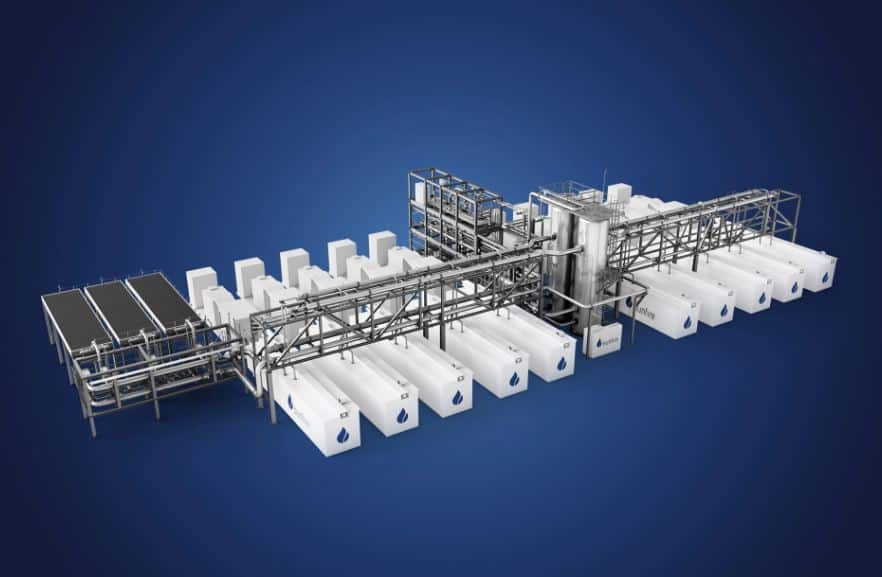


Sunfire has launched HyLink® Alkaline 23, a new outdoor pressurized alkaline electrolyzer system. The 50-megawatt electrolyzer module is designed for the implementation of triple‑digit megawatt projects and reduces total installed costs (TIC) on the customer side by up to 50 percent.
The system is built around Sunfire’s second-generation 30-bar pressurized alkaline stack, which is already deployed in industrial hydrogen production facilities across Europe. Operating at elevated pressure reduces the need for downstream compression, a cost and energy penalty that remains a significant factor in large-scale hydrogen supply chains. While the company highlights proven stack performance in operating plants, the economic impact of high-pressure operation is increasingly evaluated in relation to balance-of-plant integration rather than stack efficiency alone, particularly as project developers move toward standardized 100-MW and above configurations.
A key feature of the HyLink® Alkaline 23 concept is the scaling of module capacity from the company’s prior 10-MW architecture to a 50-MW unit, effectively reducing the number of required modules in a 100-MW deployment from ten units to two. This shift has implications beyond logistics. Fewer modules directly reduce interface complexity, electrical integration points, and commissioning sequences, all of which have historically contributed to delays in large electrolyzer projects.
Sunfire has also restructured the system design for outdoor deployment, removing the requirement for dedicated electrolyzer buildings. By integrating air cooling systems and centralizing key plant components, the design reduces civil engineering scope, which is often a hidden cost driver in hydrogen project budgets. Increased prefabrication further shifts labor from on-site construction to controlled manufacturing environments, a trend consistent with broader industrial modularization strategies seen in energy infrastructure.
According to the company, these combined design changes can reduce total installed costs by up to 50 percent. While such figures are increasingly common in electrolyzer marketing narratives, the real cost impact is highly dependent on project-specific variables such as grid connection requirements, hydrogen purification specifications, and local construction economics. In practice, TIC reductions of this magnitude typically reflect optimized system boundaries rather than uniform cost declines across all components.
Christian von Olshausen, Sunfire’s CTO, describes the redesign as a combination of five efficiency levers: increased module capacity, elimination of building infrastructure, integrated system interfaces, higher prefabrication levels, and reliance on validated 30-bar stack technology. Each lever addresses a known cost or complexity constraint in scaling alkaline electrolysis, though their cumulative effect will ultimately depend on field deployment data from upcoming large-scale installations rather than design assumptions alone.
The HyLink® Alkaline 23 system is positioned for deployment in energy-intensive sectors including refining, ammonia, and chemical production, where hydrogen demand is increasingly being decarbonized through on-site or near-site electrolysis. These industries are now transitioning from pilot-scale hydrogen integration to repeat-order megawatt clusters, a shift that places greater emphasis on replication efficiency than first-of-a-kind project innovation.
Sunfire CEO Nils Aldag notes that many of the company’s current 100-MW projects are repeat orders from existing customers, indicating early signs of standardization in procurement patterns. This development is significant in a market that has historically been characterized by bespoke engineering solutions and limited replication between projects.
As electrolyzer systems move into triple-digit megawatt deployment ranges, the competitive focus is increasingly shifting from single-stack performance metrics toward system integration efficiency, construction minimization, and repeatable industrial design.
Add EnergyNews.biz as a preferred source on Google


